
A crown hair transplant planned to look natural today and future-proofed for your lifetime. Designed by Dr. Vinay at Northwestern Hair.
Northwestern Physician · Inventor of Timeless Hairline Design + Timeless Crown Design · A Physician’s Personal Guarantee


260多条五星好评
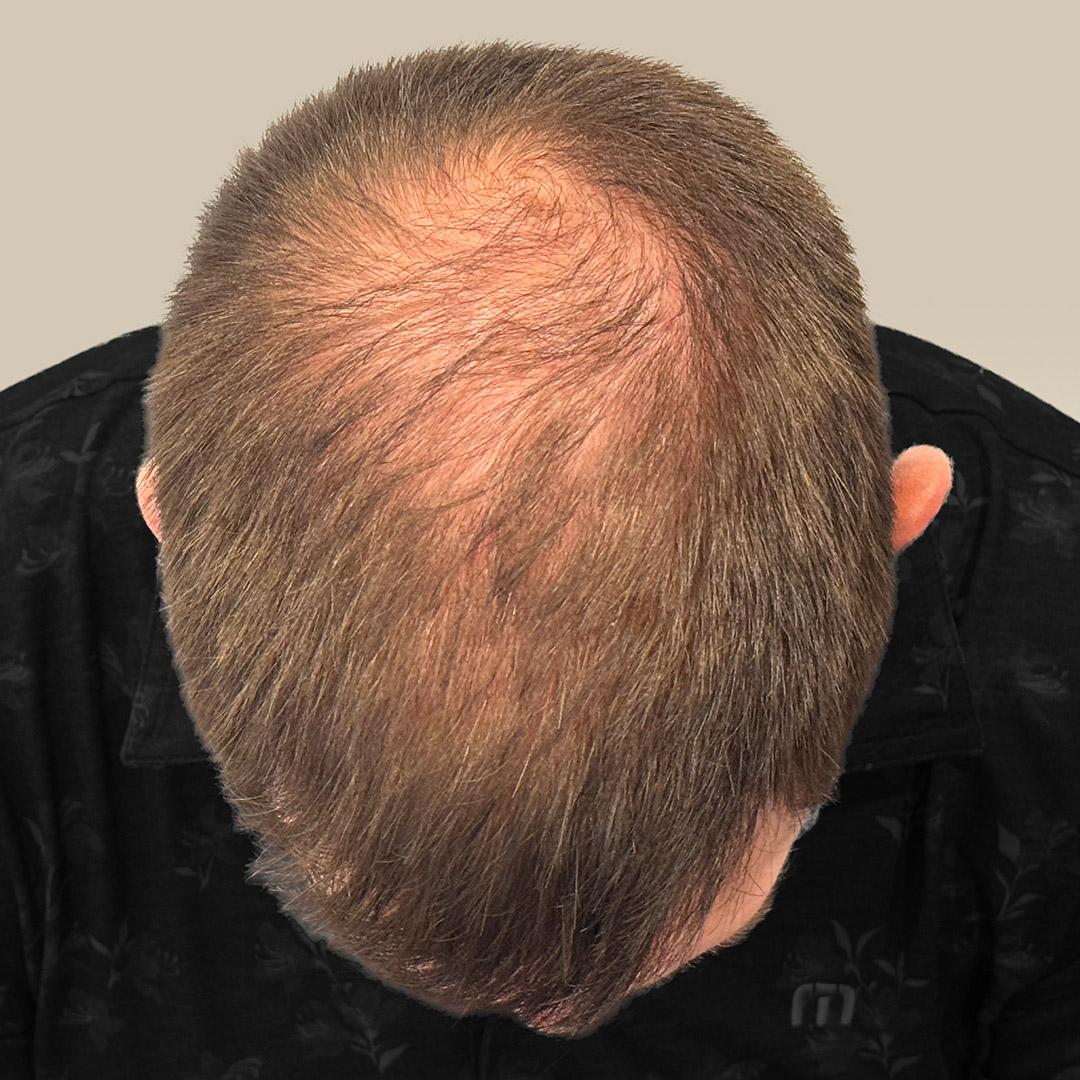
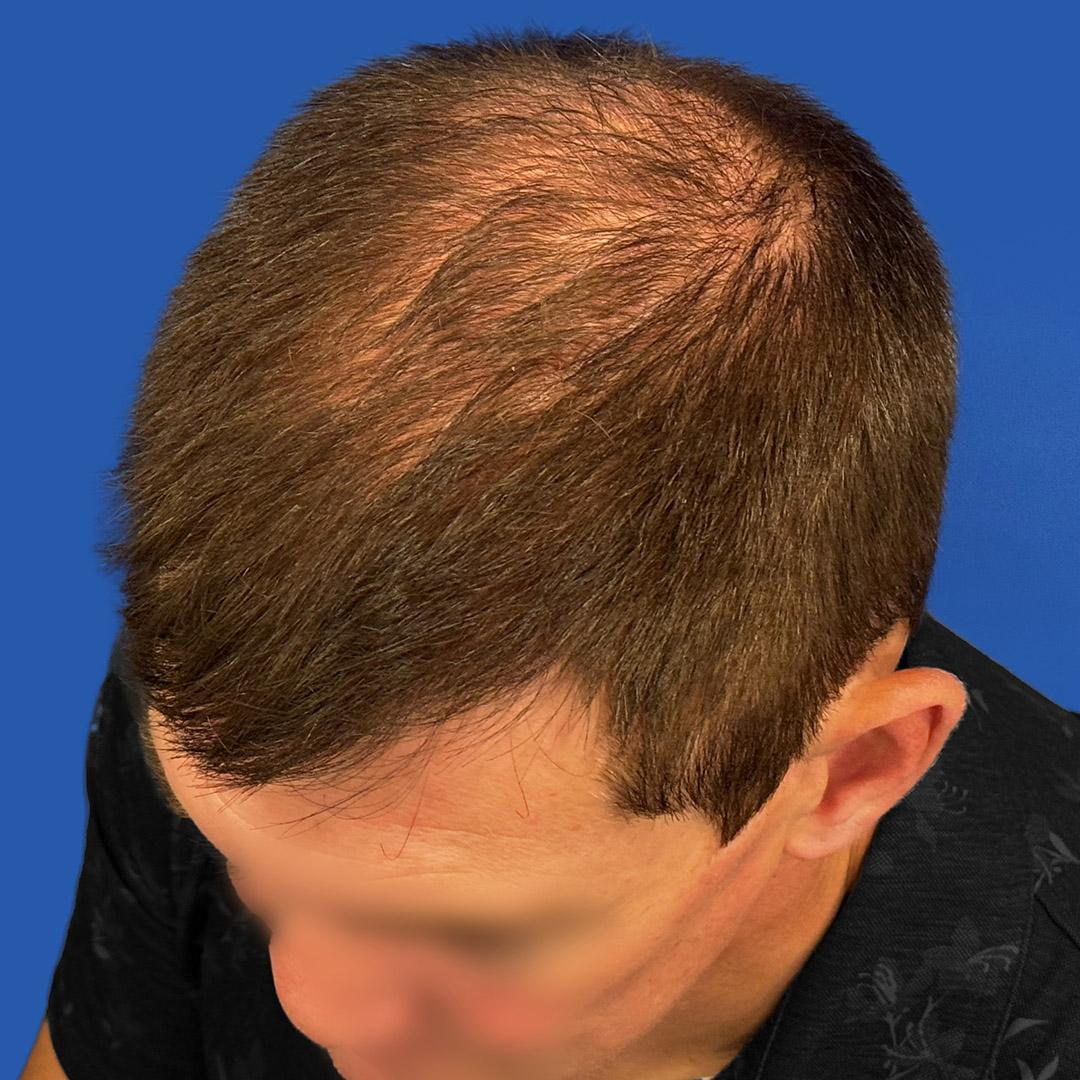
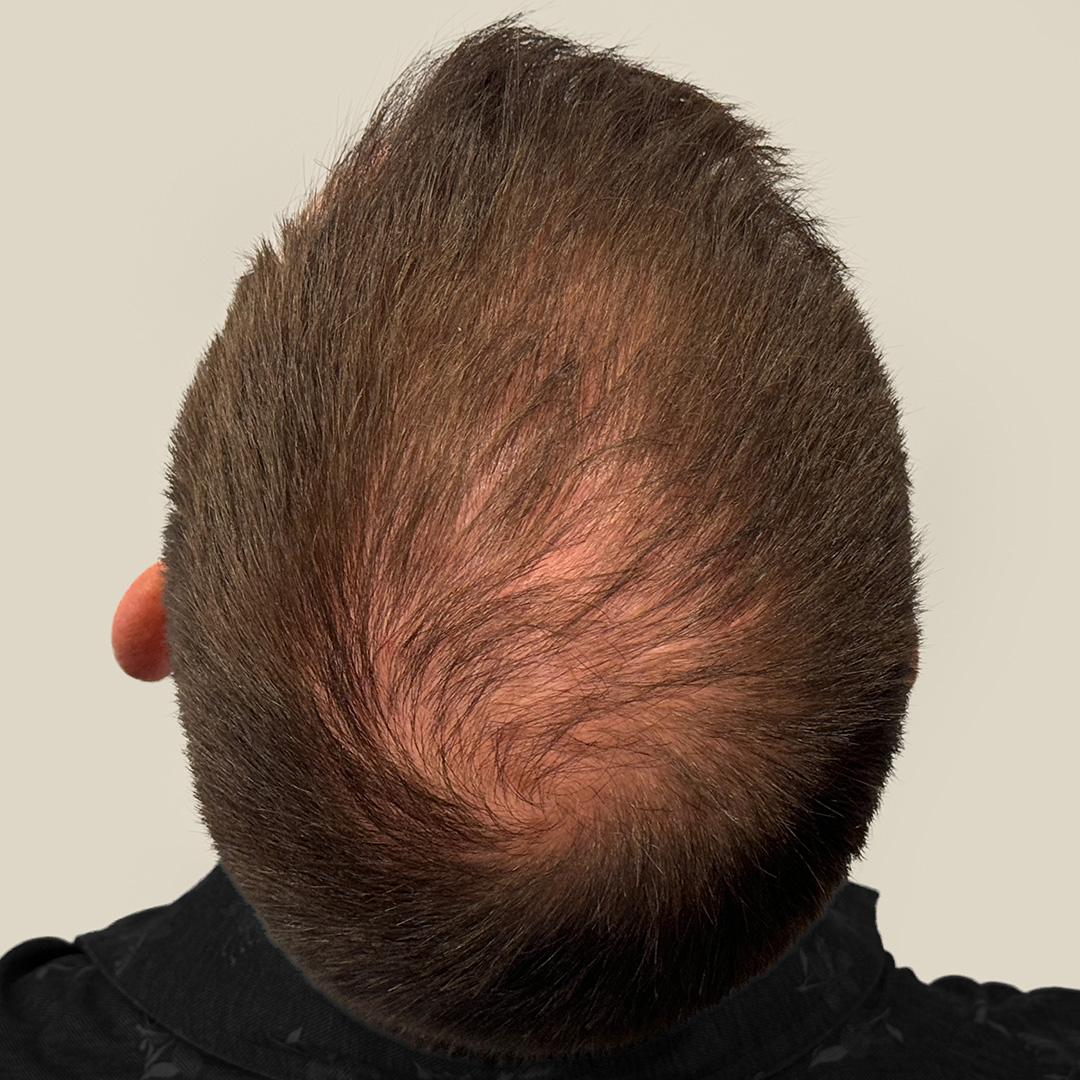

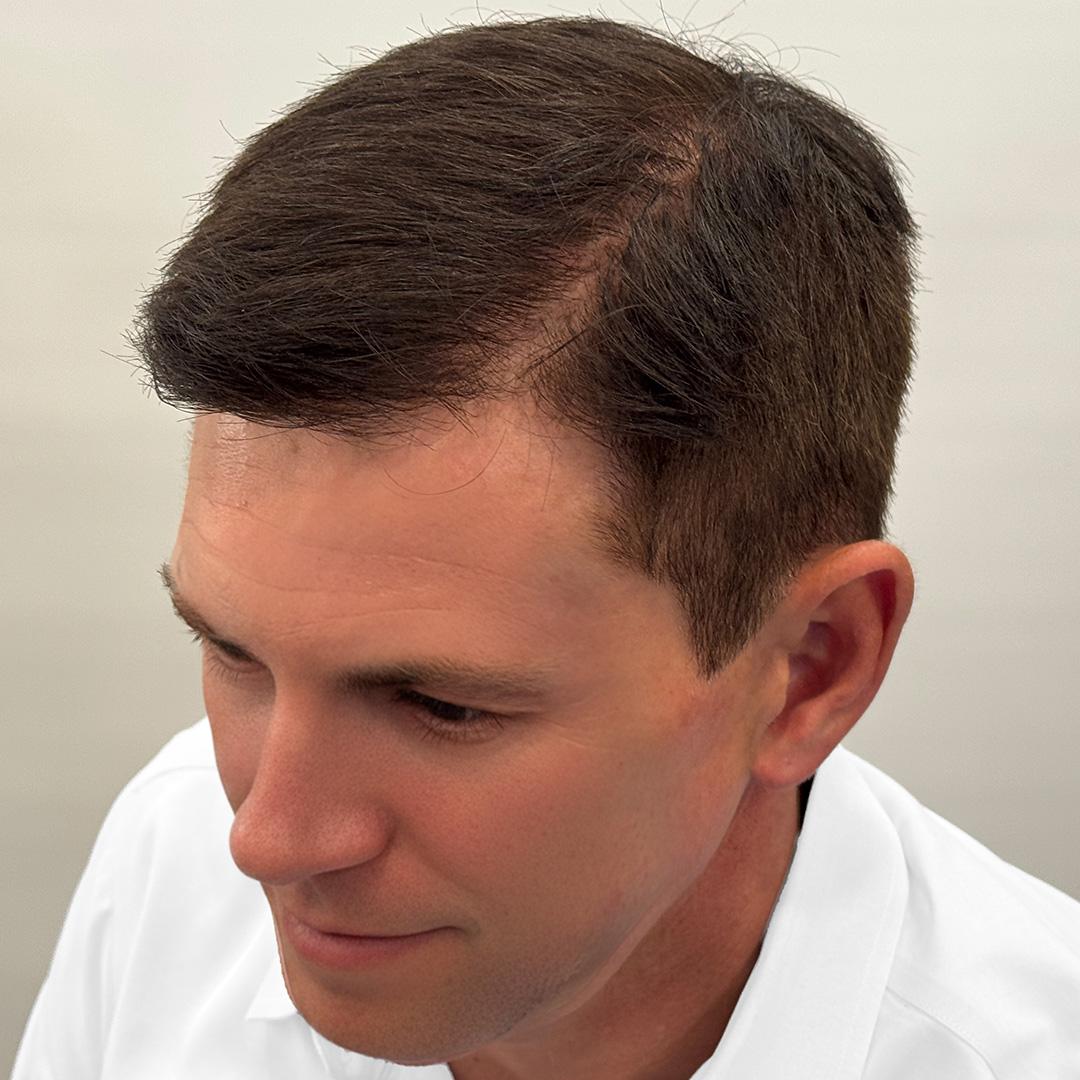
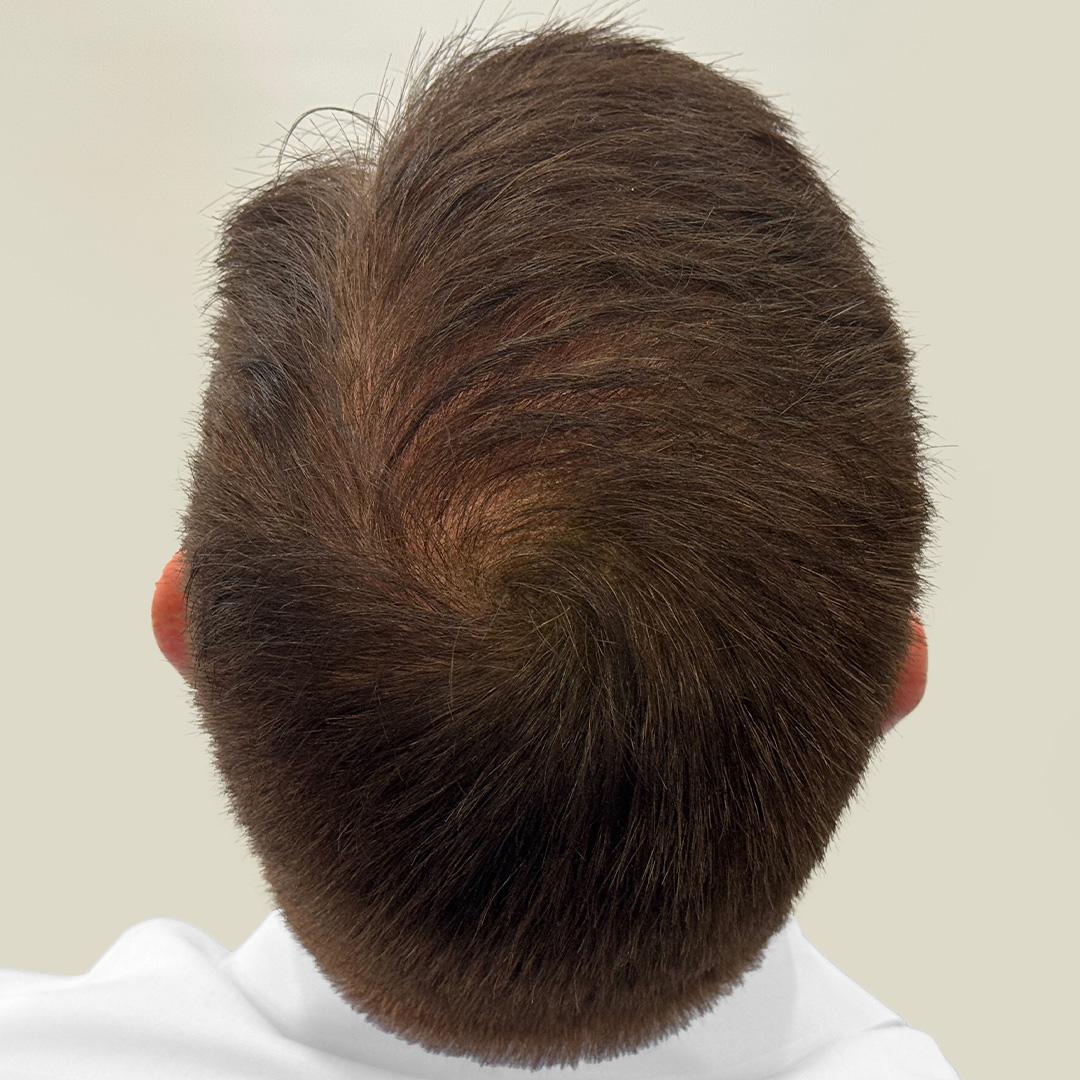
A crown hair transplant is different from a hairline transplant. Not harder in a way that should make you hesitate — different in ways that require more planning, and more experience with the specific dynamics of the crown.
Over years of crown work at Northwestern Hair, we’ve developed a methodology called the Timeless Crown Design that plans for these dynamics from the very first measurement. Before we walk you through that methodology, here are the six things you should understand about a crown hair transplant. Each of these shapes how we approach every crown restoration we perform — and each is a question you should be able to ask any clinic considering your crown before you commit.
The area of a circle grows with the square of its radius. In practical terms, this means your crown’s graft need grows exponentially compared to its width. A centimeter of expansion at the perimeter can double the total area we plan to restore. This is why lifetime planning matters here in a way it doesn’t anywhere else on the scalp. At Northwestern Hair, every crown design maps the final possible size of your crown before we place a single graft, so that today’s procedure is planned against your lifetime — not just against what your crown looks like now.
As the crown expands and the hairline thins, the front edge of the crown eventually becomes the visible frontal boundary of your hair. For many patients — especially younger patients — we draw an internal hairline within the crown design and hold it to the same natural standards as any Timeless Hairline. The two designs are considered together because the anatomy will eventually connect them. A clinic that plans your crown without considering how it will look once the surrounding hair evolves is planning for today only.
The crown is best restored with thicker, coarser hair. The best source of that hair is the ridge — the band of dense, coarse hair that sits directly around the crown’s future perimeter. Extracting from the ridge preferentially serves two purposes at once: the crown restoration uses the exact hair type it needs, and the ridge is naturally debulked so the transition between crown and surrounding hair looks harmonious. If an internal hairline is part of the design, that hair comes from a different donor zone — the perimeter of the donor area — because a natural hairline requires fine, single-hair grafts. A well-planned crown restoration understands both donor zones and extracts from both accordingly.
This is good news. The hairline is on your face, scrutinized in high light from close range, held to a nearly undetectable standard. The crown lives above the eye line and is seen from above, behind, and in profile — rarely with the direct scrutiny the hairline receives. This means the crown accepts a wider natural tolerance. Not every graft needs to be a fine single-hair unit. Small variations in angulation and density are actually part of what makes a natural crown look natural. The crown can be restored efficiently, with fewer grafts than a hairline restoration of comparable area, and with graft types that would be wrong for the hairline but are ideal here.
Multiple surgeons have observed that graft survival is somewhat lower in the crown than in the hairline or mid-scalp. This is a known and manageable phenomenon in hair restoration. What we’ve learned over years of crown work is that preparing the recipient site with ACS — starting in the days before surgery — significantly closes this gap. ACS increases local blood flow and seeds growth factors into the tissue, so that when the grafts arrive on the day of surgery, they are met by an environment already primed to support them. Since implementing pre-operative ACS for our crown procedures, we’ve seen a substantial improvement in yield. This preparation is a standard part of every crown restoration we perform.
A naturally aging crown is thinner at the center and denser toward the perimeter. Our approach mirrors that anatomy — either with density that builds outward from the center, or with uniform density that is deliberately measured against the surrounding scalp. In our experience, this is what allows the crown to continue looking natural as it expands over time. We never place high density at the center of the crown without planning for the donor supply that will cover the perimeter later. If today’s procedure places too much density at the center, the crown ends up denser in the middle than at its edges as it expands — the opposite of a naturally aging crown, and the pattern the eye reads as unnatural. Measured planning today keeps future procedures simple: when today’s plan is proportional, tomorrow’s expansion is straightforward.
Each of these six considerations should be part of any thoughtful crown consultation. If you have met with another clinic about your crown and these questions weren’t part of the conversation, you deserve a more thorough plan. Crown restoration is one of the most confidence-transforming procedures in hair restoration when it’s planned well. Patients who complete a well-designed crown restoration consistently describe a level of visual and personal restoration that surprises them. This is why we do this work — and it’s why patients seek us out for it.
Making a crown hair transplant is two things at once. It is a design — the Timeless Crown Design — and it is the clinical technique that delivers the design into the scalp. The two are inseparable. The design decides what the procedure must be capable of, and the clinical technique is what makes the design possible in practice.
Making a crown hair transplant is two things at once. It is a design — the Timeless Crown Design — and it is the clinical technique that delivers the design into the scalp. The two are inseparable. The design decides what the procedure must be capable of, and the clinical technique is what makes the design possible in practice.
The art is the Timeless Crown Design: a seven-step methodology that maps your final possible crown perimeter, plans the internal hairline where needed, predicts your lifetime graft need, reconciles that need with your donor supply, allocates today’s grafts as a share of your lifetime plan, places future-proofing grafts where the anatomy indicates, and draws the swirl that gives the restoration its natural rotational shape.
The science is a stack of five specialized techniques: preparation of the scalp with ACS to maximize graft yield, Micro PUE® to conserve the donor supply across a lifetime of procedures, the SP89 sapphire blade to control the directionality of the swirl, interfollicular grafting to future-proof the perimeter, and iso-hypothermic plasmonic preservation to make mega sessions possible in a single procedure.
Together, the art and the science of the crown allow us to serve any patient whose crown can be well planned — regardless of ethnicity, hair texture, or stage of expansion. What follows is both. The design first. Then the techniques that bring it to life.
A seven-step methodology that maps your final possible crown perimeter, plans the internal hairline where needed, predicts your lifetime graft need, reconciles that need with your donor supply, allocates today’s grafts as a share of your lifetime plan, places future-proofing grafts where the anatomy indicates, and draws the swirl that gives the restoration its natural rotational shape.
Preparation of the scalp with ACS to maximize graft yield, Micro PUE® to conserve the donor supply across a lifetime of procedures, the SP89 sapphire blade to control the directionality of the swirl, interfollicular grafting to future-proof the perimeter, and iso-hypothermic plasmonic preservation to make mega sessions possible in a single procedure.
Together, the art and the science of the crown allow us to serve any patient whose crown can be well planned — regardless of ethnicity, hair texture, or stage of expansion. What follows is both. The design first. Then the techniques that bring it to life.
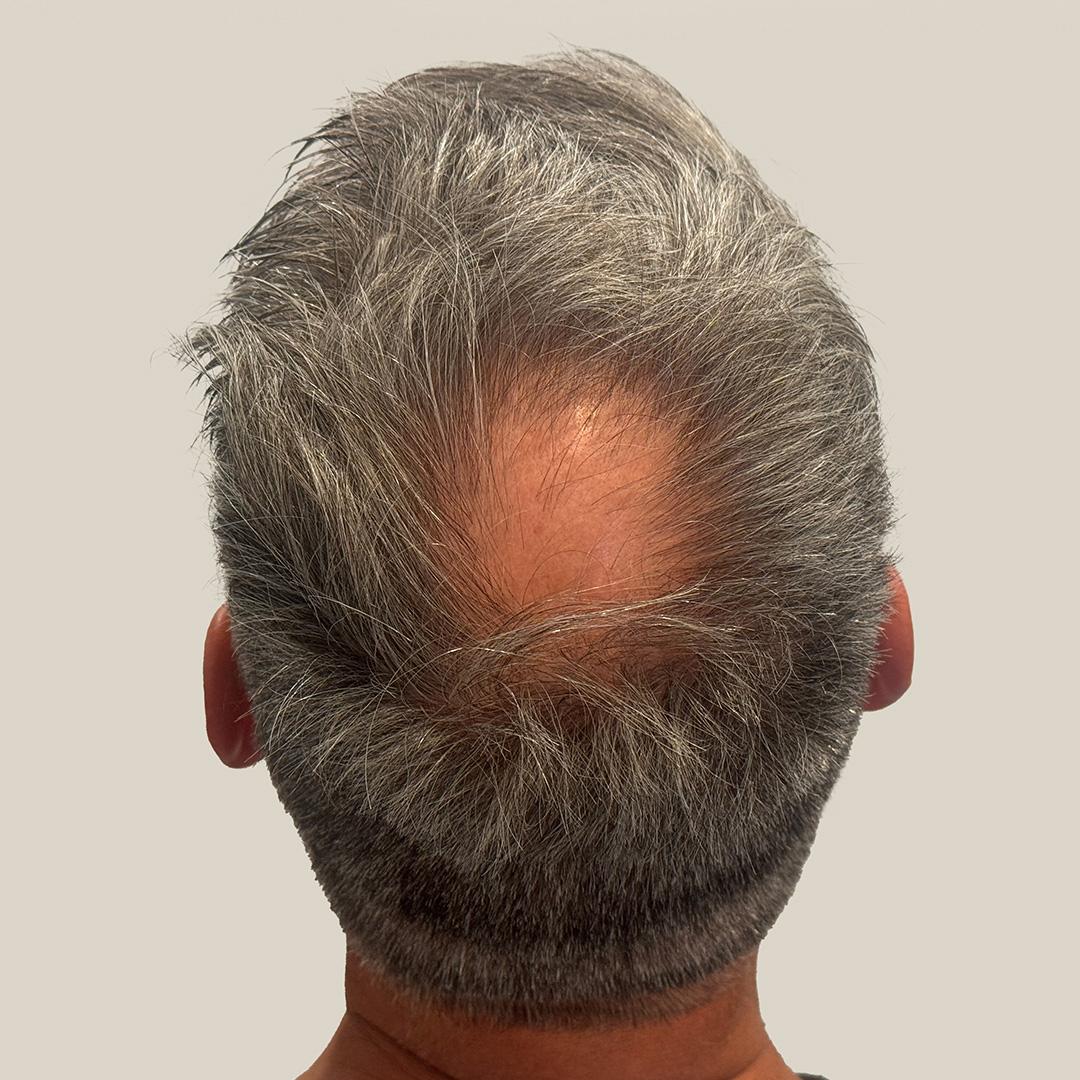
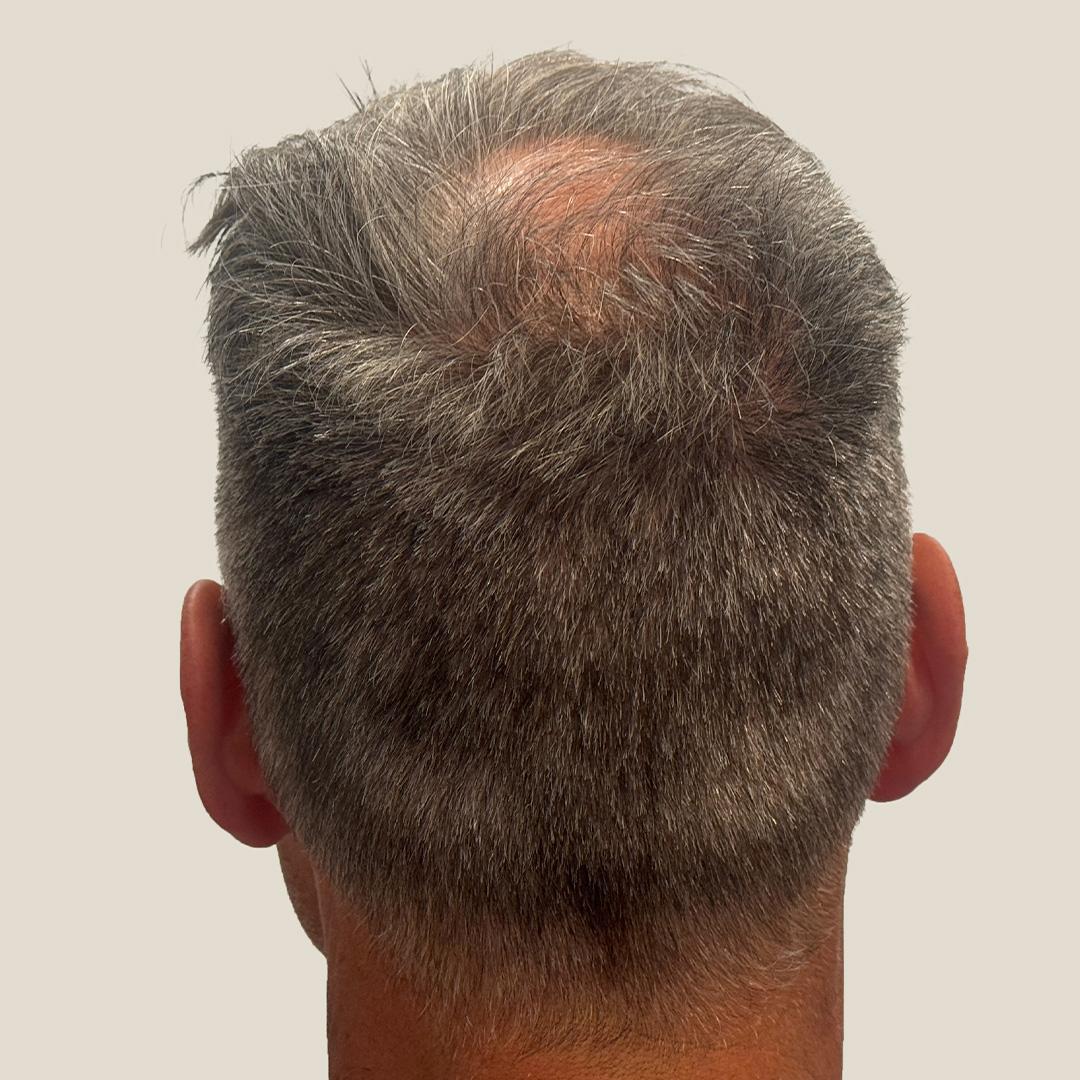
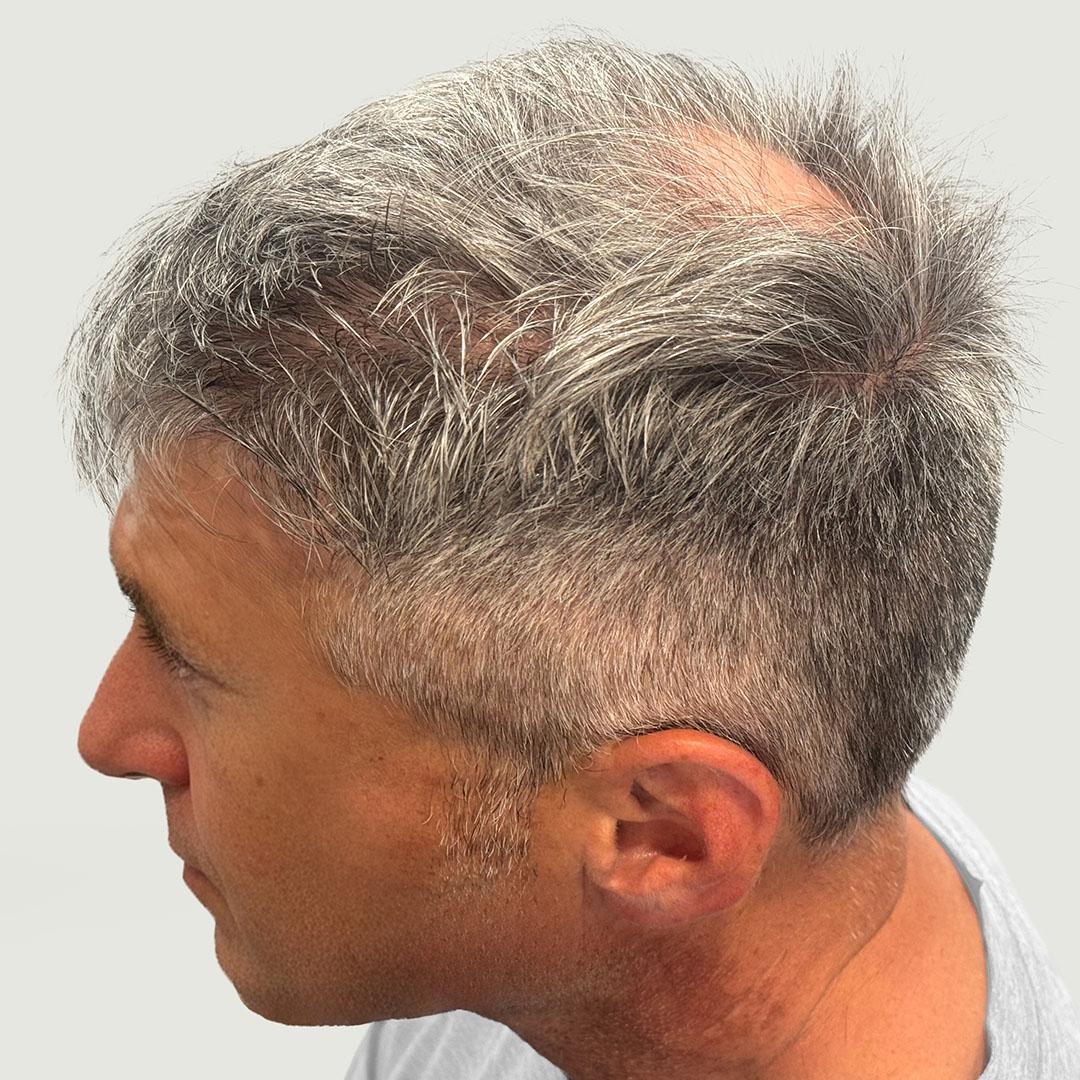
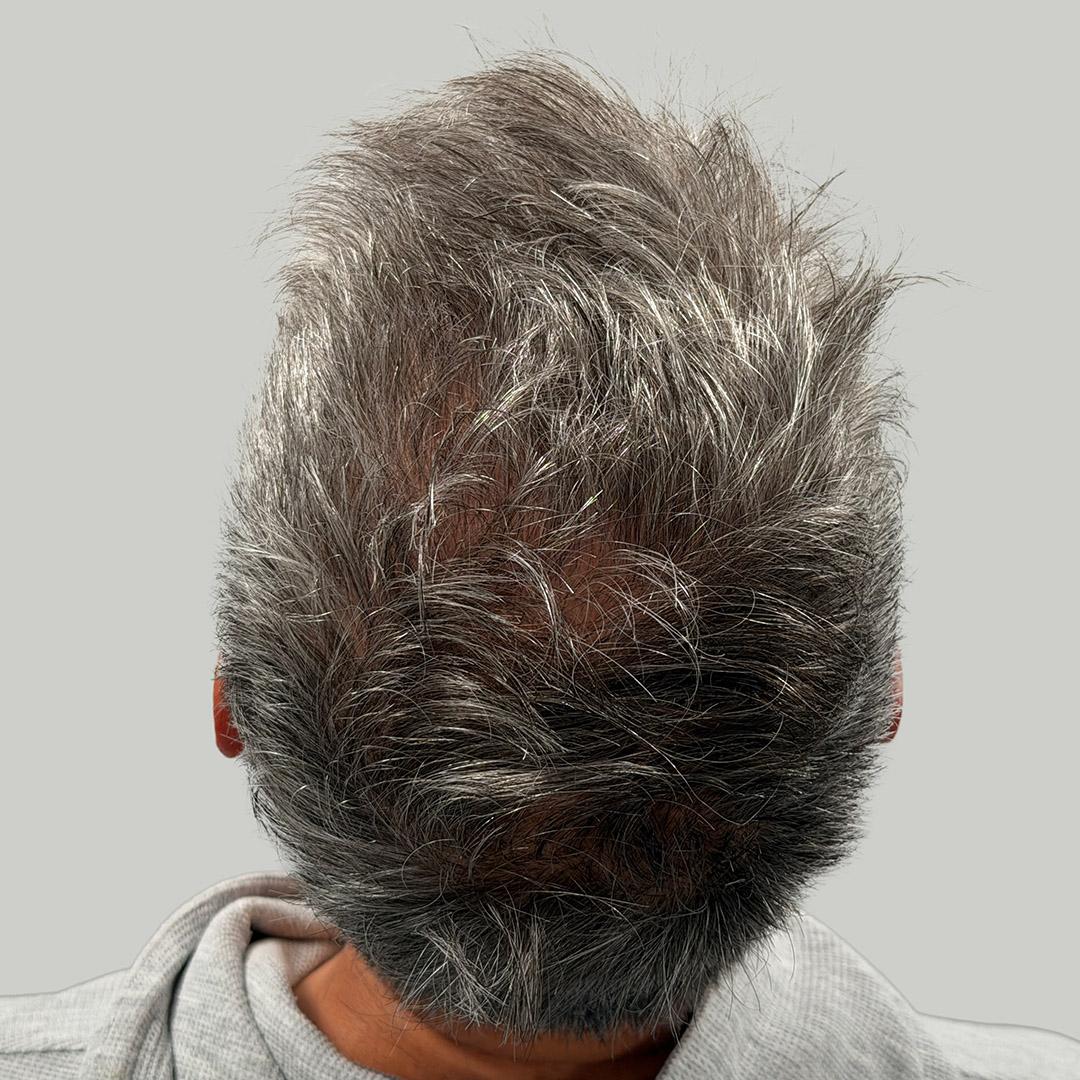
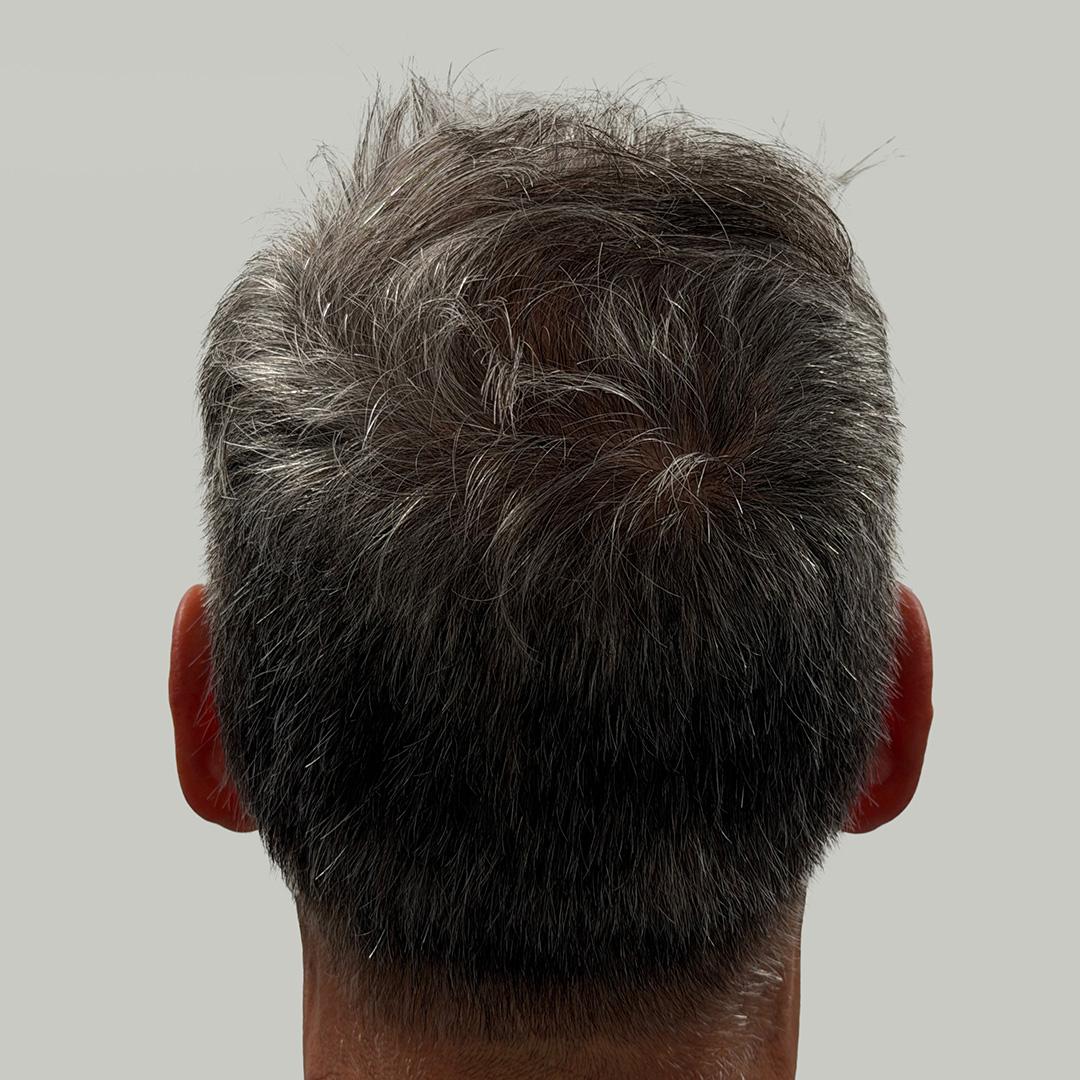


The Timeless Crown Design is a seven-step methodology performed the morning of every crown hair transplant. Each step is anatomically anchored, and every decision the design makes is grounded in the patient’s own biology.
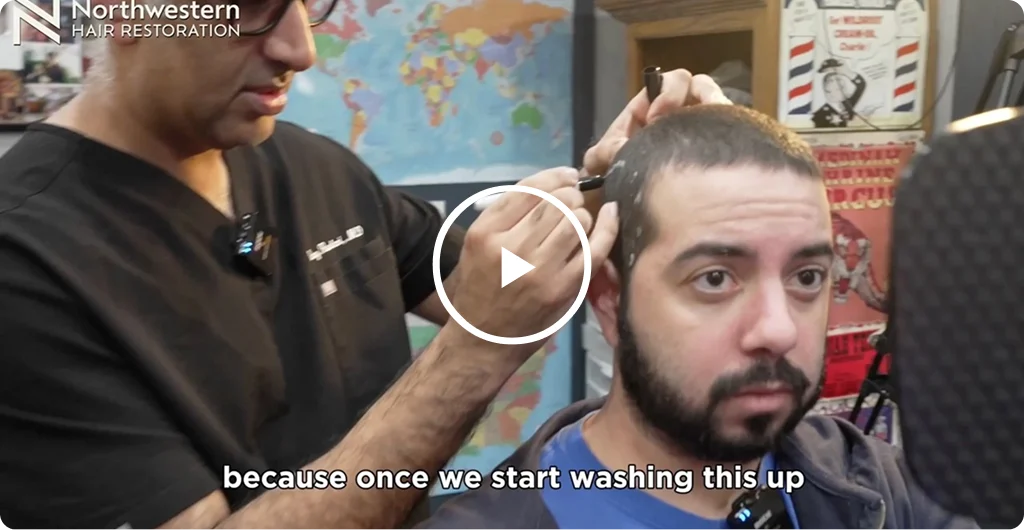
Step 1 mirrors the first step of the hairline design. We map the recession line — the boundary between the permanent donor hair and the hair that may thin over time.
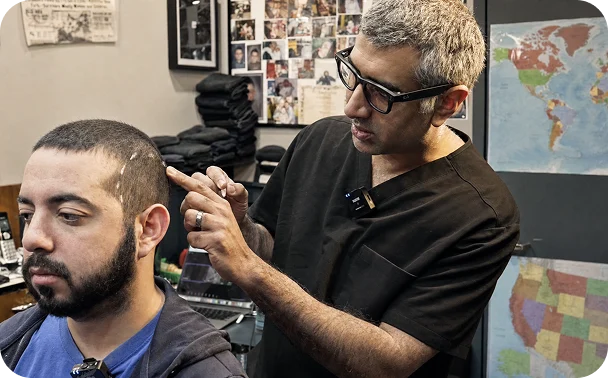
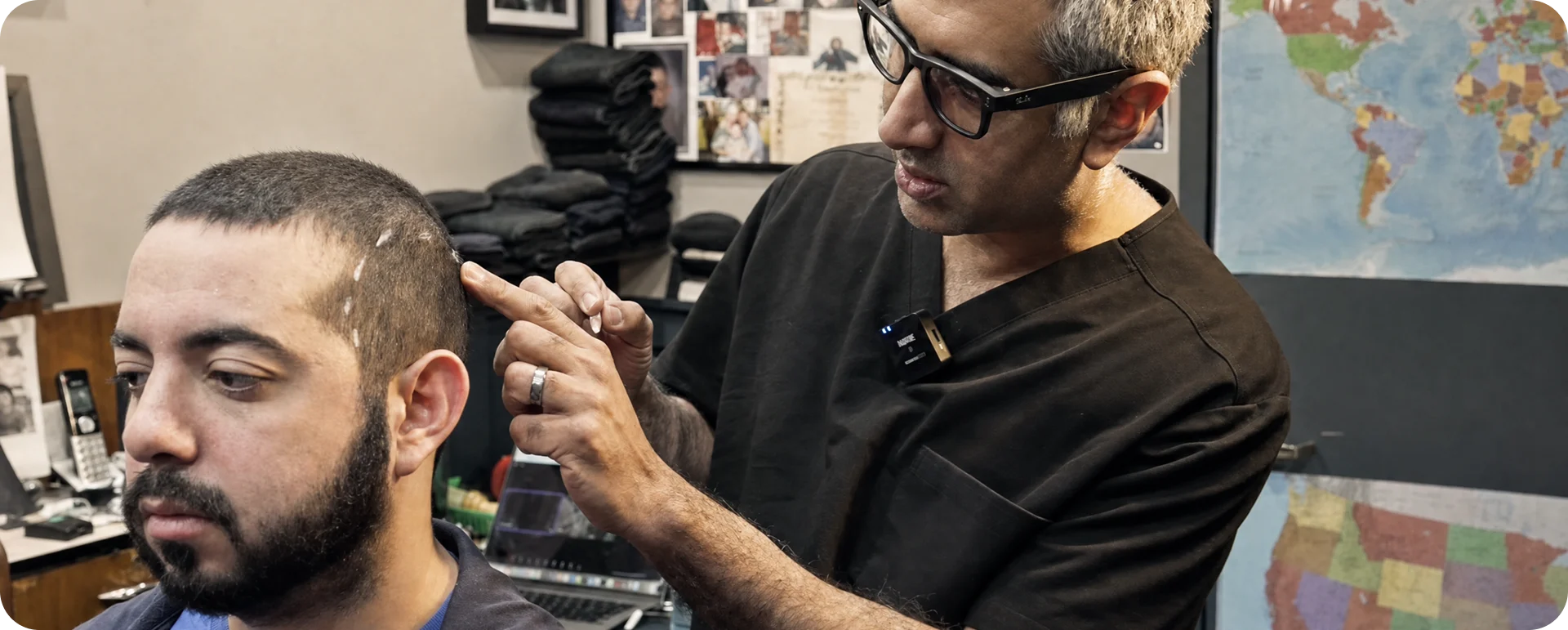
The recession line is drawn by palpation. Dr. Vinay’s fingers trace the scalp from the sideburn upward and around, feeling for the point where the coarse, unchanged donor hairs give way to finer hairs above. Below this line, the hair caliber has not changed — these follicles are resistant to the hormones that drive male pattern hair loss. Above this line lies the transition zone where thinning may develop with age.
The recession line defines the maximum possible perimeter of your crown. Directly below the line sits the ridge — the band of thickest, coarsest hair on the scalp. This band is the crown’s own donor pool: it is the hair type the crown needs most, it sits closest to where the transplant will place it, and debulking it during extraction creates a smoother visual transition between the crown restoration and the surrounding hair. Step 1 is not just about defining a boundary. It’s about identifying the exact hair that will build the restoration.
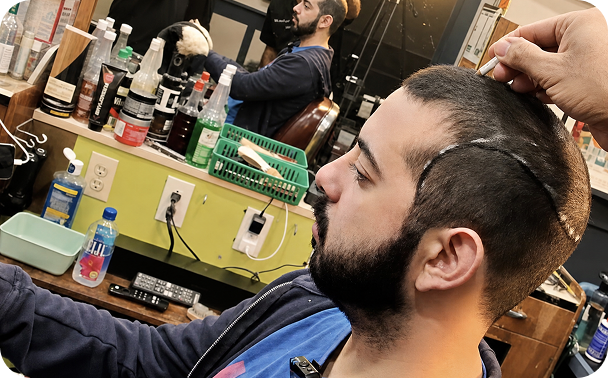
For patients with a strong, stable front hairline and an isolated crown, this step is short. The current hairline is the final hairline, and we design the crown against it.
For younger patients with a developing crown and some evidence of hairline recession, this step is where the entire design is shaped. We plan an internal hairline within the crown design — the line at which the crown restoration will meet the front of the scalp once the surrounding hair evolves.
The internal hairline is drawn in profile view first. Dr. Vinay marks the point at which a hairline could naturally sit as the forehead rises and turns back toward the crown, respecting the anatomy of your face. The patient then stands, and the line is evaluated from the front — where Dr. Vinay imagines how it will read once the transplanted hair has grown out. He asks a specific question: “If you grow your hair out, how are you going to wear it?” The answer shapes the placement. A forward-facing hairstyle allows the hairline to sit further back on the scalp while the hair combed forward carries the visible weight. A pulled-back hairstyle means the line sits where the hair will exit, which may allow for a slightly more forward placement.
The temples are drawn as an extension of this internal hairline. In profile, the natural temple recession pattern is preserved — the hairline flows from the temples rather than being imposed on them.
If the internal hairline is going to be built as part of today’s procedure, we plan for the two donor zones the design will require: the ridge for the crown itself, and the perimeter of the donor area for the fine, single-hair grafts that build a natural hairline leading edge.
With the full restoration area defined between the recession line and the internal hairline, the next decision is how many grafts it will take to cover the area over your lifetime.
For mature patients, the recession they were going to have has largely already happened. Today’s crown is close to the final crown, and today’s graft count is close to the lifetime graft count.
For younger patients, this step defines the entire plan. Rather than sizing the plan against what the crown looks like today, we size it against what the crown could look like at its final size — accounting for every hair inside the marked area that could eventually thin. This becomes the ceiling: the total number of grafts needed across the patient’s lifetime to restore the crown at uniform density.
One clinical detail is factored in at this step: graft survival in the crown is approximately 80 to 85 percent, compared to 90 to 93 percent in the hairline and mid-scalp. This is a known phenomenon in hair restoration, and it is why every Northwestern Hair crown procedure includes ACS preparation before the day of surgery. The lifetime graft count is sized against the crown’s actual yield, with ACS built in to close the gap.
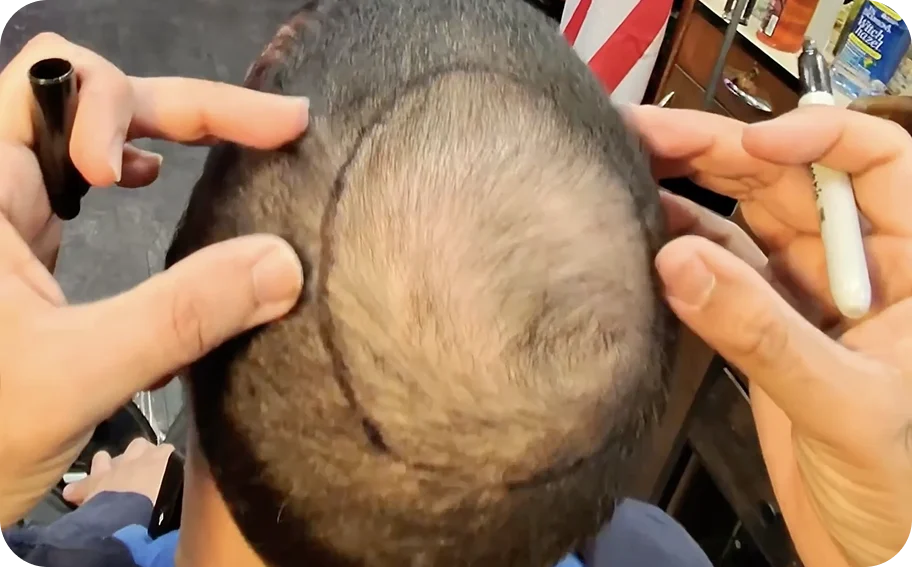
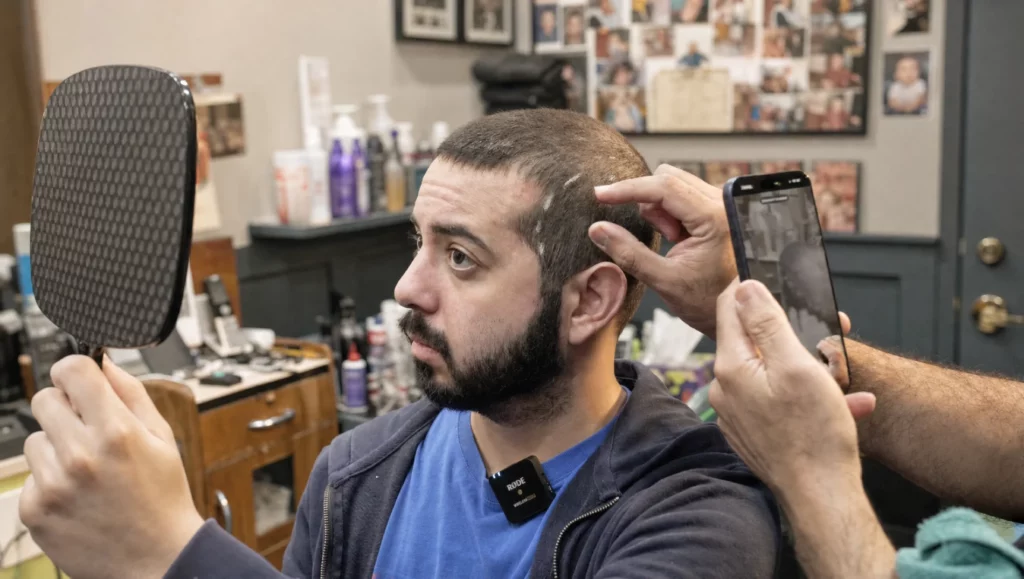
The lifetime graft count is a demand. The donor site is a supply. Step 4 aligns the two.
The donor site is assessed for available capacity — how many grafts can be responsibly extracted across your lifetime while preserving the donor zone’s long-term appearance. When the supply comfortably serves the lifetime demand, the plan proceeds as designed. When the two need to be balanced, we work with you to shape the design.
Two variables can be adjusted. The first is density — the uniform density planned for the full area can be lowered, which spreads the same graft budget across the full coverage. The second is area. Because the outer perimeter of the crown is anchored to real anatomy at the recession line, the only line that can shift is the internal hairline at the front. This is where the patient conversation matters most.
If the internal hairline is planned to sit slightly further back, the hairstyle carries the presence of the hair. A forward-facing hairstyle projects the visible density in front of the line — so the patient looks fuller than the position of the line alone would suggest. Many of our patients embrace this approach because it allows the plan to be conservative and confident. For patients who prefer to wear their hair pulled back, the internal hairline sits further forward, and the plan is sized accordingly. Both approaches work. The choice is yours, and the plan is honest about it either way.
With the full area defined, the lifetime graft count predicted, and the donor supply reconciled, we return to the crown as it exists today.
We measure the current thinning zone and compare its size to the full final area mapped in Step 2. The ratio is the allocation. Today’s procedure receives a proportional share of your lifetime graft count. The remainder is held in reserve for future procedures as the crown continues to evolve.
A real example: Daniel’s plan.
Daniel’s crown at the time of his procedure measured approximately one-third the size of the final possible crown outlined by his recession line. His lifetime graft need for the full area came to 14,000 grafts. His donor supply supported approximately 7,000 grafts in today’s session at Northwestern Hair’s capacity.
The plan flowed cleanly from the geometry: 4,000 grafts to restore today’s visible thinning zone at measured density; 3,000 grafts placed interfollicularly along the sides, where the anatomy showed the fastest thinning trajectory; and 7,000 grafts held in reserve for future procedures. His front hairline was stronger than his sides, so it did not need future-proofing today.

This is what a well-planned crown restoration looks like when the math meets a real patient. The current thinning is addressed. The next decade of predicted change is pre-placed exactly where the anatomy indicates. The remaining budget is protected for the years beyond that. In our experience, this discipline is what allows every future procedure to remain simple.
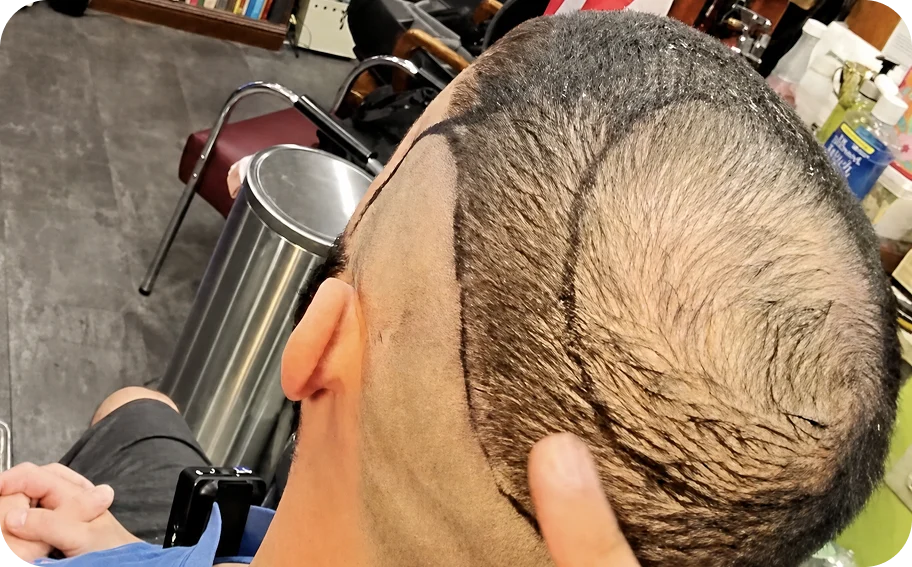
At Northwestern Hair’s session capacity, we ask a question most clinics can’t: should we future-proof in addition to restoring today’s thinning zone?
The answer is almost always yes — and the placement is targeted, not uniform. Dr. Vinay examines the perimeter of the crown and identifies which zones are ahead of the others in their evolution. Is the back progressing faster? Is the side? Is the front hairline area? Wherever the anatomy indicates the fastest change, that zone becomes a priority for pre-emptive placement.
The body maps the placement for us. Where visible density is dropping fastest, the space between hairs is greatest — and the technical opportunity for future-proofing is largest. We place grafts where they’ll be needed soonest, so that the crown continues to look consistent as it evolves.
This is a design decision that requires the graft capacity to execute. At standard session sizes of 2,400 to 3,000 grafts, future-proofing isn’t practically available — the entire session goes to today’s thinning zone. At Northwestern Hair’s preferred session size of 8,000 grafts (with capacity to reach 10,000 when the design calls for it), future-proofing becomes a standard part of the design. The technique that executes this step — interfollicular grafting — is detailed in Part 2.
With every allocation decision made, the design turns to the visible shape of the crown itself — the swirl.
The swirl is drawn by reading the anatomy. Dr. Vinay locates the natural whorl, reads the directionality of the surrounding hairs, and reproduces the rotational shape that carries hair outward from the whorl into the perimeter. The anatomy tells us what to do; the physician follows.
The swirl is the part of crown restoration most patients ask about, and it’s genuinely important — but it’s also the part of the design that flows most directly from anatomy. The depth of a crown hair transplant lies in the six steps that come before it: mapping the recession line, planning the internal hairline where needed, predicting the lifetime graft count, reconciling with the donor supply, allocating today’s grafts as a share of the lifetime plan, and placing future-proofing exactly where the anatomy calls for it.
Once the swirl is drawn, the incisions that will hold the grafts along the rotational vector are set. The design is complete. Every design decision has been made. What follows is how the crown we designed becomes the crown we build.
The design is complete. What follows is the surgical execution — the five clinical techniques that turn the Timeless Crown Design into a crown that grows in naturally and lasts.
ACS is used twice during a crown hair transplant — once before the procedure and once after — for reasons specific to crown anatomy.
Graft survival in the crown is somewhat lower than in the hairline. Multiple surgeons have observed this, and it is a known phenomenon in hair restoration. What matters is how a clinic addresses it. ACS is our answer.
Before the procedure.
ACS is delivered to the crown in the days before surgery. Two things happen at the recipient site. First, local vascularity increases — the tissue becomes more richly perfused, and the scalp is primed to support the incisions the design will require. Second, growth factors are seeded into the tissue in advance, so that the biological environment is already active by the time the first graft is placed.
This matters because of what every transplanted graft needs during its first days in a new location. Each graft has approximately five days to build a new blood supply from the surrounding tissue. Until that vasculature forms, the graft is supported by the ambient environment around it. ACS is how we prepare that environment. By pre-seeding the recipient bed with vascular density and growth factors before the procedure, we shorten the time each graft needs to establish itself. When the grafts arrive on the day of surgery, they are met by tissue that is already responding.
After the procedure.
ACS is delivered a second time after the transplant to optimize yield at the first signs of hair regrowth when the follicles are ready to sprout. A transplanted hair grows back at the caliber its new blood supply can support — and the blood supply itself develops to meet the metabolic demand of the hair. ACS supports both sides of this relationship simultaneously, so the grafts grow back at their maximum caliber.
Since implementing pre-operative and post-operative ACS in our crown procedures, we’ve seen a substantial improvement in yield. This is why ACS is a standard recommendation for every crown restoration we perform.
Micro PUE® is Northwestern Hair’s refinement of the standard FUE extraction technique. On the hairline, its value is in the naturalness of the graft — the pilosebaceous unit is transferred intact, and the transplanted hair reads as native because structurally it is. On the crown, the case for Micro PUE® is different: it’s about conserving your donor supply across a lifetime of expansion.
How Micro PUE® works.
Instead of coring out a small cylinder of tissue around each follicle, Micro PUE® vibrates the entire hair unit out of the scalp within its own natural sheath. Two operational advantages follow.
The first is a lower transection rate — the percentage of grafts damaged during extraction. Standard FUE coring typically produces a transection rate of approximately 12 percent. Micro PUE® reduces this to under 2 percent. Across your lifetime, this represents a 10 percent expansion of the donor supply available for future crown procedures.
The second advantage is preservation of the surrounding donor hair. Standard extraction, because it cores tissue around each follicle, can inadvertently disturb the hairs adjacent to the extraction site — approximately 20 percent of neighboring follicles. Micro PUE® reduces this to near zero. In our experience, this protection of the surrounding donor supply is what preserves options for future crown procedures, especially in patients whose lifetime graft need is high.
When Micro PUE® matters most.
Micro PUE® is essential whenever an internal hairline is being built as part of the crown procedure. The fine, single-hair grafts extracted from the donor perimeter — the second donor zone the design may require — benefit most from Micro PUE® preservation because they are the most delicate and the most visible.
For crown-only restorations, Micro PUE® adds long-term donor conservation to the value of the procedure. The value is not the quality of the hair at the crown itself, as there is more leeway in the crown’s hair’s appearance compared to the hairline. For patients balancing cost, the honest framing is that Micro PUE® is an investment in the crown restorations you may need over your lifetime, not just the one you are having today. Both choices are honest, and we work with patients to make the right one for their situation.
There are two zones on the scalp where the direction of each hair — the exit angle at which each follicle emerges — makes a defining difference in how natural the restoration looks. The first is the hairline. The second is the swirl of the crown.
Everywhere else on the scalp, a small amount of angular variation is not only tolerable but desirable — it’s part of what makes a natural head of hair look natural. At the hairline and at the swirl, however, we want each graft to point precisely along the vector we drew during the design phase.
How the SP89 sapphire blade delivers this precision.
A standard placement tool creates a round incision — a small cored opening the graft fits into. Grafts can rotate freely inside a round opening, which introduces angulation variation of up to 360 degrees. This is fine across most of the scalp. At the swirl of the crown, we want more control.
The SP89 sapphire blade creates a linear slit rather than a round opening. Because the slit is linear, the graft is constrained to a single orientation — one degree of motion instead of 360. Every graft placed through an SP89 slit exits the scalp pointing exactly along the vector Dr. Vinay drew. Across the swirl, this precision is what allows the restored whorl to rotate correctly around its natural center, so the crown continues to look like it grew there.
Interfollicular grafting is the technique that makes Step 6 of the Timeless Crown Design — strategic future-proofing — an executable technique.
How interfollicular grafting works.
Interfollicular grafting is the placement of new grafts in the microscopic space between existing hairs, without disturbing the follicles that are already there. It requires a specialized blade profile designed to slip between adjacent follicles rather than through them, and it requires the surgical hand to see the placement architecture at follicle-level resolution.
In an area of the crown perimeter that is beginning to evolve, the space between remaining hairs has widened slightly. Interfollicular grafting uses that spacing. New grafts are inserted into the widening gaps while the neighboring hairs continue to grow undisturbed. The scalp continues to look full because the existing hairs are still there — and the new grafts are now positioned to maintain that fullness as the surrounding hair evolves over time.
The body maps the placement for us. Where the anatomy indicates the fastest change, the follicular spacing is greatest, and interfollicular capacity is highest. Where the surrounding hair is still dense, the space between follicles is smaller — but the need there is smaller too. The technique aligns naturally with the anatomy of the crown.
The design decides where. The blade delivers.
Many crown hair transplants at Northwestern Hair are mega sessions — procedures involving more than 6,000 grafts in a single day. The crown’s geometric graft demand, combined with strategic future-proofing, frequently pushes a well-planned lifetime restoration above this threshold. Delivering it in a single session — with a single recovery — requires infrastructure that a standard-session clinic doesn’t need.
How the grafts are preserved during a mega session.
In a shorter procedure, grafts spend a limited amount of time outside the body before being placed. In a mega session, that time is longer. Two things determine how many grafts thrive to grow: what the grafts sit in, and what temperature they sit at.
Most clinics preserve grafts in standard fluids — saline, HypoThermosol, or ATP-based solutions. These are functional. At Northwestern Hair, we prefer the patient’s own plasma, drawn on the day of surgery and prepared as the graft-holding medium. The follicles sit in the same biological fluid they were removed from — the natural environment their oil glands, stem cells, and sheaths are adapted to.
Temperature is preserved with the same discipline. Grafts are not stored on ice, because the freeze-thaw cycle of ice-based storage can subject follicles to temperature oscillation. Every graft in a Northwestern Hair mega session is handled either inside a cooling chamber or on a cooling plate held at a single, constant temperature throughout the case. The follicle experiences no thermal variation from the moment of extraction to the moment of placement.
The technique’s name captures what it does: isothermal (constant temperature), hypothermic (cooled), plasmonic (in the patient’s own plasma).
What preservation makes possible.
The value of iso-hypothermic plasmonic preservation isn’t in the technique itself. It’s in what the technique makes possible: a comprehensive crown restoration performed in one procedure, with one recovery, rather than parceled across multiple sessions the patient has to schedule and heal from separately. For crown patients — where the lifetime graft need is often substantial — the ability to compress a lifetime of restoration into a single mega session is a real practical advantage.

The Timeless Crown Design is not a separate philosophy from the Timeless Hairline Design. Both are applications of the same underlying commitment: that a hair restoration should be planned from the endpoint of your hair journey, not from where your hair sits today.
Some patients present with a receding hairline. Some present with a thinning crown. Some present with both. The underlying planning question is the same in all three cases. What is your final foundation — the shape your hair will hold over your lifetime — and what can be built on top of that foundation that continues to look natural through every year that follows?
The Timeless Hairline Design answers this question at the front of the scalp. It draws a hairline shape that connects your current temporal hairline to your future recession line, and holds its naturalness through every state of change your hair will pass through. The Timeless Crown Design answers the same question at the back of the scalp. It designs a crown restoration that respects the finite donor supply, plans for the geometric expansion the crown will undergo, and honors the internal hairline that may or may not need to be built along with it.
What binds the two together is planning discipline — the discipline of designing today’s procedure against the arithmetic of your lifetime. The design takes up to two hours, but yields decades of natural results. It’s the first task of every procedure morning — or for mega sessions, the work of the evening before. The session is between Dr. Vinay and the patient. There are no distractions. Whether the design being drawn is a Timeless Hairline, a Timeless Crown, or both together, the commitment is the same: the vision for the restoration is complete before the work begins.
A Timeless Crown, like a Timeless Hairline, is the only kind of restoration we sign our name to.

The Timeless Crown Design is anatomically anchored, which means it applies across every patient whose crown can be well planned. Ethnicity, age, and hair type are inputs to the design — not obstacles.
Every line and reference point established during the Timeless Crown Design is based on anatomy. The recession line is palpated at the boundary between coarse donor hair and finer hair above. The ridge is identified by feel and by observation. The whorl is located as the natural rotational center of the crown. These anatomical points also define ethnicity — a Black patient’s ridge sits differently from an Asian patient’s, and hair caliber varies substantially between ethnicities.
Because the methodology follows anatomy, the resulting crown hair transplant preserves your heritage automatically. The coarser hair caliber of an African American patient calls for a different graft count per square centimeter than the finer, straighter caliber of an East Asian patient. The Timeless Crown Design absorbs these differences at the anatomical level. Our methodology doesn’t impose a single ideal across all crowns. It listens to the crown it’s designing for.
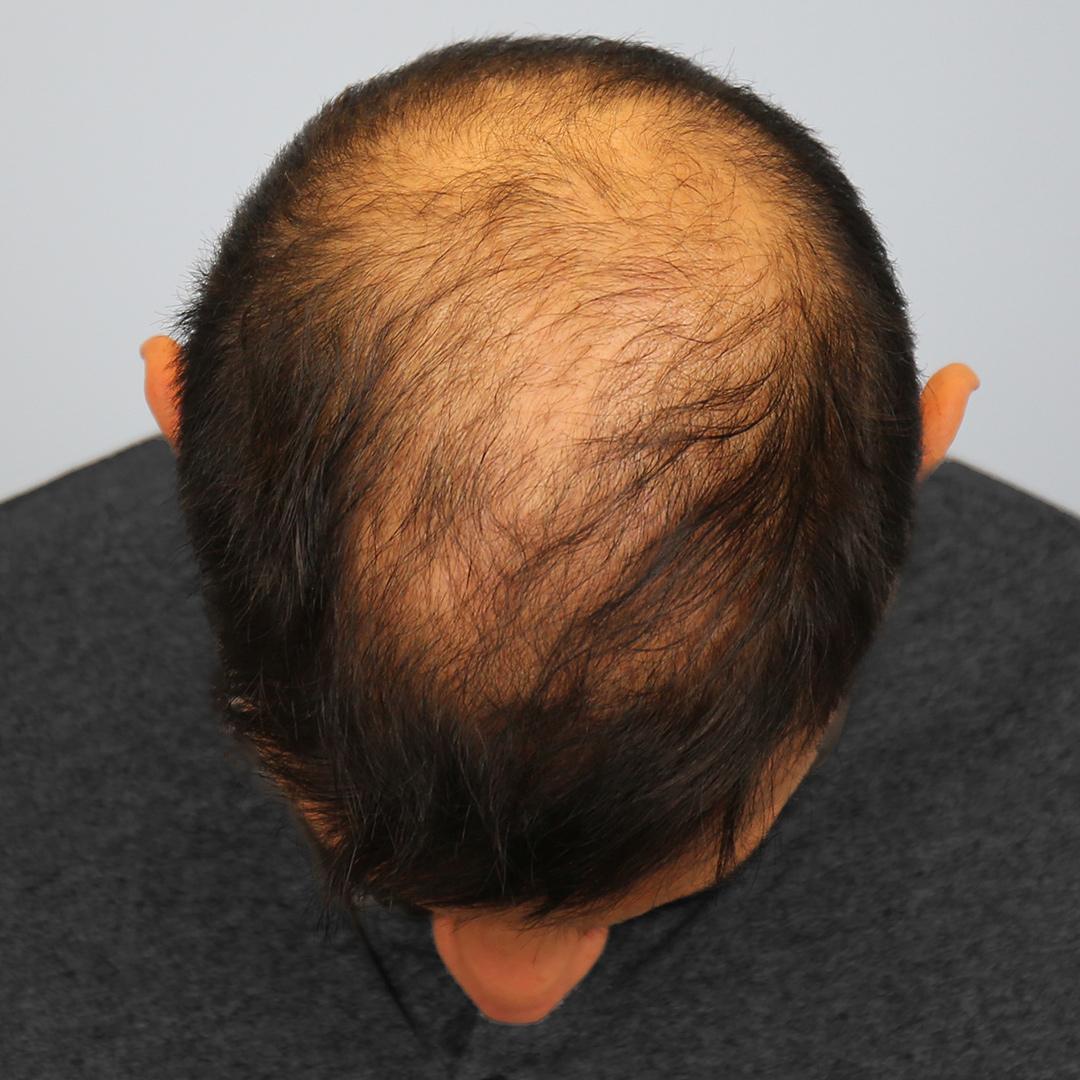
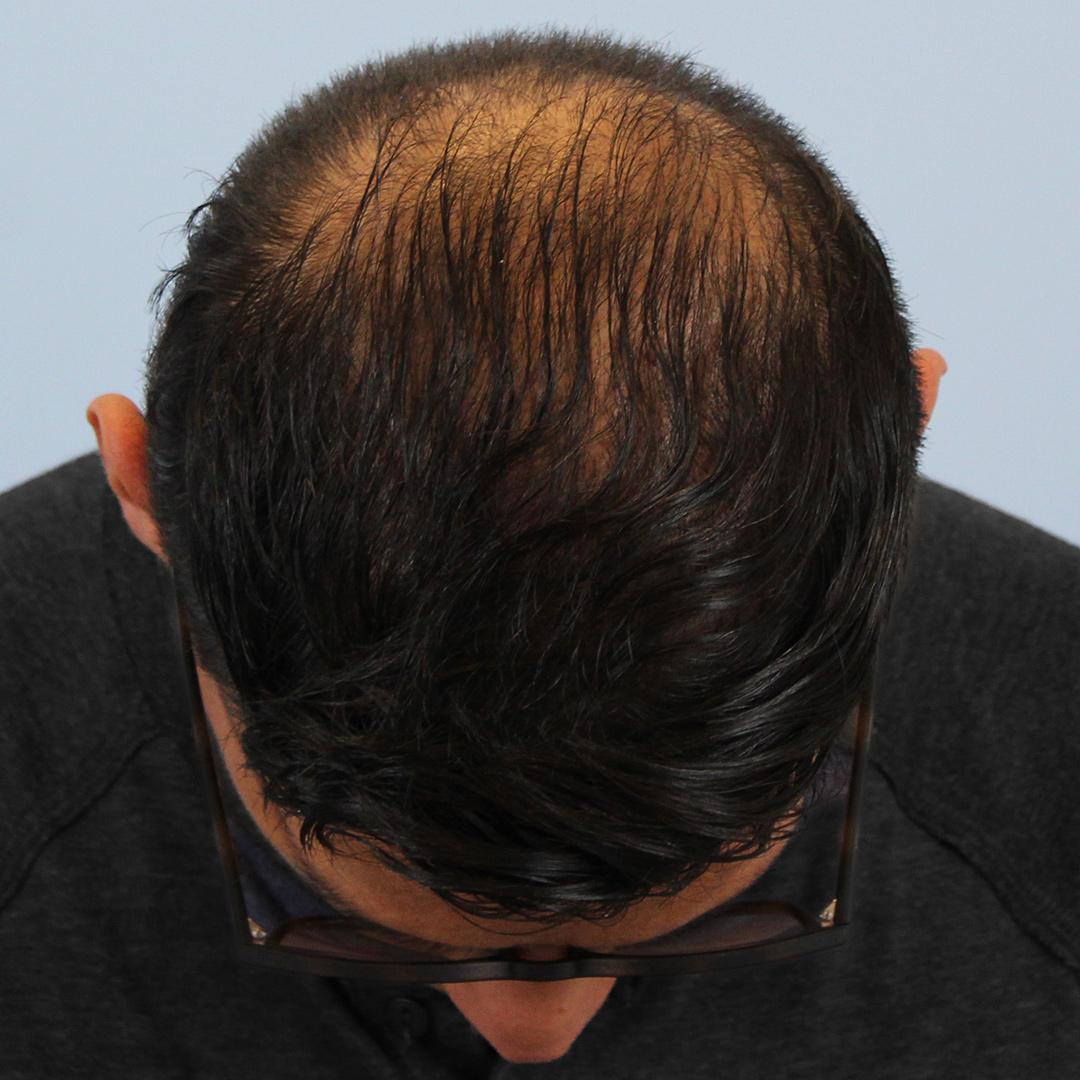


之前
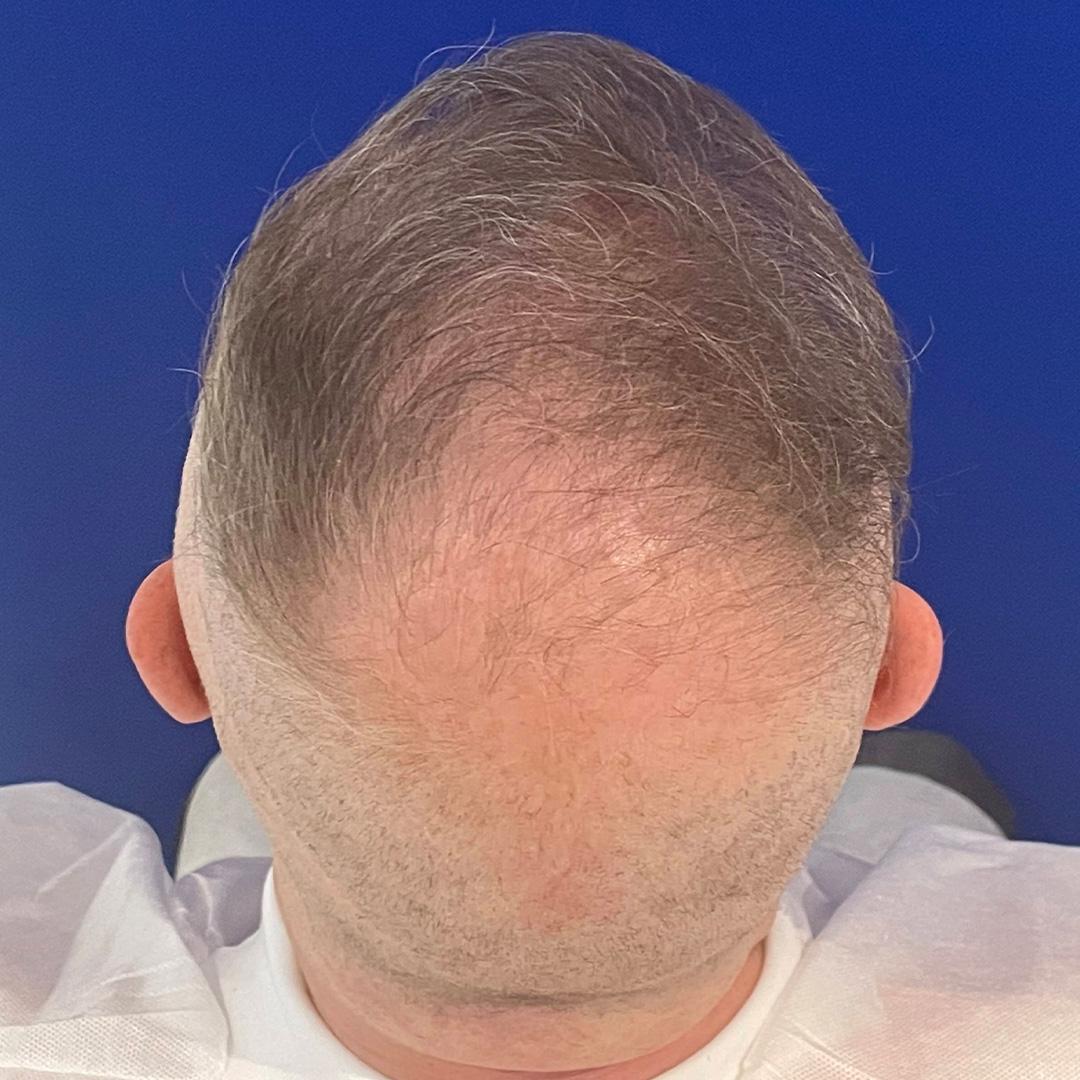
之后
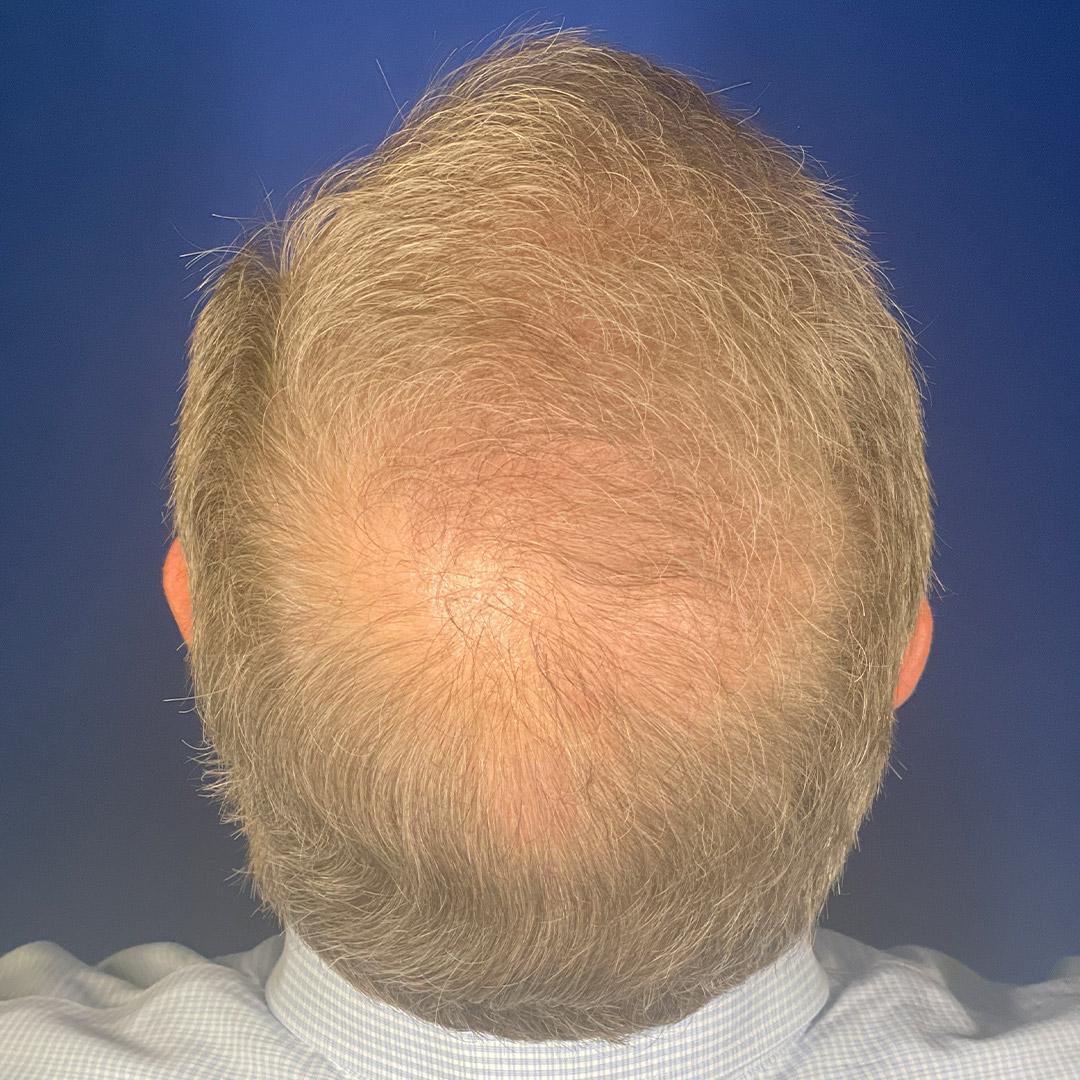
The Timeless Crown Design was built to be effective at any age.
For mature patients with a strong front hairline and an isolated crown, the design is a straightforward conversation. The final recession line is close to what we see today. The internal hairline is the current hairline. The lifetime graft count and today’s graft count are close together. The procedure is planned as a single, comprehensive restoration.
For younger patients with an early developing crown and some evidence of hairline change, the design is more nuanced — but this is the situation the Timeless Crown Design was built for. Because we draw the final recession line and the internal hairline first, and predict the lifetime graft count against that final state, age becomes a variable the plan already accounts for. We don’t guess at what a young patient’s crown will look like in twenty years. We map it, and we plan today’s procedure against it.
This is why Northwestern Hair can confidently treat young men who most clinics turn away. A young man beginning to notice change at the crown can be restored now — with a plan designed to look natural for his entire adult life. For young patients considering a crown hair transplant, this is often the difference between waiting a decade for other approaches to fall short, and starting a well-planned restoration at the moment it matters most.
A crown hair transplant is a surgical restoration of the crown — the circular area at the back of the top of the scalp where hair rotates outward from the whorl. In male pattern hair loss, the crown often thins in a widening circular pattern. A crown hair transplant transfers permanent donor hair from the sides and back of the scalp into the crown, restoring visible density and a natural swirl pattern. At Northwestern Hair, every crown hair transplant is planned using the Timeless Crown Design methodology.
The Timeless Crown Design is our proprietary seven-step methodology for planning a crown hair transplant that continues to look natural across your lifetime. The methodology maps the final possible crown perimeter, plans an internal hairline where needed, predicts your lifetime graft count, reconciles that count with your donor supply, allocates today’s grafts as a proportional share of the lifetime plan, targets future-proofing where the anatomy indicates, and draws the swirl to match your natural rotational pattern. It is anatomically anchored, which makes it applicable to any ethnicity, and it is age-agnostic, which allows us to confidently treat young men with early crown thinning.
You are a good candidate for a crown hair transplant if your donor supply can support your lifetime graft need, and if your front hairline is either stable or can be included in the restoration plan. Most patients with crown thinning are candidates when the plan is thoughtfully designed — which is why we recommend a consultation before deciding. The consultation determines your lifetime graft need, assesses your donor supply, and produces an honest picture of what a well-planned crown restoration will look like for you.
The number depends on how large your crown will eventually become — not on how large it is today. A young patient with an early-stage crown may have a lifetime graft need of 8,000 to 12,000 grafts, even though today’s visible thinning zone might only need 3,000 to 4,000 grafts. A more mature patient with an isolated crown may have a total lifetime need of 3,000 to 6,000 grafts because the crown has largely stabilized. This is why lifetime graft prediction — Step 3 of the Timeless Crown Design — is more important in the crown than in any other zone of the scalp.
The two procedures solve different problems on the same head. The hairline is on the face and is scrutinized in high light from close range, so it’s held to a nearly undetectable standard. The crown lives above the eye line and accepts a wider natural tolerance. The crown expands geometrically over time, which means it requires more careful lifetime planning than the hairline. Graft survival in the crown is somewhat lower than in the hairline, which is why we prepare the scalp with ACS before every crown procedure. And a crown restoration often includes an internal hairline drawn inside the crown design — because as the mid-scalp evolves, the front edge of the crown becomes the visible frontal boundary of your hair. Many crown hair transplants are a hairline design and a crown design combined.
A crown hair transplant follows the standard growth timeline of any hair transplant. Immediately after the procedure, the transplanted hairs enter a dormant phase. They shed within the first two to four weeks. Regrowth begins at three to four months. Density starts to become visible at six months. By eight to ten months, the crown restoration is substantially in. The full result — including the maximum caliber the transplanted hairs will regain — is visible at twelve months.
Graft survival in the crown is approximately 80 to 85 percent, compared to 90 to 93 percent in the hairline and mid-scalp. Multiple surgeons have observed this, and it’s a known phenomenon in hair restoration. What we’ve learned is that preparing the recipient site with ACS before the day of surgery significantly closes this gap. ACS increases local blood flow and seeds growth factors into the tissue in advance. Every transplanted graft has approximately five days to build a new blood supply from the surrounding tissue, and ACS is how we prepare that tissue to support each graft through this window. Since we implemented pre-operative ACS for crown procedures, our crown yields have improved substantially. This is why ACS is a standard part of every crown hair transplant we perform.
Every Timeless Crown Design plans for the crown’s evolution across your lifetime. Rather than restoring only today’s thinning zone, we map the final possible size of your crown, predict your lifetime graft need against that endpoint, and allocate today’s grafts as a proportional share of the lifetime plan. We also place a portion of today’s grafts pre-emptively in the perimeter zones where the anatomy indicates future change, so the crown continues to look consistent as the surrounding hair evolves. This is the discipline that allows a crown hair transplant to remain natural across every future procedure it may need.
Yes — and Northwestern Hair may be one of the few clinics in the United States that confidently treats young patients under 25 with a crown hair transplant. This is possible because the Timeless Crown Design is age-agnostic. We draw the final recession line and the internal hairline first, mapping the endpoint of your lifetime pattern before we place a single graft. Today’s procedure is planned against that endpoint. For young men with early crown thinning, this is often the difference between waiting years for other approaches to reach their limit, and being well restored at the moment when confidence matters most.
FUE — follicular unit extraction — is a hair transplant technique in which individual hair follicles are extracted from the donor area and transferred to the recipient site, without the strip incisions of older transplant methods. At Northwestern Hair, we perform FUE crown hair transplants using Micro PUE® — our refinement of the standard FUE technique. Instead of coring out a small cylinder of tissue around each follicle, Micro PUE® vibrates the entire hair unit out of the scalp within its natural sheath. This reduces the transection rate from approximately 12 percent to under 2 percent, and preserves the neighboring donor hair much more thoroughly than standard FUE. For a crown hair transplant, where the donor supply must serve a lifetime of expanding graft need, this conservation is substantial.
The cost of a crown hair transplant depends on the graft count for today’s procedure and the technique selected. Detailed pricing is available on our hair transplant cost page. We recommend a consultation before comparing pricing across clinics, because the graft count alone doesn’t reflect the lifetime plan. A well-planned initial procedure — with lifetime graft planning built in — often provides more value across a patient’s lifetime than a series of procedures each addressing only today’s thinning zone. The Timeless Crown Design is included with every crown hair transplant we perform.
A crown hair transplant is a relatively easy procedure to recover from. Pain is minimal, and most patients are off any pain medications by the following day. There is a ten-day protocol for taking care of the scalp and the new grafts during the early healing window, but most patients feel ready to return to normal daily activities by the day after the procedure. Because the crown sits on top of the scalp rather than at the front of the face, many patients find the crown restoration less socially disruptive during initial healing than a hairline restoration — the transplanted area is easily covered by a loose cap.
A well-planned crown hair transplant is one of the most confidence-transforming procedures in hair restoration. Patients who complete a Timeless Crown Design consistently describe a visual and personal restoration that surprises them — hair they haven’t seen in years, an appearance they thought they had permanently traded for something less, and a level of confidence that reshapes how they show up in the world.
This is what a thoughtful crown hair transplant delivers when the planning is right. And it’s why we’ve spent years developing the methodology that makes it possible.
If you’re considering a crown hair transplant, we invite you to schedule a consultation with Dr. Vinay. In that conversation, we’ll map your recession line, discuss your hairline, predict your lifetime graft need, and walk you through what a Timeless Crown Design would look like for you specifically. You’ll leave with clarity about your options and the plan that best fits your goals.