




Chicago Corporate Professionals and Hair Restoration: Discretion, Downtime, and Results
There’s a particular kind of calculation that happens when a professional in a high-visibility career starts seriously considering hair restoration.
It’s not the same calculation a 22-year-old makes researching options in his apartment. It’s more layered. The stakes feel different when your appearance is part of how you’re perceived in a boardroom, a client meeting, or a courtroom. When your calendar runs six weeks out, and “significant downtime” isn’t a concept that fits into it. When the concern isn’t just whether the result will look good, it’s whether the process of getting there will be visible to people whose perception of you matters professionally.
Chicago’s professional class — finance, law, medicine, consulting, real estate, tech, executive leadership — represents a significant share of Northwestern Hair’s patient base, and for good reason. This is a city where careers are built on presence, where appearance intersects with professional identity in ways that feel concrete rather than abstract, and where the decision to address hair loss involves considerations that go beyond aesthetics.
This piece is written for that specific patient. The one who wants real answers to the questions that are actually driving their hesitation — not reassurances designed to move them toward a consultation, but honest information about what discretion, downtime, and results actually look like when the procedure is done right. Contact Northwestern Hair Restoration today for more information.
The Discretion Question
Let’s start with the one that tends to be unspoken but is usually driving the conversation.
Most professional patients considering hair restoration have a version of the same underlying concern: they don’t want people to know they had something done. Not colleagues. Not clients. Not the people they manage or report to. The idea of being visibly “in recovery” in a professional setting — or worse, having the procedure itself become office knowledge — is for many patients a more significant barrier than cost or recovery logistics.
This concern is legitimate and worth addressing directly rather than minimizing.
What the Healing Process Actually Looks Like
 With No-Touch Micro PUE® — the extraction technique used exclusively at Northwestern Hair — the recovery profile is considerably more manageable than older surgical approaches and more discreet than most patients expect.
The donor area at the back and sides of the scalp is trimmed for the procedure, but the extraction pattern itself, done with precision oscillating instruments rather than aggressive punches, leaves the area without the obvious thinning or visible scarring that characterized older FUE approaches. For patients with enough existing hair length, the donor work is largely invisible within days.
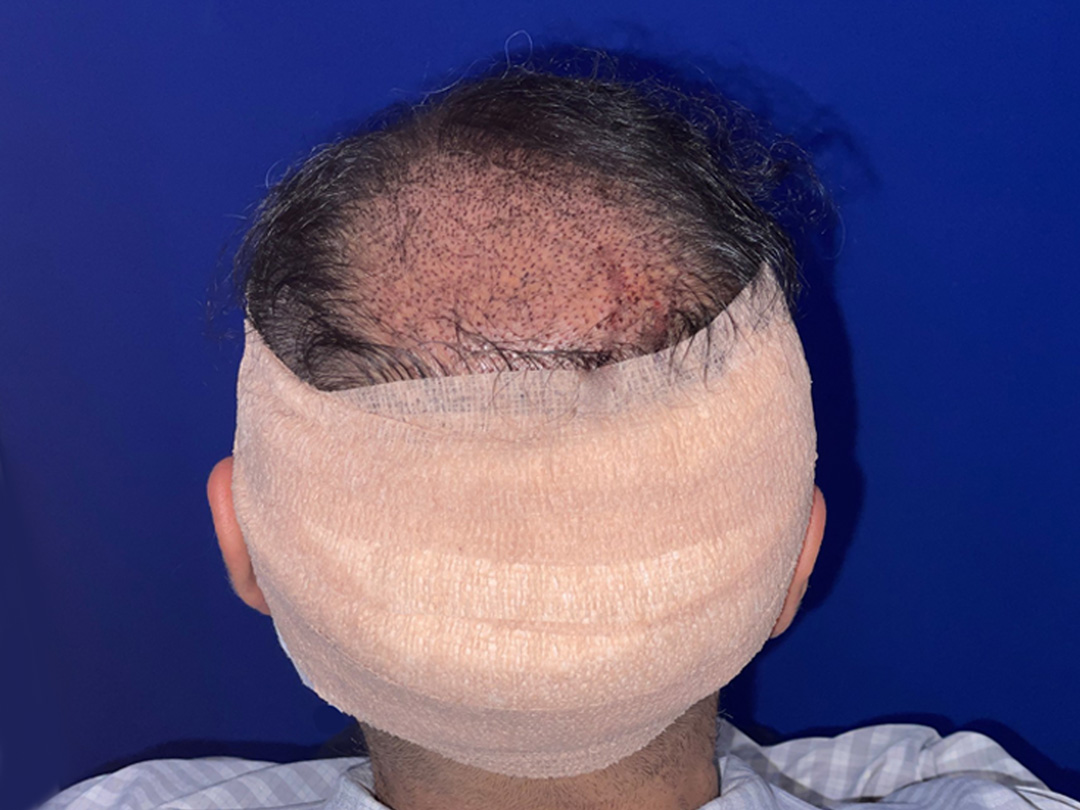
The recipient area — where grafts are placed — develops small scabs over the first week to ten days. These are present but not dramatic. They’re concentrated on the scalp rather than the face, and for patients who wear their hair at any length, they’re largely concealable. By day ten, the scabs have shed, the scalp looks normal, and most patients are genuinely presentable.
Facial swelling affects a minority of patients getting hairline restoration — roughly twenty percent — and resolves within the first week. It’s manageable. It’s not universal. And for patients who time the procedure thoughtfully relative to their professional calendar, it’s a non-issue.
The Hat Window
Between procedure days and day five, the scalp is healing, and the recipient area has visible scabbing. A baseball cap covers everything effectively during this window. For most professional environments, five days of hat-wearing isn’t a significant event — particularly in casual or hybrid work settings, or timed around a long weekend.
By day five, the option to wear a hat disappears as a necessity and becomes a choice. By day ten, most patients have no visual evidence of anything worth concealing.
The Strategic Scheduling Advantage
One of the genuine advantages of a one-procedure-per-day practice — where the surgeon commits an entire day to a single patient — is that your procedure is scheduled as a distinct calendar event rather than fit into a high-volume rotation. For a professional with a complex schedule, that predictability matters. You know your date. You plan around it. You build a five-to-ten-day buffer and return to full professional activity with no one the wiser.
The patients who manage this most smoothly tend to schedule around:
- Long weekends that extend the buffer naturally
- Planned vacation days that don’t read as unusual to colleagues
- Slower periods in their professional calendar — between deals, between trial phases, after a major deliverable
- The late fall or winter window, when hats are seasonally unremarkable, and the professional calendar tends to compress around holidays
None of these requires dramatic rearrangement. They require the kind of scheduling intelligence that professional patients apply to everything else in their lives.
The Shedding Phase Is Not a Visibility Problem
One thing worth addressing directly: the transplanted hair sheds in the weeks following the procedure, and new growth emerges gradually over the following months. This is biological, expected, and well-explained in any good post-procedure consultation.
What it is not is a dramatic visual event. The shedding happens gradually, and the scalp in that phase looks very similar to how it looked before the procedure — perhaps slightly thinner in the transplanted area during the resting phase, but not in a way that reads as anything unusual to someone who didn’t know you had a procedure. The dramatic before-and-after transformation happens over twelve months, not in a way visible week to week.
For a professional worried about colleagues noticing something strange during recovery, the honest answer is: there’s nothing to notice after the first ten days. The result develops invisibly over time and reveals itself at the twelve-month mark as the natural density of a result done well.
The Downtime Question
The professional concern about downtime is usually about two things: time away from work and physical restrictions that interfere with normal professional activity. Both deserve honest answers.
Time Away From the Office
Most patients take the procedure day off — which is an obvious given — and the following day as a buffer. Some take a third day depending on their role, their commute, and their personal comfort level. Beyond that, the majority of Northwestern Hair patients return to desk work, calls, client-facing responsibilities, and normal professional function within two to three days of their procedure.
The physical experience of the procedure itself, for most patients, is manageable. Discomfort that requires medication typically resolves by the following morning. The sensation during healing — some tightness in the donor area, some sensitivity in the recipient zone — is real but doesn’t prevent cognitive function, professional communication, or the kind of work most white-collar professionals spend their days doing.
What it does temporarily limit is physical exertion. High-intensity exercise, heavy lifting, and anything that significantly elevates blood pressure are restricted for roughly two weeks post-procedure. For patients whose professional life doesn’t involve physical labor — which describes most of Northwestern Hair’s corporate patient base — this restriction is largely irrelevant to their work life, even if it affects their gym schedule temporarily.
The One-Procedure Commitment
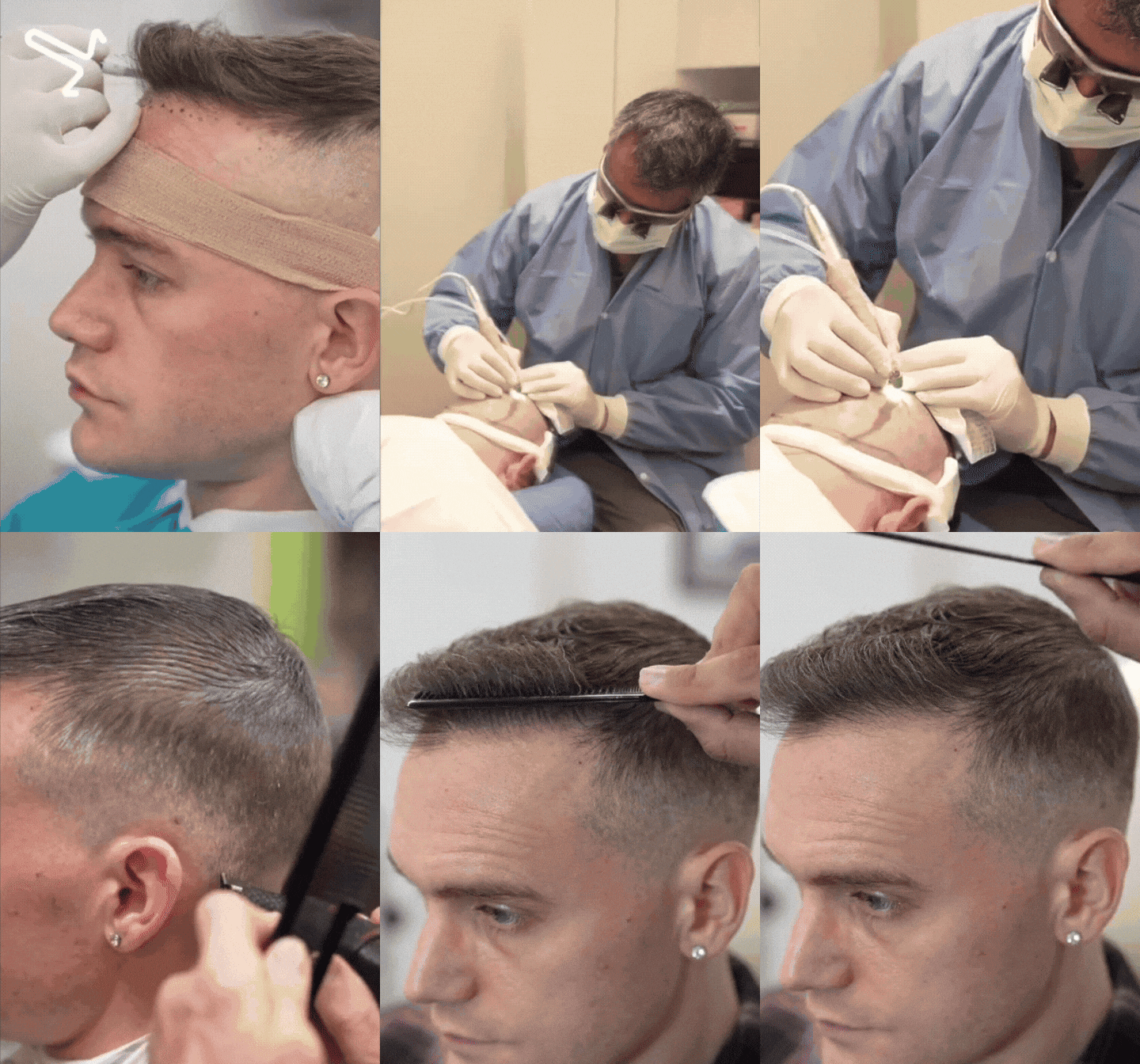
 The procedure itself runs six to ten hours, depending on graft count. That’s a full day — an early start, a long sitting, and an evening of light activity and rest. For professionals who haven’t spent a full day in a clinical environment since their last physical, this is the primary logistical challenge.
What it isn’t is a multi-day hospitalization, a general anesthesia recovery arc, or a period of genuine incapacity. Local anesthesia means you’re awake, comfortable, and able to handle calls, messages, and light work during the procedure if the nature of your role requires it. Patients routinely spend portions of long sessions on their phones managing what needs managing.
The day is long. The commitment is real. The disruption to professional life, for most patients, begins and ends there.
Video Calls and Remote Work
A practical consideration that has become more relevant as professional life has shifted toward hybrid and remote models: the first week of healing is considerably easier to manage when camera-off is a socially acceptable option in some meetings. For professionals in roles where video presence is mandatory and constant, the timing conversation is worth having. For professionals in roles where a five-day stretch of lower camera visibility is manageable — and for most, it is — the hybrid work era has genuinely made the discretion logistics easier than they were a decade ago.
The Results Question
For professional patients, the results question has a specific texture that differs from what drives it for other patients. It isn’t just that my hair looks better. It will look natural enough that the improvement reads as personal rather than procedural.
This distinction matters. A result that clearly reads as a hair transplant — even a successful one — can create the exact kind of professional self-consciousness it was meant to resolve. The goal isn’t visible restoration. It’s an invisible restoration. Hair that looks like yours, grows like yours, and requires no explanation.
Why Natural Results Require More Than Good Grafts
The technical execution of the procedure — graft survival, extraction precision, placement density — determines whether hair grows. The surgical artistry behind hairline design determines whether what grows looks natural.
These are not the same skill, and not every surgeon has both.
A natural hairline isn’t a straight line drawn at a conventional position. It has micro-irregularity at the leading edge, varied graft angles that mimic the multidirectional growth of natural hair, intentional asymmetry that matches the organic variation of the patient’s existing features, and proportions calibrated to the specific geometry of the patient’s face rather than a standardized template.
For a professional whose colleagues will see them at close range in meeting rooms, across conference tables, and on camera, this level of design specificity is not a luxury consideration. It’s the variable that determines whether anyone notices.
At Northwestern Hair, hairline design is treated as the central artistic act of the entire procedure — hand-drawn specifically for each patient, accounting for their face shape, their existing hairline characteristics, their age, and the likely trajectory of their future hair loss. The result is designed to look right immediately and to continue looking right as the patient ages, not to produce a twelve-month photo that starts looking incongruous by the time they’re a decade older.
The Confidence Variable
There is a professional dimension to the results question that doesn’t get discussed in clinical language, but is probably the most relevant consideration for the patients reading this: what a successful hair restoration outcome does to professional presence.
Hair loss affects confidence in ways that are cumulative and often unconscious. The client meeting where you’re half-aware of the angle of the lighting. The headshot that needs updating but keeps getting deferred. The professional photograph you avoid or angle carefully. The general low-grade self-consciousness that doesn’t dominate your awareness but sits in the background of professional situations where appearance carries weight.
A well-executed result doesn’t just improve how you look. It removes a variable from your mental bandwidth that you may not have fully recognized as occupying it. The professionals who describe their results at Northwestern Hair most consistently aren’t saying they look dramatically different. They’re saying they stopped thinking about it — and that the cognitive space that was quietly devoted to managing the self-consciousness is simply available for other things.
That’s not a cosmetic outcome. It’s a professional one.
Managing the Professional Calendar: A Practical Guide
For professionals who’ve decided the procedure makes sense and are thinking through the logistics, here’s a practical framework built around the realities of a demanding Chicago professional schedule.
Choose your window deliberately. The procedure requires one full day and a meaningful buffer of five to ten days before you’re fully back to normal professional function without any concealment considerations. Look at your calendar six to eight weeks out and find the stretch where that window creates the least friction. A long weekend plus two or three additional days off is often enough. A planned vacation handles it entirely.
Schedule a Thursday or Friday procedure. The weekend following the procedure is the highest-value recovery time — two days of natural rest without the need to explain anything to anyone. A Friday procedure gives you the weekend plus Monday and Tuesday before a Wednesday return, which for most professionals is a manageable buffer.
Communicate at the level of detail you’re comfortable with. You don’t owe anyone an explanation. A medical procedure is a medical procedure. Most professionals at or near the executive level have enough scheduling autonomy that blocking a few days without a detailed explanation is unremarkable.
Plan your hat situation. Know before procedure day what you’re wearing for days one through five. A fitted cap in a neutral color works in virtually every casual professional context and most hybrid ones. If you work in a formal environment where a hat is genuinely impractical in all circumstances for five days, the Friday procedure plus a long weekend buffer usually addresses it.
Front-load your workload before the procedure. The week before your procedure, clear your decks as much as possible. The week after, protect your calendar from the highest-intensity obligations. The procedure itself leaves you functional but not optimal — prioritizing cognitively demanding client work and important presentations for the two weeks following is straightforward professional management.
Tell only who needs to know. If you have a business partner, an EA, or a direct report who manages your calendar, a brief matter-of-fact explanation is usually less complicated than engineering complete opacity. Most professionals in these roles have more discretion than their employers give them credit for.
The One-Patient Commitment and What It Means for Professionals
There’s a dimension of Northwestern Hair’s clinical model that resonates specifically with professional patients: the one-procedure-per-day standard isn’t just a quality control measure. It’s a reflection of how high-performing people tend to think about what they’re paying for.
A professional who has built a career on depth of focus, personal accountability, and the quality differential that comes from doing one thing at a time with full attention — rather than optimizing for volume — recognizes the model immediately. It maps onto values they already hold.
When Dr. Vinay commits an entire day to a single case, the implications are concrete. The surgeon who designed your hairline in the consultation is the surgeon extracting your grafts and placing them eight hours later. The attention is undivided. The outcome is the only thing on the agenda. The post-procedure follow-up is direct — a call or text reaches the physician, not a staff intermediary managing a patient queue.
For a professional accustomed to the difference between a service provider who handles them as one of many and one who treats them as the only client that day, this isn’t a small distinction. It’s the reason the result is what it is.
The Bottom Line for Chicago Professionals
The concerns that make professional patients hesitant about hair restoration — discretion, downtime, and the naturalness of results — are all legitimate. They’re also all addressable.
The discretion is real because the recovery is genuinely manageable, the healing is concealable within days, and the final result is designed to be invisible as a procedure. The downtime is finite and schedulable around a professional calendar with straightforward planning. And the results, done with the precision and surgical artistry that No-Touch Micro PUE® and Northwestern Hair’s approach produces, are the kind that read as natural rather than restored, which is the only kind of result that serves a professional patient’s actual goals.
The professionals who’ve sat in Dr. Vinay’s consultation chair, asked the hard questions, understood the process fully, and went through with the procedure consistently report the same thing: they wish they’d done it sooner. Not because the vanity of it finally won out, but because the self-consciousness they were managing quietly cost them more than the procedure itself.
That’s a professional calculation worth making clearly — with full information, and without pressure.
Chicago professional with questions about fit, timing, and what the process actually looks like? Book a consultation with Dr. Vinay at Northwestern Hair. One conversation, one patient, no pressure.