




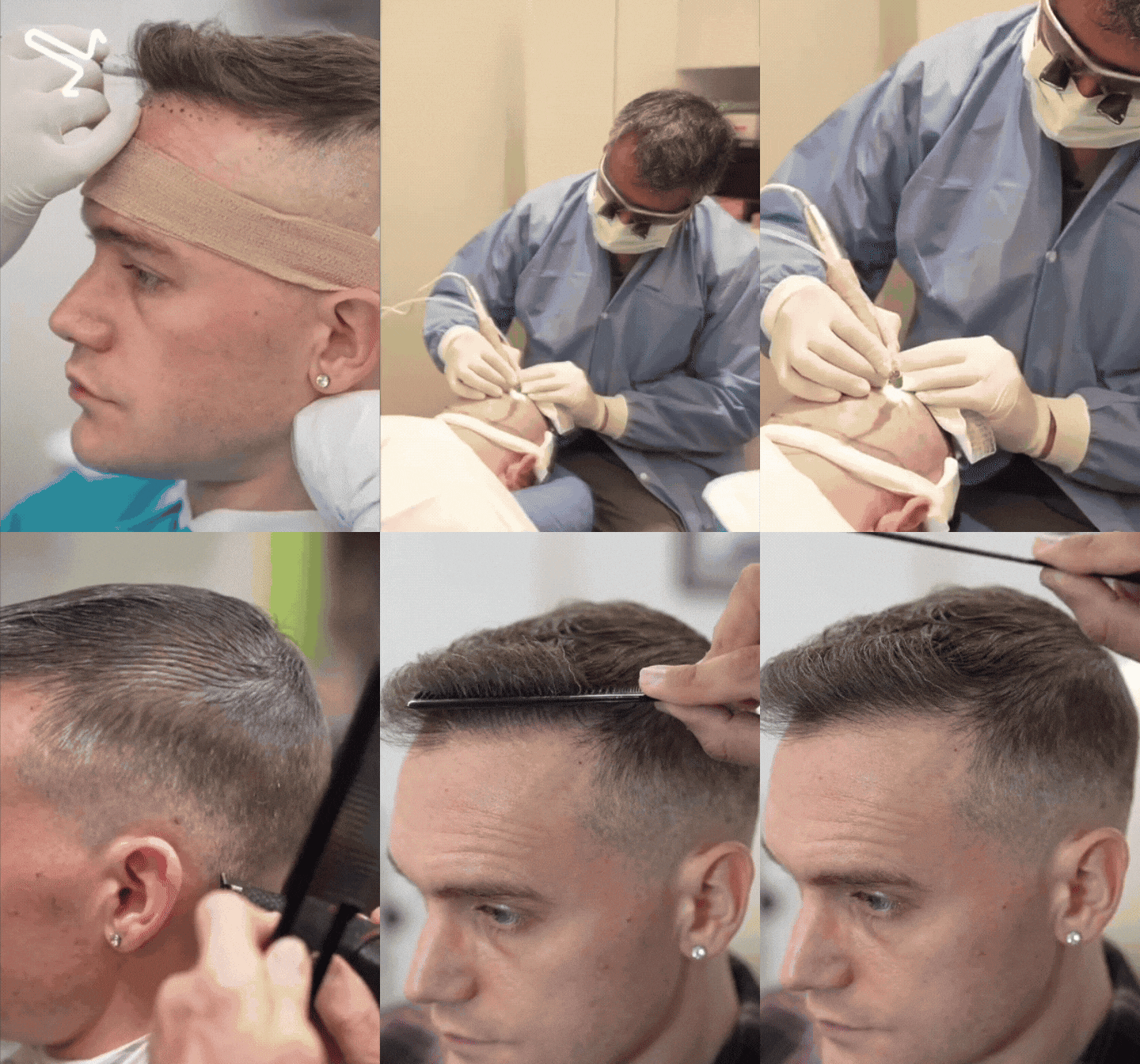
Hair Transplants for Asian Men: How Hairline Design and Texture Require a Different Approach
Hair transplantation is not a one-size-fits-all procedure. Technique, design philosophy, and graft handling all need to adapt to the individual — and one of the most meaningful ways cases differ is in the biological and aesthetic characteristics of the patient’s hair itself.
For Asian men seeking hair restoration in Chicago, this matters more than it does for almost any other patient group. Asian hair presents a specific set of characteristics — in thickness, texture, growth pattern, scalp contrast, and follicular structure — that make both the extraction process and the artistic design of the hairline meaningfully more demanding. A surgeon or technique that performs adequately on finer, lower-contrast hair can produce noticeably suboptimal results on Asian hair if those differences aren’t understood and accounted for. Contact Northwestern Hair Restoration today for more information.
Here’s what makes Asian hair transplantation distinct and how Northwestern Hair’s approach addresses each factor directly.
The Biological Characteristics of Asian Hair
Understanding why Asian hair requires a different approach starts with the hair itself. Several characteristics common in patients of East Asian, South Asian, and Southeast Asian descent create a distinct technical context:
Shaft diameter. Asian hair tends to have a significantly larger individual shaft diameter than European or African hair. Thicker individual strands mean that each graft, if improperly placed or damaged during extraction, creates a more visible error. There’s less margin for imprecision.
Follicular unit composition. Asian hair follicles more frequently occur as single-hair follicular units rather than the two- or three-hair groupings common in other hair types. This affects graft yield calculations and density planning — you need more grafts to achieve equivalent visual density, and each graft contributes less coverage than it might in another patient.
Scalp contrast. Perhaps the most consequential characteristic for transplant aesthetics: Asian men with darker hair typically have a higher contrast ratio between hair color and scalp. In patients with finer or lighter hair, a less-than-perfectly-natural hairline or slightly misaligned graft can be difficult to notice. In a patient with dense, dark, straight hair against a lighter scalp, the same imperfection is immediately visible. The optical magnification effect of high-contrast hair makes every design decision — angle, direction, density distribution — far less forgiving.
Growth angle and pattern. Asian hair typically grows with a more pronounced directional pattern and often with less natural wave or curl than other hair types. Straight hair lies flat and flows in a consistent direction, which means improper angle placement at the hairline doesn’t get softened by wave or texture — it sits exactly where it was placed, pointed in exactly the direction it was set.
Why Hairline Design Is the Central Challenge
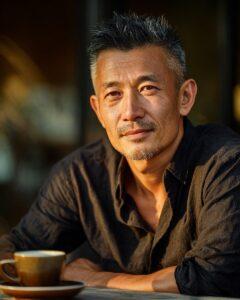 For most hair transplant patients, the hairline is the most scrutinized element of the result. For Asian men, the stakes are higher for all the reasons above — and the design philosophy needs to account for both the aesthetic conventions specific to Asian features and the optical realities of high-contrast hair.
Northwestern Hair’s approach to hairline design centers on four dimensions: the three-dimensional shape, its proportions, angles, and flow, which must fit the patient’s face precisely — and the fourth dimension of time, designing a hairline that will evolve naturally as the patient ages.
That fourth dimension is particularly relevant for Asian patients. A hairline appropriate for a man in his early 30s looks different from one that will still look natural in his 50s. Designing for the current moment without accounting for continued natural hair loss progression — and for how the transplanted hairline will sit relative to receding native hair over time — produces results that look right today and wrong in ten years.
The artistic component matters here in a way that’s difficult to quantify but easy to see in outcomes. The final hairline is hand-drawn artistry that brings life and emotion to the result. For Asian patients, that artistic calibration includes understanding how hairlines naturally present in Asian men — which tend to be more defined, with different temple recession patterns and forehead proportions than the European hairlines that dominate most hair transplant before/after imagery. A surgeon designing every hairline to the same template, regardless of the patient’s ethnicity and facial structure, will produce results that look technically adequate but not quite right.
Why Extraction Technique Is Especially Critical for Asian Hair
The graft health implications of No-Touch Micro PUE® apply to every patient — but the consequences of extraction damage are amplified for Asian hair specifically.
In standard FUE, tweezers can crush grafts and sharp punches can sever key structures — leaving hairs dry, kinked, or scarred. For patients with wavy or curly hair, some degree of post-transplant texture irregularity can be partially masked by the hair’s natural movement. For Asian patients with straight, high-diameter hair that lies flat, damaged texture is immediately visible and has nowhere to hide.
A kinked or dry transplanted hair sitting alongside straight, healthy native hair is conspicuous in a way that directly undermines the naturalness of the result. The optical contrast that makes Asian hair so striking when healthy makes any textural anomaly equally striking when it isn’t.
No-Touch Micro PUE® uses vibration and suction to extract each graft without physical contact, preserving the oil glands and connective tissue that give the hair its natural texture, growth behavior, and appearance. For Asian men, this isn’t just a quality-of-care preference — it’s the difference between transplanted hairs that match their native hair and ones that are detectably different for the rest of their lives.
The 50% reduction in graft injury that Micro PUE produces relative to standard FUE matters for every patient. For Asian patients, where every imperfection in the transplanted hair is rendered in high contrast against the scalp, that margin of quality is the difference between a result you’re proud of and one you’re self-conscious about.
Density Planning for Asian Hair: A Different Calculation
 Because Asian hair follicular units tend to favor single-hair grafts more than other hair types, the density math for Asian patients differs from that in standard transplant planning models.
Most density planning frameworks are calibrated around follicular units containing an average of two or more hairs. When a larger proportion of a patient’s grafts are single-hair units, achieving the same visual density requires a higher graft count — or a more strategic placement approach that maximizes the perceived coverage each graft provides.
This is where surgical artistry and technical planning intersect. Northwestern Hair uses sequential extraction to target the exact graft types needed and high-density graft placement techniques to maximize coverage while maintaining natural spacing. For Asian patients, that means identifying and strategically deploying multi-hair follicular units where they exist — typically in the mid-scalp — while reserving single-hair units for the hairline where their finer appearance reads as more natural.
The result is a distribution plan calibrated to the actual follicular composition of the patient’s donor area, not a generic template applied regardless of hair type.
What Asian Patients Should Ask in a Consultation
If you’re an Asian man evaluating hair transplant options in Chicago, a few questions cut through generic sales presentations quickly:
How many Asian patients has this surgeon treated, and can you see those results specifically? Before/after galleries dominated by European hair types don’t tell you much about how a surgeon handles Asian hair characteristics. Ask to see cases with similar hair type, contrast level, and hairline design needs.
What is the extraction method, and how does it handle thick, straight hair? The answer should go beyond “we use FUE” — you want to understand specifically how grafts are extracted and transferred, and whether that process accounts for the damage that physical graft contact causes to high-diameter hair.
How is the hairline designed, and how does the surgeon account for your specific facial proportions? A thoughtful answer discusses your individual forehead shape, temporal recession pattern, face shape, and long-term hair loss trajectory. A generic answer about standard hairline design is a yellow flag.
What is the plan for future loss? Hair loss rarely stops at the point of transplant. For Asian men whose hair loss pattern is likely to progress, donor conservation and a design built to age naturally are non-negotiable considerations.
The Bottom Line for Asian Men Considering a Hair Transplant in Chicago
Asian hair is not a complication — it’s a set of characteristics that, understood properly, can produce some of the most striking hair transplant results achievable. The high contrast, the strong directional growth, the defined hairline — these are assets when the technique and design are calibrated correctly.
What they require is a surgeon who understands those characteristics specifically, an extraction method that preserves graft quality at the level Asian hair demands, and a design philosophy that accounts for facial structure, cultural aesthetic context, and long-term progression — not a standard template applied to every patient regardless of hair type.
At Northwestern Hair, every case is approached as an individual commission. For Asian patients traveling from across Chicago or from elsewhere in the Midwest, that means a consultation built around your hair type, your face, and your goals — and a result designed to look natural not just today, but for decades.
Schedule a consultation with Dr. Vinay at Northwestern Hair →