



What Is Micro PUE? The Minimally Invasive Hair Transplant Technique Chicago Patients Are Asking About
If you’ve been researching hair transplants in Chicago, you’ve likely come across FUE — Follicular Unit Extraction — as the modern standard. But increasingly, patients walking into Northwestern Hair are asking about something more specific: Micro PUE. What is it? How is it different from standard FUE? And is it actually better? Contact Northwestern Hair Restoration today for more information.
Here’s the complete breakdown.
What Is Micro PUE?
Micro PUE is an advanced hair transplant technique built on a fundamental insight that standard FUE largely ignores: healthy hair isn’t just about the follicle.
Hair follicles need supporting structures to survive and grow — specifically oil glands and connecting tissue that surround and feed the follicle. In standard FUE, the rotating blades and tweezers used to extract follicular units can cut and crush these structures in the process. The follicle makes it to the recipient site, but it’s already compromised before it ever gets there.
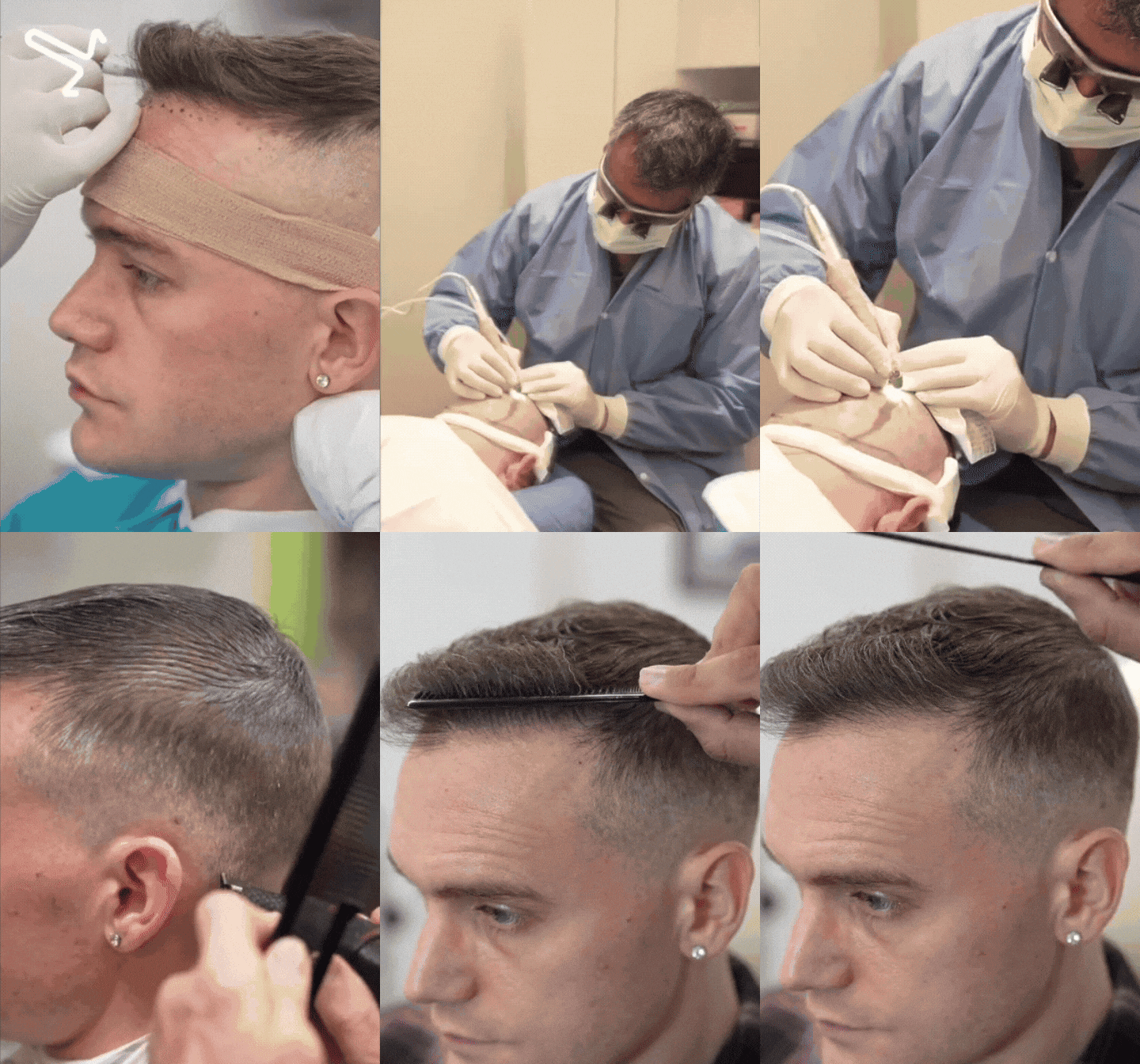
Micro PUE addresses this by using vibration and suction instead of blades and tweezers to gently collect hairs — a method formally described as Minimally Invasive Collection by Reticular Oscillation. The result is grafts that arrive healthier, more intact, and better equipped to grow.
In head-to-head comparisons conducted by Northwestern Hair’s physicians, Micro PUE caused 50% less injury to hair than traditional FUE. That’s not a marginal improvement — it’s a meaningful structural difference in what gets transplanted.
The Problem With Standard FUE That Most Clinics Don’t Talk About
 FUE is widely marketed as the gold standard of hair transplantation — and compared to older strip methods (FUT), it genuinely is a step forward. No linear scar, faster recovery, more natural-looking results.
But standard FUE still has a real limitation: the extraction method itself.
FUE hairs can end up dry, frizzy, kinked, or dead because FUE blades and tweezers can cut and crush vital structures during collection. The follicle might be technically alive at placement, but it’s been through enough mechanical trauma that its long-term survival and appearance are compromised.
This is why some patients who’ve had FUE elsewhere notice transplanted hairs that look slightly off — a different texture, unnatural direction, or density that doesn’t quite blend. It’s not always a placement problem. Often, it starts at extraction.
Micro PUE vs. FUE: Head-to-Head
| Factor | Standard FUE | Micro PUE |
| Extraction method | Rotating blades + tweezers | Vibration + suction |
| Graft injury rate | Higher | ~50% lower |
| Oil glands preserved | Often damaged | Better preserved |
| Hair texture post-transplant | Can appear dry, frizzy, kinked | Smoother, more natural |
| Grafts per session | Typically split across 2 days | 3,000–5,000 in a single session |
| 2-day procedure required | Often yes | No |
| Long-term graft survival | Variable | Higher |
| Density appearance | Can look like sprouts or mini plugs | Natural, blended density |
What Makes the Results Look More Natural?
Three things work together in Micro PUE to produce results that are harder to distinguish from native hair:
- Healthier grafts from the start. FUE hairs can look unnatural, and some may not survive the procedure. Micro PUE’s gentler extraction method means the hairs arriving at the recipient site are in significantly better condition — which directly affects how they look and behave once they grow.
- More natural hairline design. With healthier hair, hairlines look more natural and are easier to keep looking natural forever. Because fewer grafts are needed to achieve a given result, there are also more donor grafts preserved for future procedures if hair loss continues over time.
- Natural-looking density. High-density grafts in FUE can look like sprouts of grass or mini plugs. With micro-grafting, density is created in a way that looks natural. The difference is visible, and patients who’ve had standard FUE elsewhere before switching to Micro PUE consistently notice it.
One Session Instead of Two
One of the more practical advantages of Micro PUE is session efficiency. Because the technique is less traumatic to the scalp and to individual grafts, Northwestern Hair can perform 3,000–5,000 grafts in a single session — eliminating the need for the two-day procedures that standard FUE often requires.
Two-day FUE procedures aren’t just inconvenient. Splitting a large case across two days introduces additional stress on already-extracted grafts and on the donor area, which can have a compounding negative effect on overall outcomes. Micro PUE avoids that entirely.
Who Is Micro PUE Right For?
 Micro PUE is a strong option for most surgical hair restoration candidates, but it’s particularly well-suited for:
Patients who want the most natural possible result. If you’re particular about texture, density, and hairline appearance — and want transplanted hair that looks genuinely indistinguishable from native hair — Micro PUE’s graft quality advantage matters more to you than to someone with lower aesthetic expectations.
Patients who’ve had previous FUE with suboptimal results. If your existing transplant looks slightly off and you’re trying to understand why, graft injury during extraction is often a contributing factor. Micro PUE is frequently chosen by patients who’ve been through standard FUE once and want a better outcome the second time.
Patients concerned about future hair loss. Because Micro PUE achieves results with fewer grafts and causes less donor-area trauma, you’re preserving more of your long-term donor supply — important if your hair loss pattern is likely to progress.
Patients who want to complete treatment in one trip. The single-session capacity of Micro PUE means Chicago patients and those traveling from out of state don’t have to plan around a two-day surgical window.
Micro PUE at Northwestern Hair
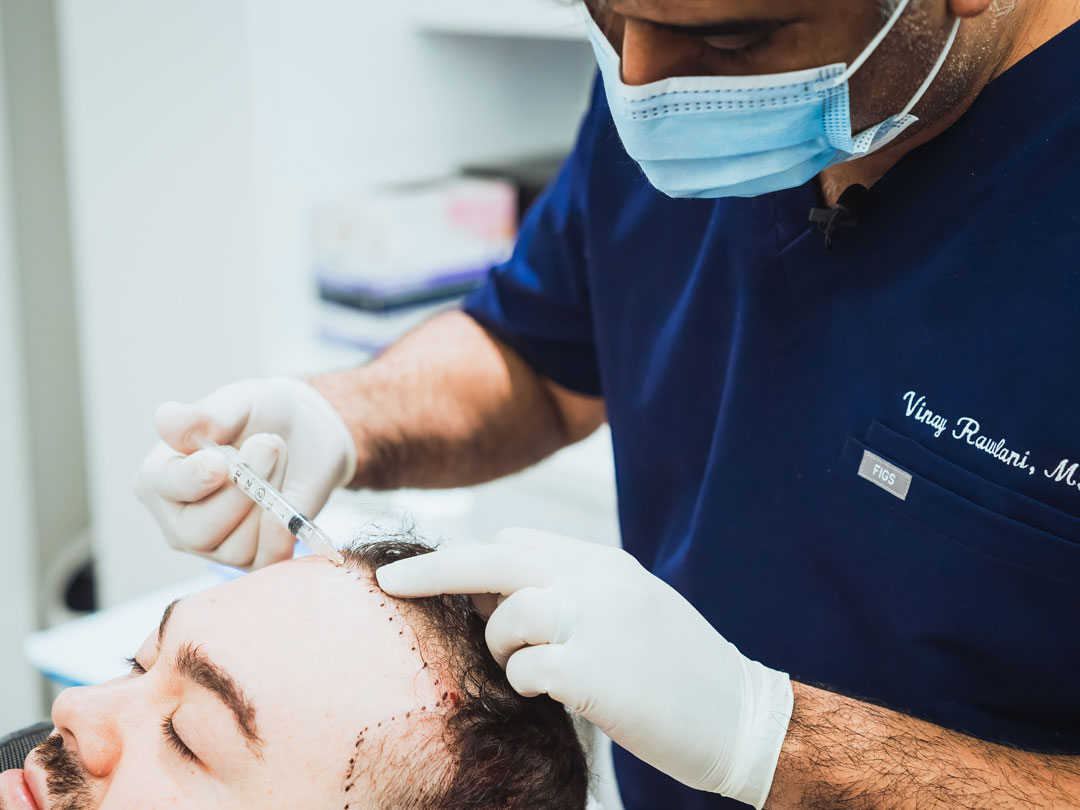
At Northwestern Hair, every Micro PUE procedure is performed personally by Dr. Vinay Rawlani, who trained at Northwestern and the University of Chicago and has undergone hair restoration himself — both surgical and non-surgical. That background informs how he approaches every case: with an understanding of what patients actually want to see in the mirror, not just what looks acceptable in a clinical photo.
Micro PUE is offered as part of Northwestern Hair’s full surgical menu alongside standard FUE and Discrete FUE. The right choice depends on your hair loss pattern, graft needs, donor area characteristics, and goals — all of which get evaluated in a consultation before any recommendation is made.
The Bottom Line
Standard FUE is a proven technique. But the extraction method it relies on has a real cost in graft health — and that cost shows up in the final result. Micro PUE solves that problem at the source, delivering healthier grafts, more natural outcomes, and more preserved donor supply, all in a single session.
If you’re evaluating hair transplant options in Chicago and want to understand whether Micro PUE is the right fit for your situation, the next step is a consultation with Dr. Vinay.