


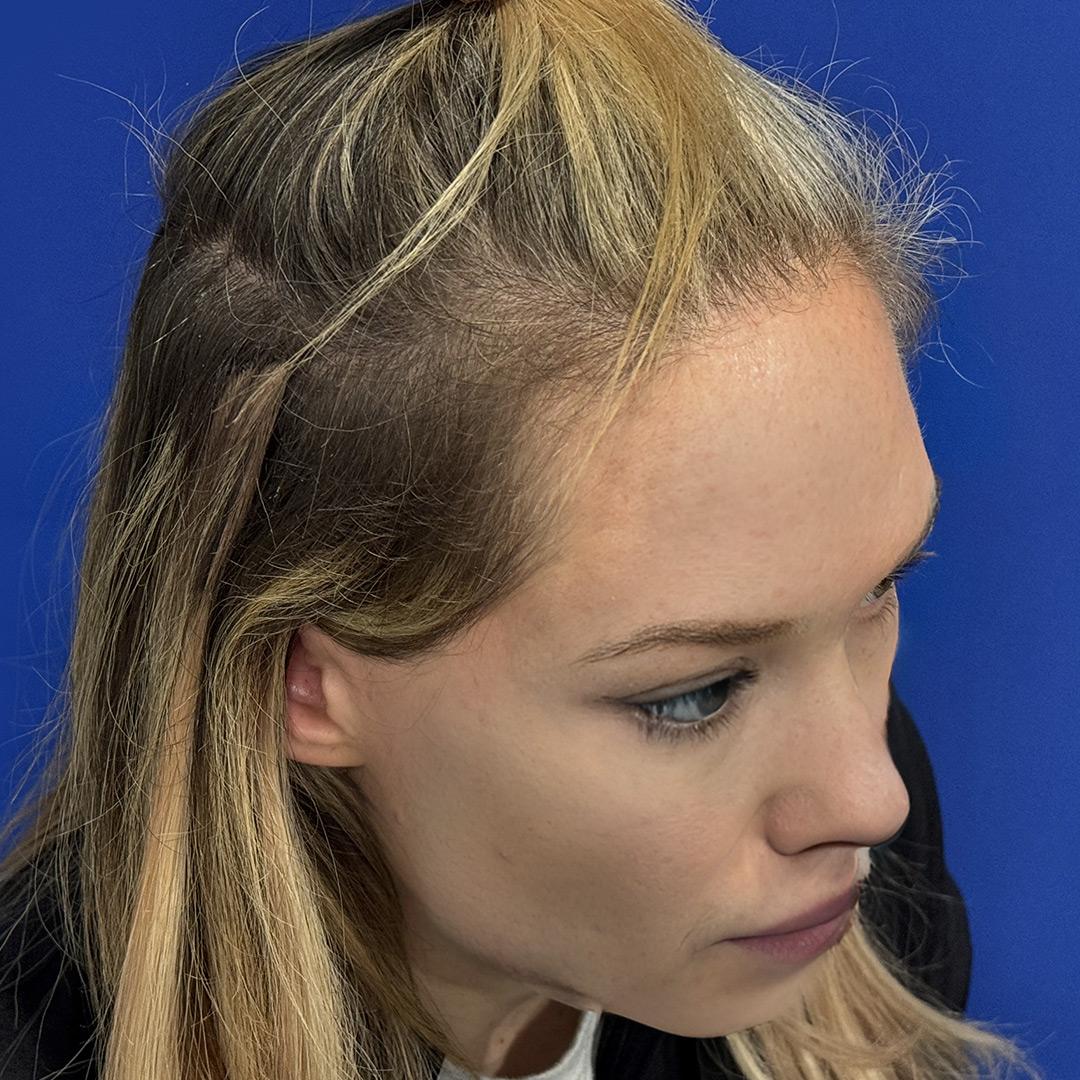
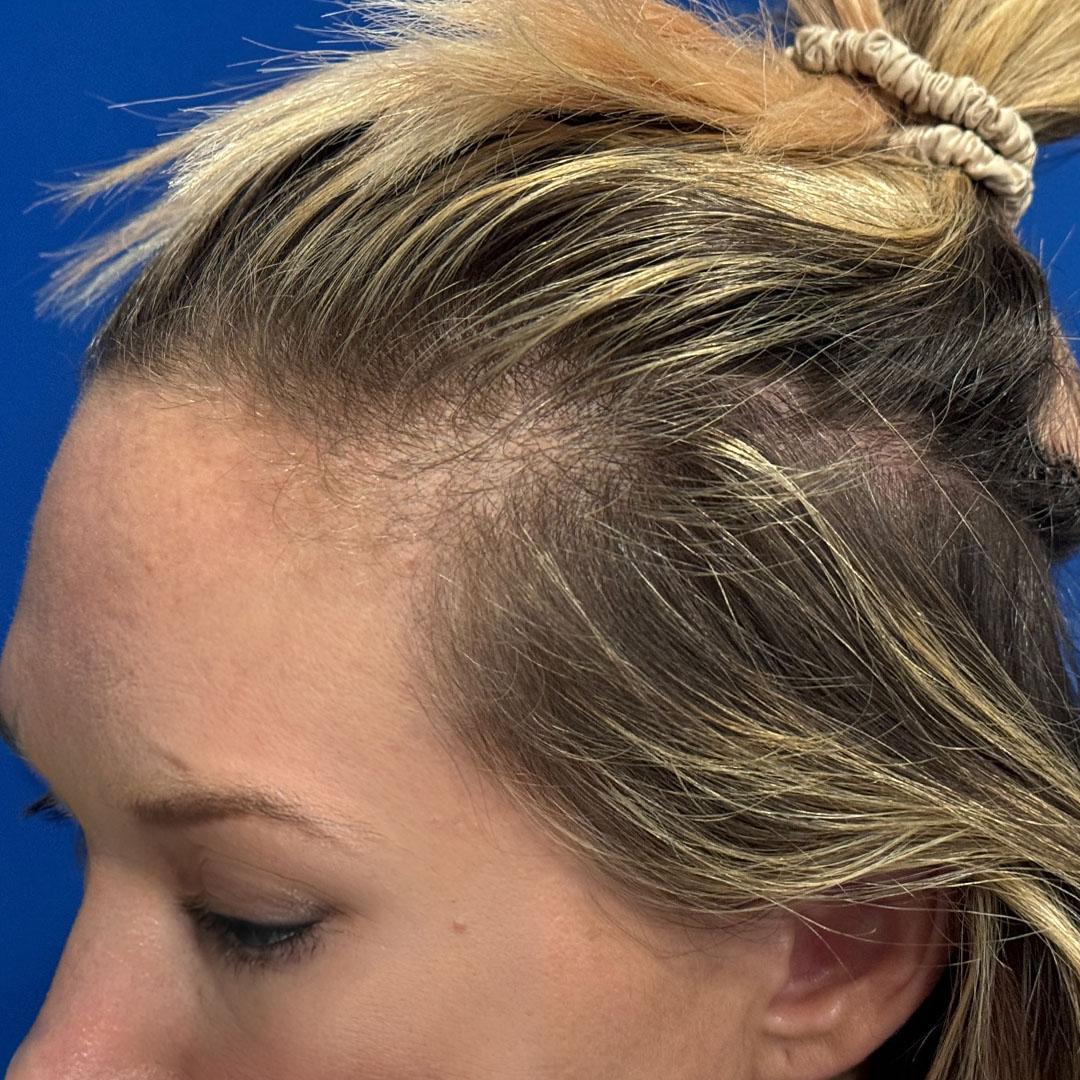
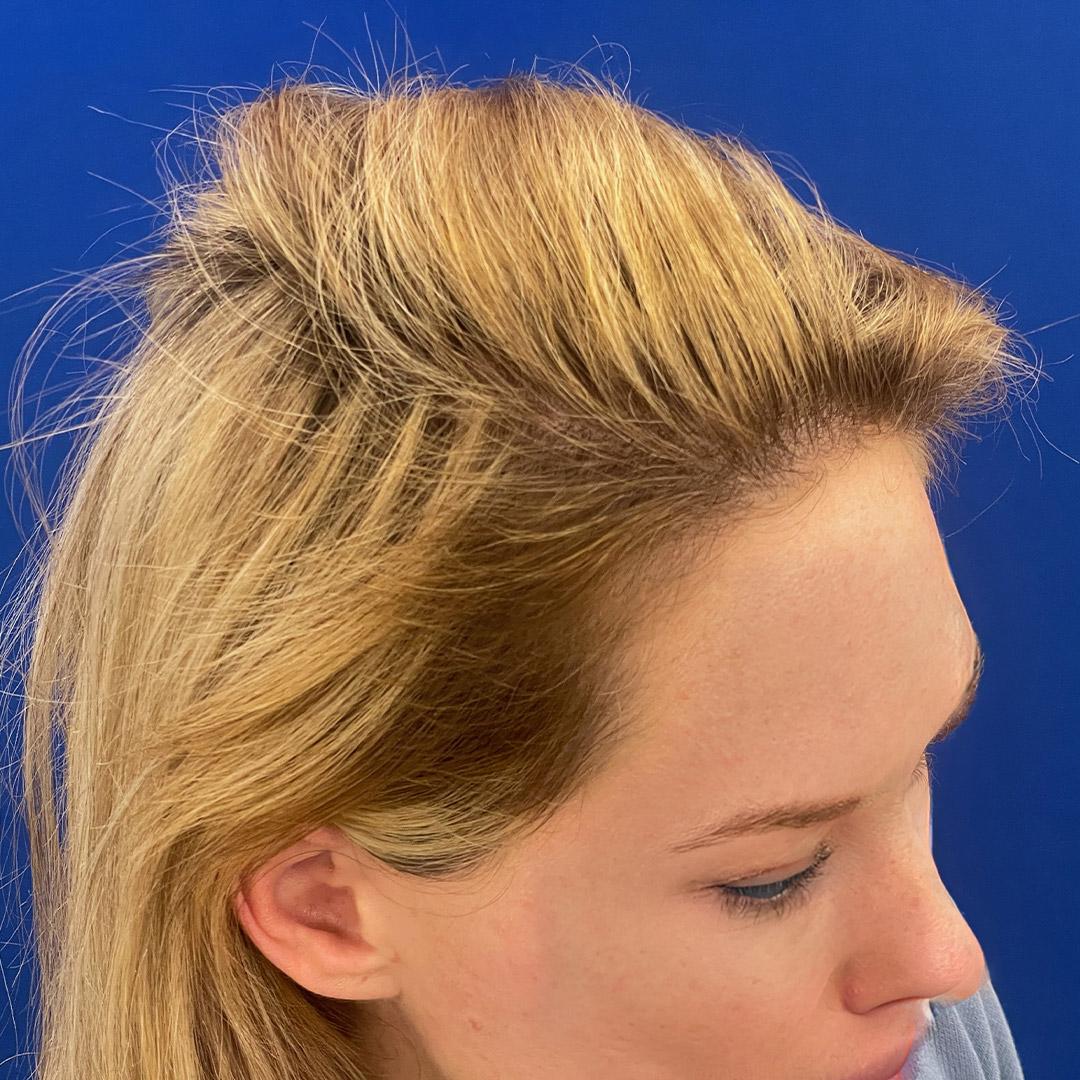
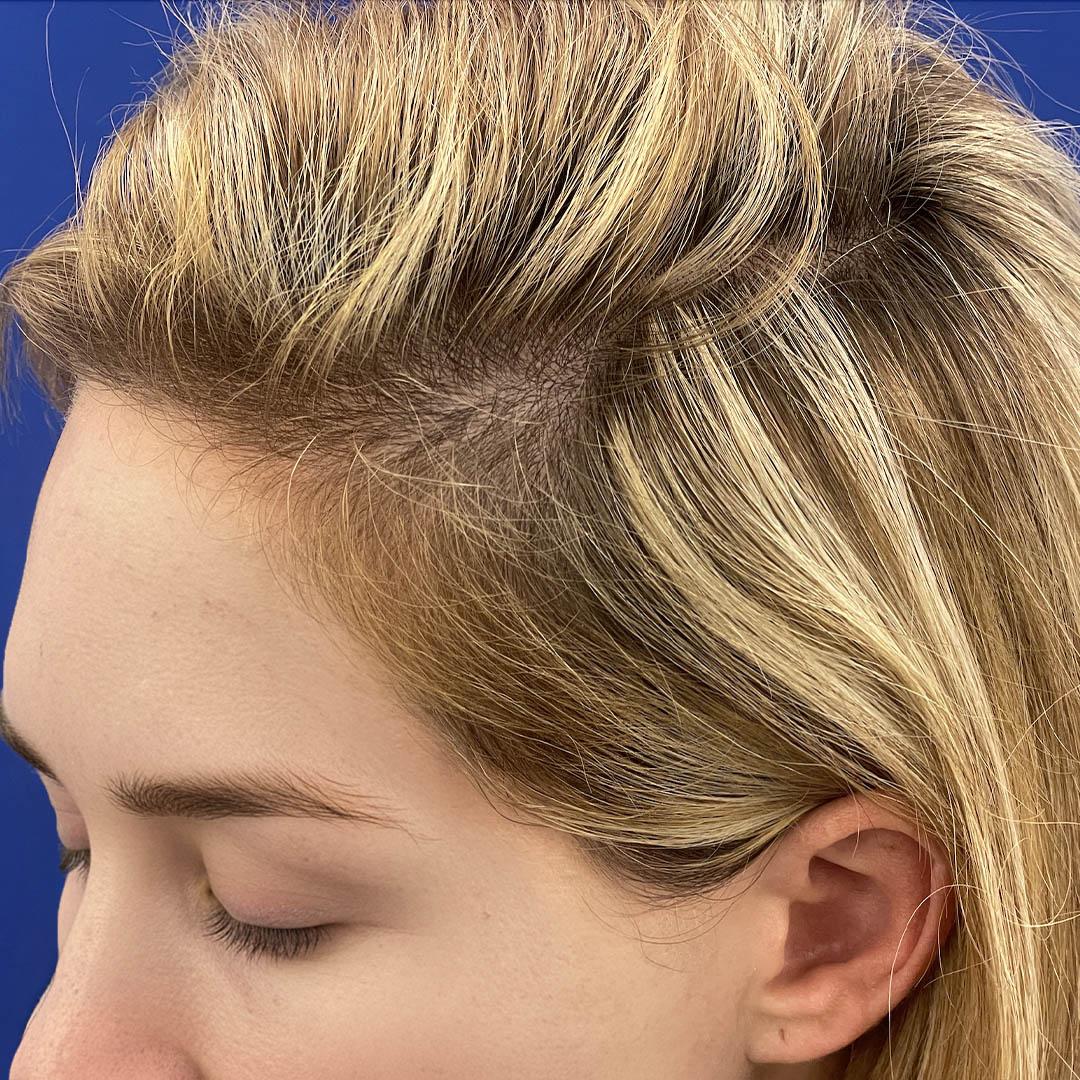
The first step is the same for every woman who walks through our door: find out why it’s happening before deciding what to do about it.
+200 reseñas
Hair loss in women rarely has one cause, and it rarely shows up as one clean pattern either — which is why treating it before understanding it produces poor results.
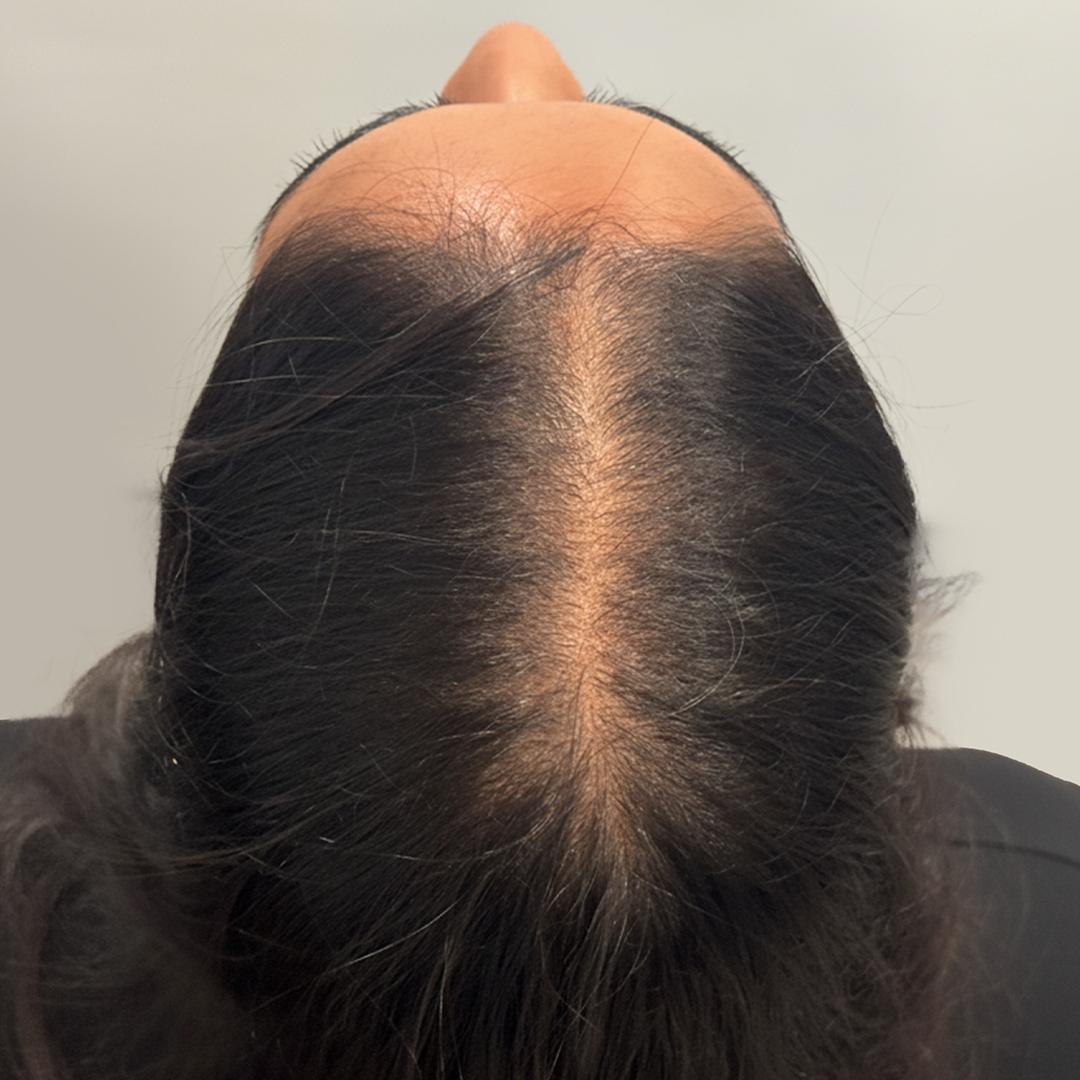
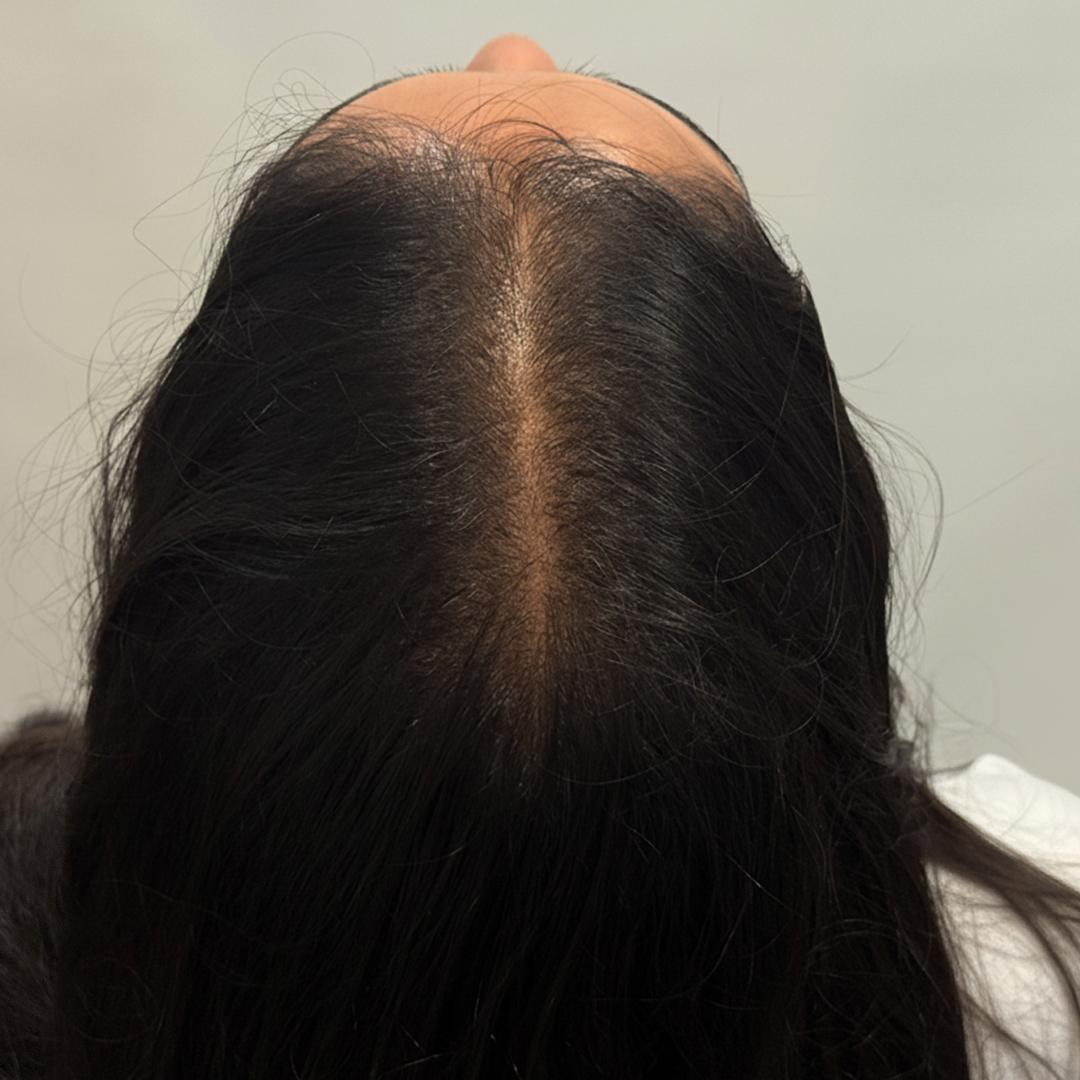
Men’s hair loss is overwhelmingly pattern baldness, driven by one hormonal pathway, and it shows up the same way in almost every case. Women’s hair loss branches — hormones, thyroid function, iron levels, inflammation, stress, or postpartum changes, sometimes several at once — and it can show up as a widening part, diffuse thinning, or a receding hairline, sometimes all in the same patient at different points.
That’s why the order of operations matters more here than almost anywhere else in hair restoration. A treatment chosen before a diagnosis is a guess, and a guess wastes the thing patients have the least of: time their hair loss isn’t waiting on.
We treat women with every type of hair loss, whether the cause is metabolic, hormonal, inflammatory, autoimmune or scarring. These are the six we see most often, and each one calls for a different plan.
Pérdida de cabello posparto
Menopausal Hair Loss
Pérdida de cabello nutricional o metabólica
Pérdida de cabello hormonal (alopecia androgenética)
Pérdida de cabello después de la quimioterapia
Pérdida de cabello relacionada con el estrés (efluvio telógeno)

Nuestros tratamientos en casa te dan acceso a los mismos medicamentos, dispositivos y experiencia que el Dr. Vinay utiliza en su programa completo, entregados como una rutina manejable que puedes seguir en tu propio horario.
Reúnase con el Dr. Vinay para discutir su historial de pérdida de cabello, estilo de vida y objetivos.
Podemos recomendarle análisis para obtener una imagen completa. Basándose en su consulta, el Dr. Vinay le receta una combinación de tratamientos —que incluyen medicamentos, dispositivos y suplementos— dirigidos a los mecanismos específicos que impulsan su pérdida de cabello.
La caída del cabello no es estática, y tu plan tampoco lo es. El Dr. Vinay supervisa tu progreso y ajusta tu plan según sea necesario.
Same four targets, opposite plans — becauseSome women need a surgical solution. Others get everything they need from ACS and a home regimen. A few are better served by a hair system while a non-surgical treatment does its work underneath. What fits depends on how far the loss has progressed and what’s driving it.the diagnosis is what decides.
Quirúrgico
Women with a stable donor area and a defined zone of loss: a widening part, a high or receding hairline, traction alopecia, or scarring from a past procedure. Diffuse or still-active loss usually needs to be stabilized first, which is why candidacy is decided at diagnosis.
Follicles are taken one at a time from the donor area and placed where density is needed, following the direction and angle of your natural hair so the part and hairline read as your own. Procedures are performed only at our Chicago flagship, and results mature over the following twelve months.
No quirúrgico
Women at almost any stage. ACS is organized into three plans: Maintain, for women who want to keep the hair they have; Restore, for women regrowing areas that have thinned; and Replace, for women pairing it with a transplant or a hair system.
ACS is prepared from a small sample of your own blood and applied to the scalp to do three things: block the inflammatory signals driving the loss, raise the metabolism of the follicle, and restore blood flow to it. Dr. Vinay was the first to bring it into hair restoration from orthopedic medicine.
No quirúrgico
Women whose diagnosis can be managed at home, women extending results between in-office treatments, and women who live too far to visit the clinic regularly.
After your consultation, Dr. Vinay prescribes a regimen built for your diagnosis and it’s shipped to your door. Follow-ups happen over Zoom with progress photos, so the plan changes when your results say it should.
No quirúrgico
Women whose scalp is part of the problem: flaking, buildup, inflammation, sensitivity or damage from styling and chemical services. Hair can’t grow well from a scalp that isn’t healthy.
Our trichologist, Debbie Ansay-Martinez, examines the scalp under magnification and treats it to restore its normal balance, at HairLab Chicago in Deerfield. When a skin condition is involved, Dr. Elizabeth Kiracofe is consulted.
No quirúrgico
Women with advanced loss, loss after chemotherapy or autoimmune conditions, or anyone who wants full coverage right away while another treatment works underneath.
A CRLAB CNC system is custom built to the shape of your head and matched to your color, density and part, then fitted by Chanel Kwak at HairLab Chicago. The base lets the scalp breathe, so ACS or scalp treatment can continue beneath it.
No quirúrgico
Women with a visible part, thin crown or scarring who want the appearance of more density, on its own or alongside a medical treatment or transplant.
Fine pigment is placed in the scalp to reduce the contrast between hair and skin, so thinning areas read as fuller. It’s performed by Sandra Salgado, our scalp micropigmentation specialist for women, and usually takes two to three sessions.
Plastic and reconstructive surgery is the specialty that heals wounds. That is what the training is.
I began practicing plastic surgery and grafting techniques in 2009, alongside the rest of a surgical practice. For the last five years my work has been entirely hair. The advances we made in transplantation and in non-surgical restoration were significant enough that it became the only thing we do.
I trained in plastic and reconstructive surgery at Northwestern University, where I was Chief Resident and the Louis E. Fazen Endowed Scholar of Medicine, and at the University of Chicago. I have performed over 10,000 procedures.
I have colleagues with real expertise in hair loss. What our particular training gave us was expertise in wound healing as a process, not as a complication to be managed. It is also why we are successful at grafting, since a transplant is a wound-healing problem before it is anything else.
That is what allowed me to bring ACS into hair restoration from orthopedic medicine, where it was developed to heal tendons, ligaments and cartilage, tissues where blood supply is poor and healing is slow. A thinning follicle has the same problem. I was the first to use it for hair, and we have continued to develop it since.
Dr. Vinay refers into a team he works with directly. These aren’t names on a directory. They’re the people your care is handed to when your diagnosis calls for them, and he stays involved when it is.
Trichologist and hair replacement expert, founder of HairLab Chicago. Scalp and hair care, and the non-medical side of hair loss — a category that does not require a prescription but does require proper treatment and restoration of scalp homeostasis.
Functional health physician. Hormone replacement therapy for hormonal causes of hair loss, and the broader metabolic and hormonal picture that patterned loss sits inside.
Dermatologist, consulted on cases where a condition of the skin is affecting the hair, and where specialty medication rather than hair loss treatment is what the scalp requires.
Many women come to us after seeing several providers and sitting through free consultations that ended without a real answer.
If you want a doctor focused on results, there’s value in time with that doctor one-on-one. Here’s what your consultation covers:
We diagnose conditions
We prescribe treatments.
We refer to other professionals.
We do the follow-ups.
Treatment pricing depends on your plan, and you’ll have it in writing at your consultation. Hair systems vary with size, length and degree of customization.
Consulta
$100 for a 30 to 45 minute consultation with Dr. Vinay, in person or over Zoom, applied toward your treatment if you proceed.
Payment plans
Available through Cherry and PatientFi, with flexible monthly options and no-interest financing for qualified patients.
Insurance
Some plans reimburse for medical hair prostheses. Where yours does, you pay directly and submit the invoice to your insurer.
Because this program sits inside a physician practice, we can provide the cranial prosthesis prescription and documentation your insurer requires, which a salon can’t do on its own. We’ll also tell you honestly when your policy is unlikely to cover it.
Todas. Alopecia androgénica en hombres y mujeres, efluvio telógeno, alopecia posparto, alopecia menopáusica, alopecia por tracción, alopecias cicatriciales y pérdida de cabello causada por afecciones o tratamientos médicos. El primer paso es siempre el diagnóstico, porque el tratamiento correcto depende de lo que realmente está causando la pérdida.
Un historial médico detallado, examen del cuero cabelludo, prueba de tracción del cabello, tricoscopia bajo magnificación y análisis de sangre cuando esté indicado. Estamos trabajando para identificar la causa subyacente, no solo los síntomas superficiales. El plan de tratamiento sigue al diagnóstico, no al revés.
Sí. Cada consulta de pago en Northwestern Hair es realizada personalmente por el Dr. Vinay.
Antes de reservar una cita con él, los pacientes también pueden hablar de forma gratuita con miembros de nuestro equipo para hacer preguntas iniciales y decidir si una consulta formal es el siguiente paso adecuado. Las consultas previas gratuitas están disponibles en inglés, español y chino.
Cuando un paciente consulta con el Dr. Vinay en español o chino, un miembro del equipo que habla idiomas extranjeros se une a la conversación para traducir, por lo que el idioma nunca es una barrera.
Una evaluación médica real, no una reunión de ventas. El Dr. Vinay revisa su historial, examina su cuero cabelludo y cabello, realiza pruebas de diagnóstico según sea necesario y le da una opinión honesta sobre sus opciones, incluido cuándo la mejor respuesta es esperar o no hacer nada en absoluto.
Una consulta formal con el Dr. Vinay es de pago y reserva su tiempo específicamente para usted. Dura entre 30 y 45 minutos y puede ser aplicada a su tratamiento si decide continuar.
Para los pacientes que aún no estén listos para ese paso, puede hablar con un miembro de nuestro equipo —incluyendo miembros del equipo que hablan español o chino— para que respondan sus preguntas primero.
Sí. Trabajamos con PatientFi y Cherry para ofrecer opciones de financiación a tasas competitivas, incluida la financiación sin intereses para pacientes calificados. Te guiaremos sobre lo que tiene sentido en la consulta.
Si estás perdiendo cabello, eres candidato a una evaluación. La candidatura para un tratamiento específico depende de tu patrón de pérdida, tu área donante, la condición de tu cuero cabelludo, tu edad, tu historial médico y tus objetivos, que es para lo que es la consulta. Tratamos todo el espectro de la pérdida de cabello, y la mayoría de los pacientes se van con un plan incluso cuando la cirugía no es parte de él.
Solo con consentimiento por escrito, otorgado de forma específica y para cada uso. El consentimiento general no es algo que solicitemos ni que aceptemos.
Podríamos pedir a los pacientes que compartan sus fotos con fines educativos, ya que la educación del paciente es parte de cómo opera esta práctica. Los pacientes que eligen participar reciben importantes ahorros de costos a través de Northwestern Hair Studio.
El Dr. Vinay comenzó a ejercer en Chicago en 2009. Es un médico certificado con formación en cirugía plástica, dermatología y restauración capilar, y ha realizado más de 5.000 procedimientos hasta la fecha. En 2019, la consulta se dedicó exclusivamente a la pérdida y restauración capilar.
Nuestra sede principal está en 3 East Huron, en el corazón de Streeterville en Chicago. También operamos oficinas satélite en el condado de Lake, en la North Shore y en los suburbios del oeste. Las cuatro ubicaciones ofrecen consultas y tratamientos no quirúrgicos. Los trasplantes de cabello se realizan únicamente en la sede principal de Chicago.
Llame al (312) 668-8222, envíenos un mensaje de texto o reserve en línea. La mayoría de las consultas reciben una respuesta el mismo día.