


Unshaven Hair Transplants: Can You Get Micro PUE Without Shaving Your Head?
For a certain kind of patient, the surgery isn’t the obstacle. The haircut is.
We hear it constantly at our Chicago clinic, usually from attorneys, executives, physicians, salespeople — anyone whose week is a rotation of client meetings, court appearances, and video calls: “I’m ready to do this. But I cannot show up Monday with a shaved head. Everyone will know.”
It’s a legitimate concern, and it’s kept more people from treating their hair loss than almost any medical factor. A suddenly buzzed head on a 45-year-old partner at a Loop law firm isn’t a haircut — it’s an announcement. So the question deserves a real answer: can you get a transplant without shaving your head?
Yes — with the right technique, the right case, and honest expectations about the trade-offs. Here’s how unshaven transplantation actually works, and who it genuinely fits. Contact Northwestern Hair Restoration today for more information.
Why Clinics Shave Heads in the First Place
The full shave exists for the clinic’s convenience as much as the patient’s outcome. A shaved scalp makes everything faster: the donor area is fully visible for rapid extraction, the recipient area is unobstructed for placement, and nothing interferes with speed. For a high-volume operation running multiple patients a day — the model we’ve critiqued throughout this series — shaving everyone is simply the efficient default.
But “efficient for the clinic” and “necessary for the result” are different claims. What extraction actually requires is access to the follicles being harvested — not a bare head. What placement requires is visibility of the recipient sites — not a cleared field. Both can be achieved without a full shave. It just takes considerably more time, care, and skill per graft, which is exactly why volume clinics rarely offer it.
The Unshaven Options, From Least to Most Concealed
“Unshaven” is really a spectrum of techniques, and the right point on it depends on your hair, your loss pattern, and your calendar.
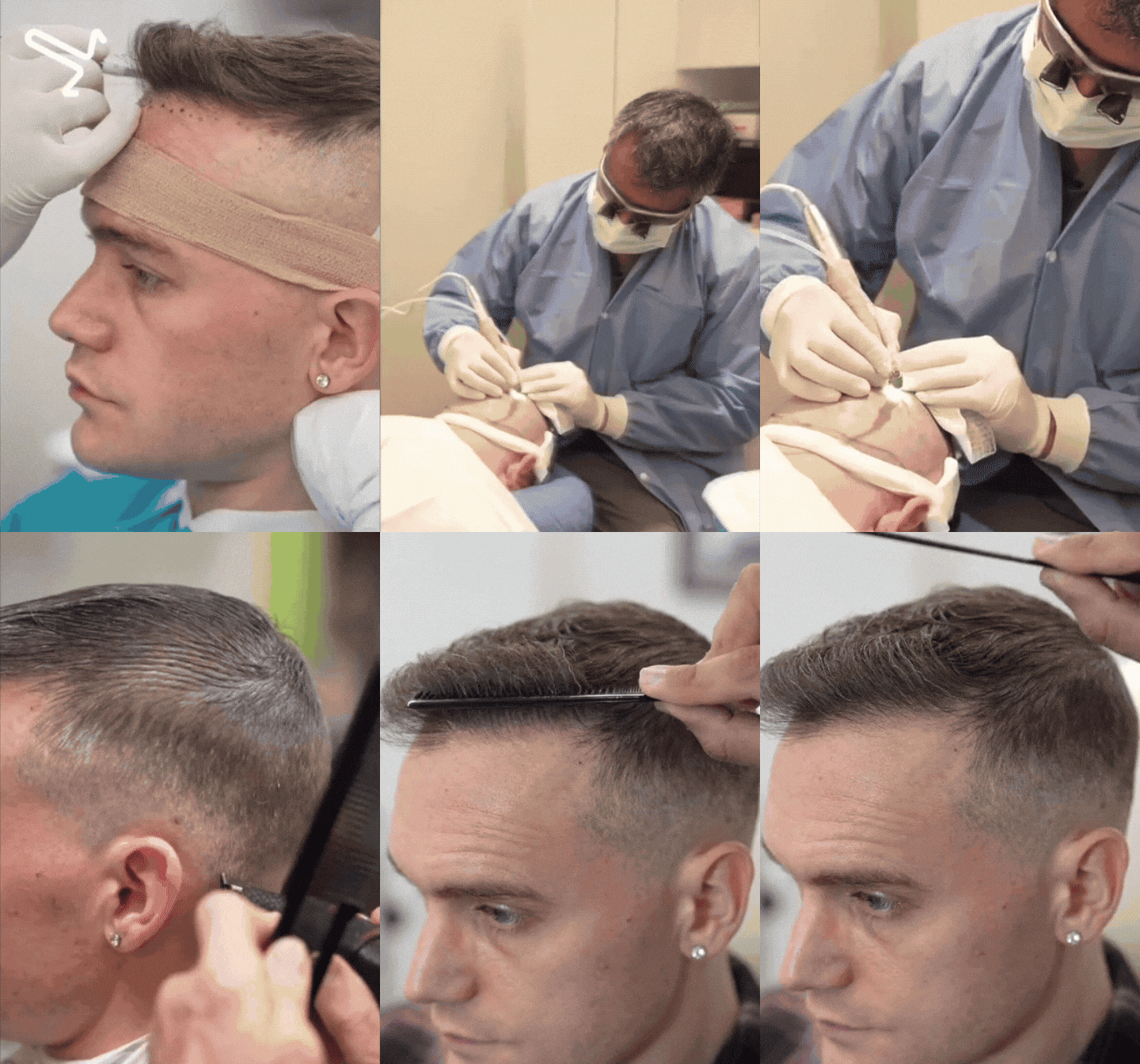
- The hidden shave (partial shave). The workhorse of discreet transplantation, and the option most patients actually choose. We shave only narrow horizontal strips within the donor zone at the back and sides — and leave the hair above them at full length. Comb the surrounding hair down and the shaved strips disappear completely underneath. If you wear your hair at even a modest length in the back, nobody sees anything: not the extraction sites, not the healing, nothing. The recipient area up top is worked between your existing hair without shaving it.
- Fully unshaven FUE (U-FUE). No shaving anywhere. Each donor follicle is individually trimmed with fine scissors at the moment of extraction — hair by hair — while every surrounding hair stays long. This is the maximum-discretion option and the maximum-labor option: extraction slows dramatically, sessions run longer, and per-session graft counts drop meaningfully. It’s the right call for a narrow set of cases — very short-notice visibility requirements, patients who wear their hair too short in back to hide even a partial shave strip, and smaller procedures like the hairline refinements and facial work we’ve discussed.
- Long-hair preview transplantation. A more specialized variant where grafts are extracted and placed with the hair shaft left long — giving the patient an immediate preview of the eventual result on day one. The long shafts still shed in the usual weeks-two-to-six shedding phase we’ve described before (the follicle stays; the shaft goes), so the preview is temporary — but for some patients, walking out with a visible result, even a temporary one, is worth a great deal.
The common thread: your existing hair becomes the camouflage. This is the part patients don’t anticipate — in an unshaven procedure, the hair you still have doesn’t just survive the process, it actively hides it. Existing hair covers the donor strips, screens the recipient-area redness and crusting, and lets the tiny scabs resolve in private.
The Honest Trade-Offs
 We’d be doing exactly what we’ve criticized other clinics for if we sold this as all upside. Unshaven work has real constraints:
Session size is smaller. Working between existing hairs — extracting without a cleared field, placing without a bare canvas — is slower per graft. A case that might be one long session shaved may become a somewhat smaller session, or two staged sessions, unshaven. For hairline restoration, temple work, crown fills, and moderate cases, this is rarely a limitation. For very large cases — major Norwood 5–6 restorations needing maximum graft numbers — the full or partial shave genuinely serves the patient better, and we’ll say so in consultation.
It demands more of the surgical team, not less. Trimming individual follicles, navigating existing hair, maintaining angles amid a full head of native hair — every step amplifies the skill component. This is precisely the environment where the Micro PUE approach — smaller punches, gentler handling, unhurried single-patient focus — stops being a preference and becomes a prerequisite. An unshaven procedure at a rushed clinic is how existing native hair gets transected and damaged in the process, costing you hair you came in with.
Cost reflects time. More surgical hours per graft are sometimes reflected in pricing — a fair thing to ask about directly in consultation, and a far better use of the price conversation than the package-deal math we broke down in the Chicago cost guide.
Aftercare requires more attention, not less. Existing hair over healing grafts means washing carefully around them, and the early-days care rules — the sleeping position, the no-touching discipline, the timeline from our what-not-to-do and grafts-becoming-secure posts — all still apply. The procedure is invisible to your colleagues; it is not invisible to you.
The Real Discretion Timeline
Here’s the question under the question — because “unshaven” is a means, and the actual goal is nobody at work knows. So let’s answer that goal directly with the realistic visibility timeline for a partial-shave or unshaven Micro PUE case with medium-length hair:
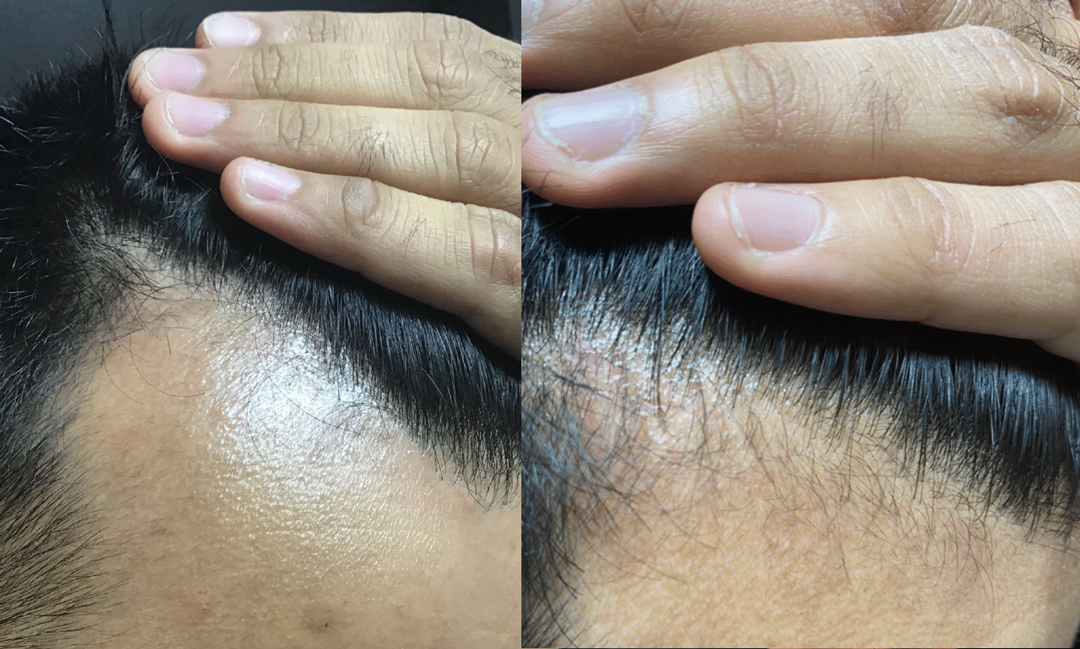
Days 1–3: Some redness and micro-crusting in the recipient area, screened substantially by existing hair. Swelling, if it appears, peaks around days 3–5 at the forehead. You would not want an important in-person meeting here.
Days 4–7: Crusting resolving, existing hair covering most evidence. Video calls are generally comfortable — camera resolution is your friend. In-person scrutiny at close range might still notice something if someone stared at your hairline.
Days 7–10: For most unshaven patients, functionally undetectable in ordinary interaction. This is why the standard playbook for our corporate patients is a Thursday or Friday procedure with a week of remote work — a plan we outlined in our post on discretion and downtime for Chicago professionals.
Weeks 2–6: The transplanted shafts shed (expected, alarming, normal), and your appearance simply returns to your pre-procedure baseline — which, remember, nobody was scrutinizing. The regrowth that follows arrives so gradually over months 4 through 12 that colleagues register it the way people register a good fitness program: he looks better lately, with no single moment to point to.
That last dynamic is the quiet genius of transplant timelines for discretion-minded patients: the result arrives too slowly to be an event. The only detectable moment is the first two weeks — and unshaven technique plus one remote week erases it.
Who’s a Good Candidate for Unshaven Micro PUE
- The fit is strongest for:
- Hairline, temple, and frontal-third restoration — the moderate-graft-count zone where unshaven technique gives up nothing
- Crown fills, and density work behind existing coverage
- Patients with enough existing length — roughly an inch-plus in the donor area hides a partial shave; longer hides everything
- Professionals with visibility constraints — the entire audience of this post
- Women — worth underlining, because this barrier lands hardest on female patients. Shaving is a near-absolute non-starter in women’s restoration, which is why unshaven and partial-shave technique isn’t a premium add-on in our Women’s Program; it’s the default. The Micro PUE recovery expectations we outlined for women assume it.
- Facial work — the beard and eyebrow cases from earlier in this series are inherently no-shave-required on the recipient side
The honest poor fits: very advanced loss needing maximum-session graft counts, donor hair worn too short to conceal anything (though at that length, post-shave regrowth is fast anyway), and patients whose priority is minimizing session count above all else.
The Bottom Line
You do not have to shave your head for a hair transplant. Between partial hidden shaves, fully unshaven extraction, and long-hair techniques, a skilled surgeon can restore your hairline while your existing hair conceals the entire process — at the cost of longer, more meticulous sessions and, for very large cases, some honest limits. For the hairline and frontal work that brings most professionals through our door, the trade-off is barely a trade-off at all: the discretion is near-total, and the result gives up nothing.
The real requirement isn’t a technique on a menu. It’s a practice built for it — unhurried, physician-performed, one patient at a time — because unshaven work punishes exactly the shortcuts that volume clinics depend on.
If a shaved head is the thing that’s kept you from treating your hair loss, schedule a consultation at Northwestern Hair in Chicago. Dr. Rawlani will assess your donor area, your hair length, and your calendar — and design a procedure your colleagues will never see, attached to a result they’ll eventually envy.