



Hair Restoration for Black Men and Women: What You Need to Know About Ethnic Hair Transplants in Chicago
Hair restoration for Black patients is one of the most technically demanding areas of hair transplant surgery — and one of the most underserved in terms of specialized expertise. The biological characteristics of tightly coiled hair create real challenges at every stage of the transplant process: extraction, graft handling, placement, and design. When those characteristics aren’t understood and accounted for, the results can range from underwhelming to genuinely damaging.
At the same time, when the technique is right and the surgeon has genuine experience with African American and Afro-textured hair, hair restoration can be profoundly transformative — for men managing hairline recession, crown thinning, or traction-related loss, and for women dealing with the hair loss patterns that affect Black women at disproportionately high rates.
This post covers what makes ethnic hair restoration for Black patients different, what the most common hair loss patterns look like, what to evaluate in any Chicago provider, and how Northwestern Hair approaches these cases. Contact Northwestern Hair Restoration today for more information.
Why Afro-Textured Hair Requires Specialized Technique
The starting point for understanding ethnic hair transplantation is understanding what makes Afro-textured hair structurally distinct — not as a disadvantage, but as a set of characteristics that demand a different technical approach.
Follicular curl beneath the surface. This is the most consequential characteristic for surgical purposes. While the coil in Afro-textured hair is visible above the scalp, the curl actually begins below the skin — meaning the follicle itself is curved, not straight. Standard FUE punch tools are designed with straight-follicle geometry in mind. When a straight rotating punch is used to extract a curved follicle, the risk of transection — cutting through the follicle rather than cleanly around it — is significantly higher than it is for straight hair types. Transected grafts don’t grow. High transection rates mean lower graft survival, fewer growing hairs, and results that don’t match what was planned.
Hair shaft geometry. Afro-textured hair has an elliptical cross-section rather than the round cross-section of straight hair. This affects how the hair behaves mechanically during extraction and how it interacts with standard punch tooling — another reason why technique adaptation is essential rather than optional.
Natural density advantages. On the positive side, the tight curl pattern of Afro-textured hair means individual hairs cover more visual surface area per strand than straight hair does. A properly executed transplant with Afro-textured hair can achieve impressive apparent density with a smaller graft count than would be needed for straight hair — when the extraction and placement are calibrated correctly.
Scalp characteristics. Black patients frequently have scalps with higher melanin concentration and different elasticity characteristics than lighter-skinned patients, which affects both extraction mechanics and how the scalp heals around recipient sites. Surgeons without specific experience in these differences may apply standard protocols that don’t account for them.
The Extraction Challenge — and Why It Matters More Here
 The transection risk with Afro-textured hair is the central technical challenge of Black hair transplantation, and it’s where most of the quality gap between experienced and inexperienced providers shows up.
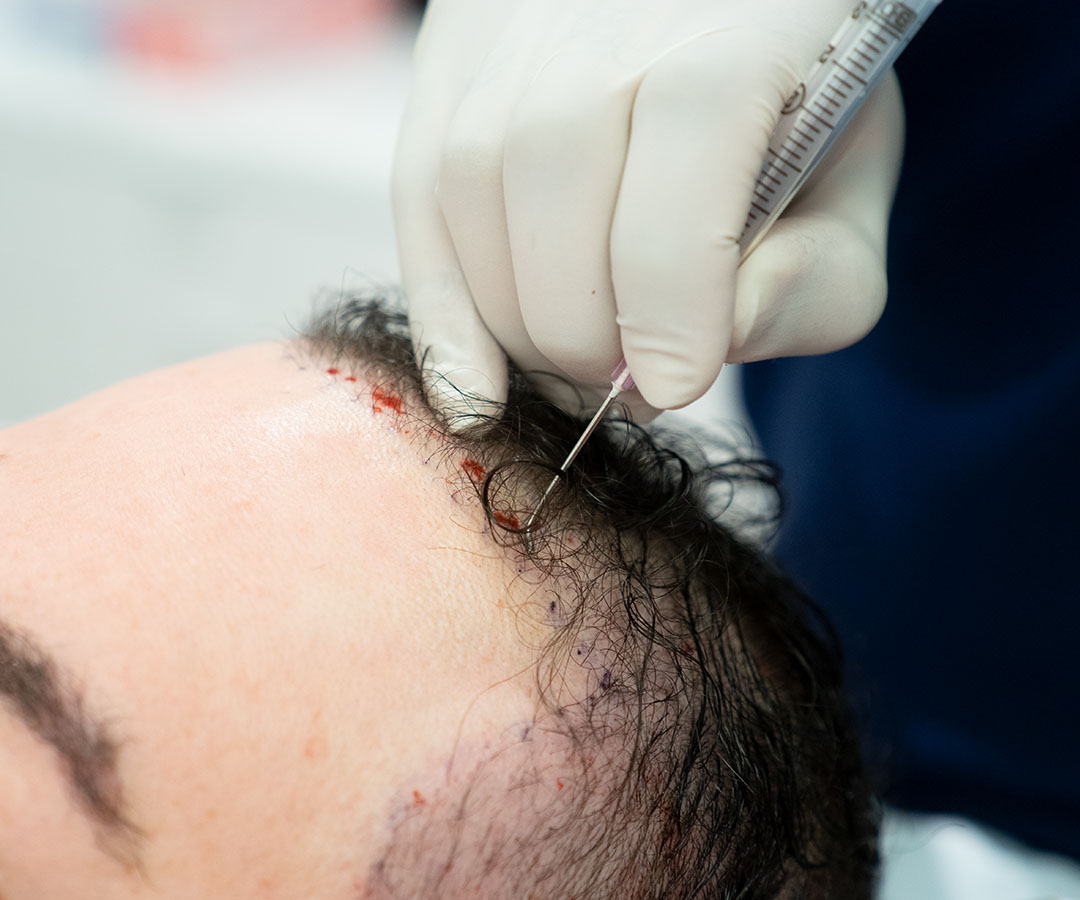
In standard FUE, rotating punches and tweezers can crush grafts and sever key structures during extraction. For straight-hair patients, this causes graft damage that reduces quality and naturalness. For patients with tightly coiled hair, the same tools applied without adaptation cause transection — physical cutting of the follicle — at rates that can compromise a meaningful percentage of the total graft count before those grafts ever reach the recipient site.
The solution isn’t simply using a smaller punch, though punch selection matters. It’s an extraction approach that accounts for the below-surface curl geometry of Afro-textured follicles — adjusting the angle, depth, and mechanical action of extraction to follow the follicle’s actual path rather than assuming a straight line.
No-Touch Micro PUE® uses vibration and suction rather than sharp rotating punches and physical graft gripping — a gentler extraction mechanism that reduces the mechanical forces that cause both transection and graft crushing. Combined with the surgeon’s understanding of Afro-textured follicular geometry, this approach produces meaningfully better graft quality and survival than standard FUE applied without adaptation.
The stakes here are high in a specific way: a high transection rate doesn’t just reduce the number of surviving grafts — it permanently depletes your donor supply. Follicles that are transected are gone. Patients who’ve had a poorly executed first procedure with high transection rates have less to work with in any future procedure, which is why choosing the right surgeon from the start matters more for Afro-textured hair than for almost any other hair type.
Hair Loss Patterns in Black Men and Women
Hair loss in Black patients often presents differently than in white patients — both in pattern and in cause — and treatment planning needs to reflect those differences.
For Black men, androgenetic alopecia (pattern hair loss) is common and presents similarly to other male pattern baldness, though hairline recession patterns and the rate and distribution of loss can vary. The hairline in Black men typically sits higher and has different temporal characteristics than European hairlines, and any restoration design needs to account for those proportional norms rather than apply a universal template.
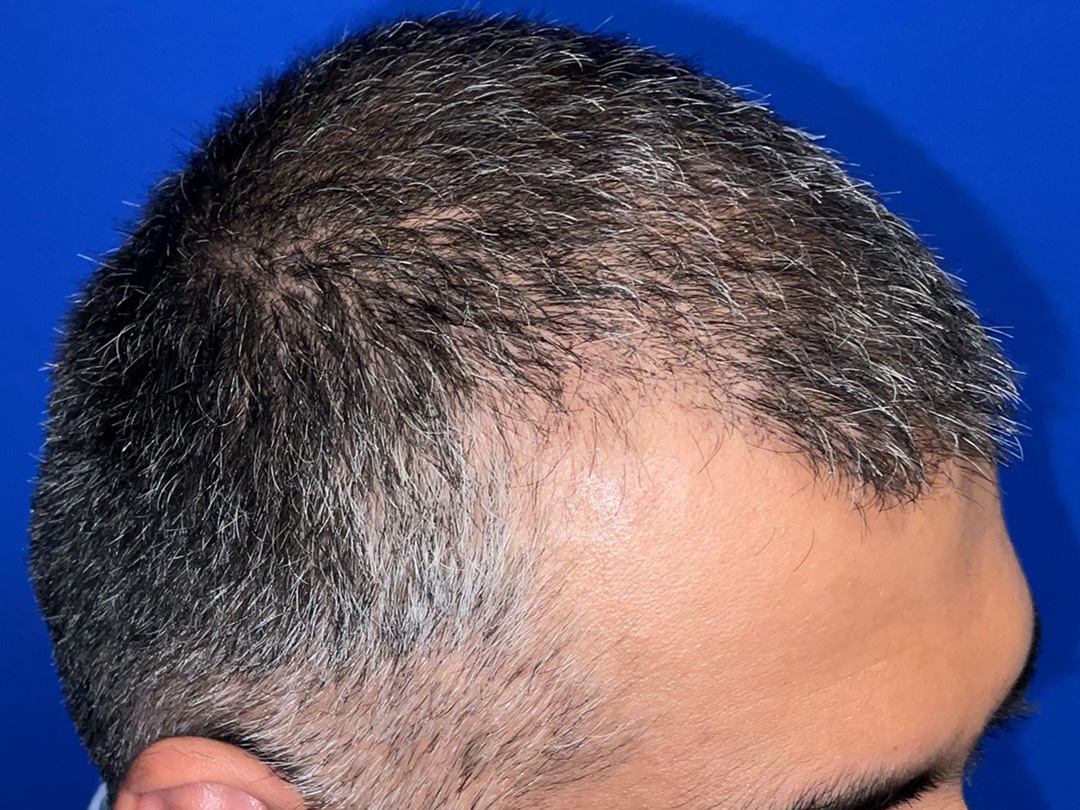
A specific and underdiagnosed condition in Black men is Central Centrifugal Cicatricial Alopecia (CCCA) — a scarring alopecia that begins at the crown and spreads outward. CCCA is not a candidate for hair transplant surgery in active phases; the inflammatory process that drives it must be controlled before any surgical intervention can be considered. An experienced provider evaluates for this at consultation rather than proceeding to surgery on a scalp that isn’t ready.
For Black women, hair loss has a broader range of causes than is typically recognized:
Traction alopecia is one of the most common and most treatable forms of hair loss in Black women — caused by prolonged tension from tight braids, weaves, extensions, cornrows, and similar styles. When caught early, traction alopecia can recover with lifestyle modification and non-surgical treatment. When the follicle has been permanently damaged by chronic tension, hair transplant surgery can restore the lost hairline and temporal density.
CCCA affects Black women at significant rates — studies suggest it may be the most common form of scarring alopecia in Black women — and frequently goes undiagnosed for years. Again, active CCCA requires medical management before surgery is appropriate.
Androgenetic alopecia in Black women tends to present as diffuse thinning across the crown rather than the defined hairline recession seen in men and can be addressed through both surgical and non-surgical approaches depending on severity.
Chemical and heat damage can cause follicular scarring and permanent hair loss in areas of repeated traumatic styling — an area where the intersection of cultural hair care practices and follicular biology requires a provider who understands both.
Hairline Design for Black Patients: Cultural Competency Matters
 Beyond the technical extraction challenges, hairline design for Black patients requires an aesthetic sensibility that goes beyond the European hairline templates that dominate most hair transplant training and before/after imagery.
Natural hairline characteristics vary significantly across ethnicities — in height, shape, temple definition, and the way the hairline interacts with facial proportions. A hairline that looks natural on a white patient may look plainly wrong on a Black patient, not because it was executed poorly, but because it was designed to the wrong template.
Northwestern Hair’s design approach centers on four dimensions: three-dimensional shape, proportions, angles, and flow — all calibrated to the individual patient’s face — and a fourth dimension of time, designing a hairline that will evolve naturally as the patient ages.
For Black patients specifically, this means designing to the actual proportional norms of Black facial structure, accounting for the coverage characteristics of Afro-textured hair, and building a hairline that looks natural not just in a clinic photo but in daily life — in natural light, in motion, and over the long arc of continued natural aging.
The final hairline is hand-drawn artistry that brings life and emotion to the result. That artistic calibration is only meaningful if it’s informed by genuine experience with the patient’s hair type and facial structure — not a one-size-fits-all template applied regardless of ethnicity.
Non-Surgical Options for Black Patients
Not every Black patient presenting with hair loss is a surgical candidate — and in many cases, non-surgical intervention is the more appropriate first step.
Autologous Conditioned Serum (ACS) uses the body’s natural healing factors to reactivate dormant follicles — stimulating hair and skin cells to replicate and grow, targeting the root causes of hair loss for results that go beyond what traditional platelet therapies deliver.
For Black women with early-stage traction alopecia, diffuse thinning, or CCCA in a managed phase, ACS can produce meaningful improvement in density and follicular health without surgery. For Black men with early pattern loss who aren’t ready for or interested in surgical intervention, ACS represents a legitimate pathway to preserving and improving what they have.
The right recommendation — surgical or non-surgical — depends on what’s actually driving the loss, the current state of the follicles in affected areas, and what the patient’s goals realistically require. That evaluation happens at consultation, not before it.
What to Look for in a Chicago Provider
For Black patients evaluating hair restoration options in Chicago, a few questions separate providers with genuine expertise from those applying generic protocols:
Can you see before/after results specifically from Black patients? A provider with real experience treating Afro-textured hair will have a gallery that reflects it. If every result in the gallery has straight or wavy hair, that’s informative.
What is their transaction rate with Afro-textured hair? Not every provider tracks or discloses this, but asking the question reveals whether they’ve thought seriously about the extraction challenge that defines Black hair transplant surgery. A thoughtful answer demonstrates engagement with the problem. A blank stare or deflection does too.
How do they handle the sub-surface follicular curl during extraction? The answer should demonstrate specific understanding of Afro-textured follicular geometry — not just a general description of their punch tools.
Do they evaluate for scarring alopecias like CCCA before recommending surgery? This is a baseline competency question. A provider who proceeds to surgical planning without ruling out active scarring alopecia is not equipped to treat Black patients safely.
How is the hairline designed for your specific facial structure? The answer should be individualized to you — your forehead proportions, your existing hairline shape, your long-term loss trajectory — not a generic description of their standard hairline approach.
The Bottom Line
Hair restoration for Black men and women is possible, powerful, and, in the right hands, produces results that are genuinely life-changing. But the technical demands are higher than for most other patient groups, the consequences of choosing the wrong provider are more severe, and the range of relevant conditions — from traction alopecia to CCCA to androgenetic alopecia — requires a provider who evaluates carefully rather than defaulting to surgery.
At Northwestern Hair in Chicago, every consultation is structured around understanding your specific situation — your hair type, your loss pattern, your history, and your goals — before any recommendation is made. For Black patients who’ve felt underserved or misunderstood by providers without relevant experience, that individualized evaluation is where the experience begins to feel different.
Schedule a consultation with Dr. Vinay at Northwestern Hair →