




Can a Hair Transplant Look Undetectable? Realistic Expectations Explained
The word patients use most often when describing what they want from a hair transplant is natural.
Not fuller. Not better. Natural.
What they mean — and what they’re usually too polite to say directly — is that they don’t want anyone to know. Not their colleagues. Not their friends. Not a stranger making eye contact across a room. They want to look like a person who has good hair, not a person who had something done to get it.
That goal is legitimate, it’s achievable, and it’s the standard Northwestern Hair holds every procedure to. But it deserves a more thorough examination than the reassuring nod it typically receives in consultations — because the factors that determine whether a result crosses the line from natural-looking to genuinely undetectable are specific, technical, and not equally present in every surgical approach.
This piece is about what undetectability actually requires. What makes the difference between a result that looks restored and one that simply looks like hair? And how to evaluate, before you commit to a procedure, whether the surgeon and clinic you’re considering are capable of delivering it. Contact Northwestern Hair Restoration today for more information.
What Undetectable Actually Means
Before getting into how it’s achieved, it’s worth being precise about what the goal actually is — because undetectable means different things in different contexts, and conflating them sets up expectations that are harder to manage honestly.
Undetectable at social distance — across a table, in a meeting, in a photograph — means the result doesn’t announce itself as a transplant. The hairline looks like a hairline, not a procedure. The density looks like natural density, not a pattern of placed grafts. The overall picture reads as a person with good hair rather than a person who had their hair restored.
This standard is reliably achievable with a well-executed procedure. It is what Northwestern Hair patients consistently report — that people notice their hair looks good without identifying any specific change, or that the result simply disappeared into their appearance over the twelve-month growth arc.
Undetectable at close range — a barber running hands through the hair, a dermatologist examining the scalp, a partner in the morning light — is a higher standard. At very close range, a trained eye examining the scalp may identify subtle evidence of a procedure: the tiny extraction points in the donor area, the recipient site distribution pattern, the micro-irregularities of placed grafts. For most patients and most social contexts, this level of scrutiny never occurs. For patients in specific professional or personal situations where it might, it’s worth discussing explicitly in the consultation.
Undetectable in before-and-after comparison — meaning that someone who knew you before the procedure and saw you after couldn’t identify what changed — is an interesting standard that sits between the two. Most patients experience this as the result of naturalizing gradually over twelve months, with no single dramatic moment that announces the change. People notice the patient looks good without connecting it to a specific intervention. This is the result of a procedure done right — evolution rather than transformation, in a visual sense.
Understanding which standard is being discussed — and whether it’s realistic for a specific patient’s situation — is the first meaningful work of the expectation conversation.
What Makes a Result Look Like a Procedure
 The most useful way to approach this question is to understand what goes wrong — the specific technical and design failures that make a result identifiable as a transplant — and then understand how each is addressed.
The Hairline That Looks Drawn On
The most immediately identifiable marker of a poorly executed hair transplant is a hairline with a uniform, straight, or overly defined leading edge. Natural hairlines are not straight. They have micro-irregularity — subtle variations in the position of individual hairs, slight asymmetry between sides, a transition zone where the density graduates from fully present to absent rather than switching off at a hard line.
When a hairline is designed with a template — a standardized curve applied without regard for the individual patient’s facial geometry, natural irregularity pattern, and existing hairline remnants — it reads as constructed. The eye doesn’t consciously identify the problem, but something about the hairline feels wrong. It’s too perfect. Too symmetrical. Too deliberate.
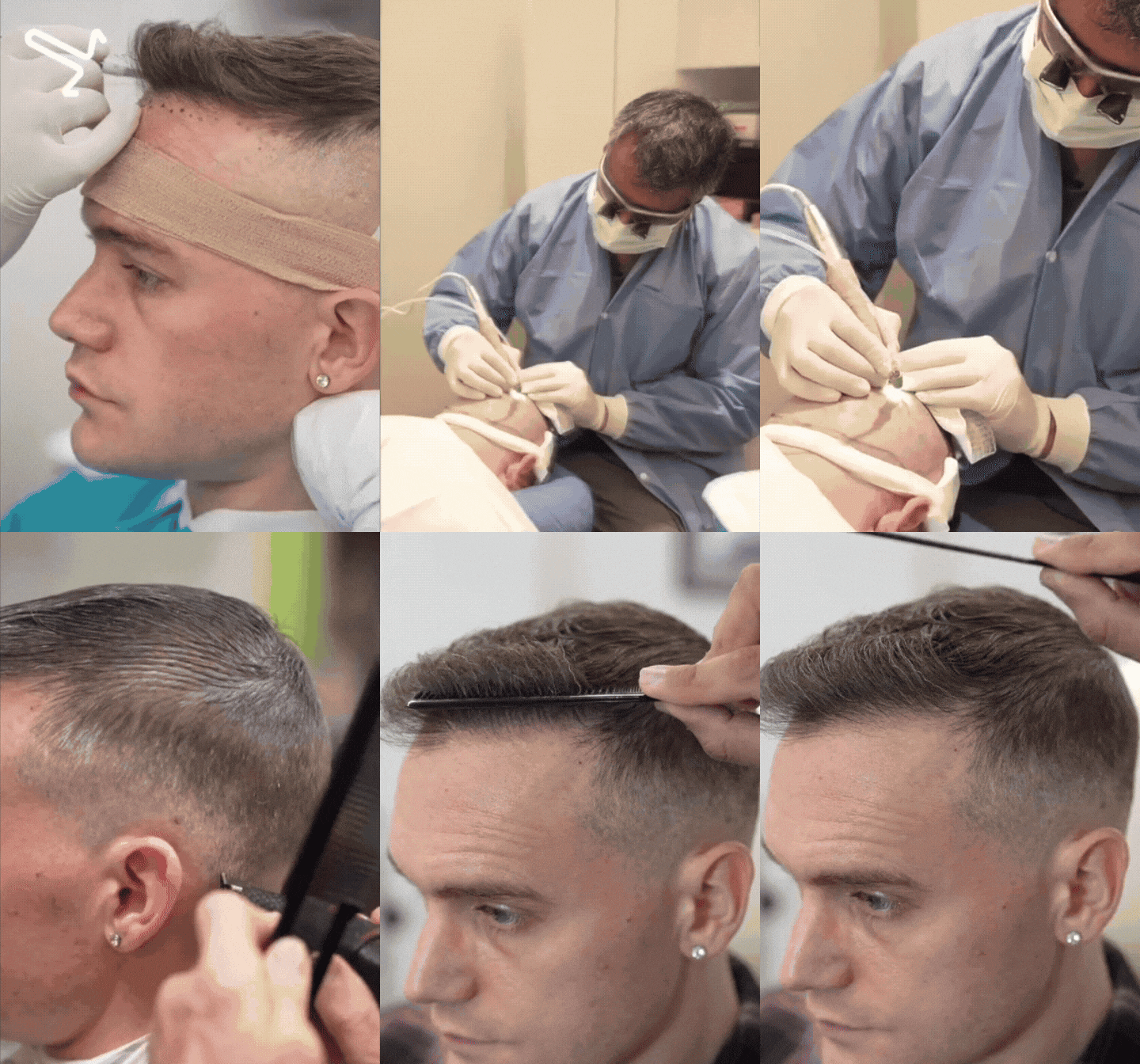
Natural hairline design is the antidote to this. At Northwestern Hair, the hairline is hand-drawn specifically for each patient — not derived from a template, not positioned according to standard measurements alone, but designed as an artistic act that accounts for the patient’s face shape, existing hair characteristics, age, and the four-dimensional requirement that the result look right not just at twelve months but across the decades ahead.
The fourth dimension matters more than most patients appreciate in the design conversation. A hairline designed for a 35-year-old should not look like a 35-year-old’s hairline forever. It should look like a naturally aging hairline that remains appropriate as the patient moves through their forties, fifties, and sixties. The micro-irregularity that makes a hairline look natural at 40 also makes it look natural at 60 — because it mimics the organic character of real hair at every stage rather than the calculated precision of a procedure calibrated to one moment.
Graft Angles That Grow in the Wrong Direction
Hair doesn’t grow straight up from the scalp. It grows at specific angles — typically quite acute, particularly at the hairline — and in specific directions that vary by zone and by individual. At the frontal hairline, hairs grow forward and slightly downward. In the temples, the direction shifts. In the crown, there’s a whorl pattern that radiates outward from a central point.
When grafts are placed at incorrect angles — upright rather than acute, or at angles that don’t match the natural growth direction of the zone — the hair that grows looks wrong even when it grows successfully. It stands away from the scalp in a way native hair doesn’t. It doesn’t lie flat or flow naturally. The coverage may be technically adequate, but the visual result is identifiably artificial.
Correct graft angulation requires surgical precision sustained across thousands of placement decisions made over the course of a long procedure. It requires a surgeon who understands the directional architecture of hair growth across every zone and who maintains the attention required to honor that architecture consistently — not just at the hairline, where the visual stakes are highest, but throughout the recipient area.
This is one of the direct consequences of the one-procedure-per-day commitment at Northwestern Hair. A surgeon whose attention is divided across multiple rooms makes placement decisions with less focus than one for whom the patient in front of them is the only case of the day. Graft angulation errors are often the product of procedural fatigue and distracted attention — which is precisely what the one-patient model is designed to eliminate.
Unnatural Density Distribution
Natural hair density is not uniform across the scalp. The hairline itself — particularly the leading edge — has lower density than the hair immediately behind it. This graduation is what makes a hairline look soft and natural rather than plugged. Behind the leading edge, density increases through a transition zone before reaching the full density of the mid-scalp.
When grafts are distributed without this graduation — when the leading edge is as dense as the zone behind it — the result looks thick in a way that reads as artificial. Paradoxically, a hairline designed with the right density distribution often produces a result that looks more natural than one that uses more grafts, because the distribution pattern is what the eye reads as real rather than the raw count.
Over-dense placement also creates physical problems. Grafts placed too close together compete for blood supply during the critical early healing period, which affects survival rates and can produce uneven growth. The surgical discipline of placing grafts at the right density — enough for cosmetic coverage, not so many that they compromise each other’s survival — is part of what separates a technically skilled procedure from a numbers-driven one.
Graft Damage That Shows in Growth
A result can be designed perfectly and still look unnatural if the grafts that were placed weren’t viable. Kinked hair — where the shaft grows in an irregular, bent pattern rather than following its natural direction — is one of the clearest markers of graft damage during extraction. Thin, wispy growth in areas where full terminal hairs were expected is another. Patchy density that doesn’t correspond to the placement pattern suggests selective graft failure driven by extraction or handling damage.
All of these outcomes trace back to the same cause: follicular architecture compromised before the graft ever reached the recipient site. In standard FUE, the mechanical forceps used to handle grafts and the sharp punch instruments used for extraction both create mechanisms for this damage. Forceps can crush the graft. Sharp punches can transect follicular structures below the visible shaft. The result is a graft that looks intact at placement and grows poorly — or doesn’t grow at all — in the months following.
No-Touch Micro PUE® eliminates these mechanisms. Vibration and suction replace mechanical contact entirely. The graft extracted is the graft the surgical plan intended — architecturally intact, biologically viable, and positioned to produce the growth that makes an undetectable result possible. A compromised graft can’t be made to grow naturally, regardless of how skillfully it’s placed. The extraction step is where the naturalness of the result is determined first — before design, before placement, before anything visible happens at all.
The Donor Area That Tells the Story
 For a result to be genuinely undetectable, the donor area has to be as undetectable as the recipient area. A beautifully designed hairline accompanied by a visibly thinned or moth-eaten donor zone isn’t an undetectable result — it’s a result that’s visible from a different angle.
The donor area shows evidence of a procedure when extraction has been too dense, too concentrated in a visible zone, or executed with instruments that leave visible scarring. Over-harvested donor areas have a patchy, uneven character that’s apparent when the hair is cut short, which most of Northwestern Hair’s patients wear at some point and want to be able to do freely.
Managing the donor area for undetectability requires extraction planning that distributes the harvest across the full available zone rather than concentrating it, instrument selection that minimizes the visible footprint of each extraction site, and a restraint in total graft count that prevents any single area from being depleted past the threshold of natural-looking density.
This is another place where the one-patient-per-day model produces a concrete difference. Extraction planning that is specific to the individual patient’s donor density, hair caliber, growth pattern, and long-term needs requires time, attention, and a commitment to that patient’s twenty-year outcome. It’s the kind of planning that gets compressed when the surgical schedule prioritizes throughput over precision.
What Realistic Expectations Actually Look Like
Having established what undetectable requires, it’s worth being specific about what realistic expectations look like for different patients — because the achievability of the goal varies with clinical factors that are patient-specific.
Hair Type and Caliber
Coarser, thicker hair covers more scalp per graft than fine hair does. A patient with naturally thick, dark hair and a defined hairline gets visual coverage from each graft that a patient with fine, light hair doesn’t. This isn’t a judgment about which patient can achieve a natural result — both can — but it shapes what density is achievable from a given graft count and what the result looks like at different stages of the growth arc.
Fine-haired patients often benefit from additional grafts at the transition zone, specific placement techniques that maximize the visual coverage of each hair, and non-surgical adjunct treatments that support the native fine hair alongside the transplant. The result can be completely natural — fine hair transplanted in alignment with fine native hair looks right in a way that coarse grafts replacing fine native hair wouldn’t — but the planning has to account for the caliber difference explicitly.
Scalp Contrast
The visual impact of any hairline — transplanted or native — is partly a function of the contrast between hair color and scalp color. High-contrast combinations — dark hair on light scalp — make density differences more visible and place greater demands on the precision of placement distribution. Lower-contrast combinations — lighter hair on similar-toned scalp — are more forgiving of density variations.
This doesn’t mean high-contrast patients can’t achieve undetectable results. They consistently do. It means the design and placement decisions are held to a tighter standard, and the result at the hairline particularly needs to be executed with the precision that Northwestern Hair’s one-patient model allows.
Extent of Coverage Required
A patient restoring an early hairline recession has a different path to an undetectable result than a patient addressing extensive crown and frontal loss. The former involves precise hairline work over a relatively contained area. The latter involves coverage decisions across a large zone where the density achievable from the available donor supply has to be distributed strategically rather than applied uniformly.
For patients with significant coverage requirements, undetectability is still achievable — but it requires honest discussion about what “complete coverage at full density” means versus “natural-looking density distribution across the full area.” The latter is what most patients actually want when they say they want a natural result. It doesn’t mean every square centimeter of the previously bald zone is covered at the density of untouched hair. It means the overall distribution of hair across the scalp reads as natural rather than sparse, and the areas of restored coverage don’t announce themselves as different from the areas of native hair.
The Role of Time in Naturalness
One of the less-discussed dimensions of how results become undetectable is the role that time plays in the process.
At the twelve-month mark — when growth is full, and the result is at its most dense — the transplant has integrated with the native hair in a way that makes distinguishing one from the other visually impossible. But the naturalness of the result actually improves further over the following months and years as the transplanted hair fully matures.
Transplanted hair at twelve months is growing from follicles that have been through a significant journey — extraction, preservation, placement, healing. The hair produced in that first year is real and terminal, but its character continues to refine as the follicle fully reestablishes its environment and the hair shaft matures. The result at eighteen months typically looks more natural than at twelve. At twenty-four months, more natural still. The transplant doesn’t degrade with time — it improves.
This is worth communicating to patients who are evaluating results at the eight or ten-month mark and wondering if what they’re seeing is the final picture. It isn’t. The naturalness is still developing. The patience that’s required through the twelve-month arc is the same patience that produces genuinely invisible results, not just adequate.
The Conversation That Needs to Happen Before the Procedure
For a patient to achieve a result that meets the undetectable standard, the expectation conversation has to happen explicitly and honestly before any surgical plan is finalized.
This conversation has several components that don’t always get covered:
What does undetectable mean for your specific social context? A patient who works in an environment where close physical contact with colleagues is common — barbering, medicine, personal training — faces a different practical standard than one whose professional life consists primarily of meetings and video calls. Understanding which standard applies to the patient’s actual life appropriately shapes design and planning decisions.
What is the realistic density achievable from your donor supply? Not a general range, but a specific estimate based on an actual evaluation of donor density, hair caliber, and the total recipient area being addressed. This number determines whether the coverage goal is achievable at full density, requires strategic distribution, or benefits from a staged approach.
What will the result look like at five years, not just twelve months? Native hair progression, natural aging of the transplanted hair, and the evolution of the overall scalp picture over time all affect whether the result continues to look natural or begins to develop the incongruities that signal a procedure from a different decade.
What does the donor area look like after the procedure? Full undetectability includes the donor zone. Understanding what the back of the scalp looks like after extraction — at various hair lengths — is part of the complete picture.
At Northwestern Hair, these questions are part of every consultation — not as a checklist, but as a genuine clinical conversation about what the patient’s specific situation supports and what the right path looks like for their individual case.
The Honest Limitation
There is one honest limitation worth acknowledging directly: the more extensive the loss that surgery is addressing, the greater the demand on donor supply and the more complex the density distribution challenge becomes.
A patient with Norwood Stage 6 or 7 loss, addressing the full extent of their thinning with a single procedure, is asking their donor supply to cover a large area. The density achievable across that area may be lower than the density of adjacent native hair in some zones — not because the procedure failed, but because the supply-to-demand ratio requires strategic allocation rather than maximum coverage everywhere.
For these patients, undetectability is still achievable — but it requires a definition of the goal that includes the whole picture rather than any single zone in isolation. A result where the hairline is natural, the mid-scalp has adequate cosmetic density, and the crown is addressed to a degree consistent with available supply reads as natural when viewed as a complete picture. It may not have the same density uniformly across every zone that a patient with less extensive loss achieves. That’s an honest distinction worth making rather than a failure to meet the standard.
What it’s never worth doing — and what Northwestern Hair doesn’t do — is overclaiming what a given supply can deliver. A patient who understands what is achievable and has that expectation fully met by the result is happy. A patient who was told they’d achieve something the clinical reality couldn’t support is a patient who will be disappointed by a result that any objective observer would call successful.
The Standard That Makes It Possible
Genuinely undetectable results don’t happen by accident. They’re the product of a specific set of technical and artistic commitments applied consistently across every case.
No-Touch Micro PUE® protects every graft from the extraction damage that produces kinked, weak, or absent growth. Hand-drawn hairline design calibrated to the individual face, the patient’s age, and the decades ahead. Graft angulation executed with the precision that sustained surgical focus makes possible. Density distribution that honors the natural graduation of real hairlines rather than imposing uniform coverage. Donor management that leaves the extraction zone as undetectable as the recipient zone.
All of these elements have to be present. In a procedure where one surgeon is personally responsible for every step of every case — one patient, one day, full attention from start to finish — they consistently are.
That’s what makes the undetectable standard achievable rather than aspirational. Not a commitment stated in a consultation. A commitment is built into the structure of how the work gets done.
Want to understand what an undetectable result looks like for your specific situation? Book a consultation with Dr. Vinay at Northwestern Hair. The design conversation is where it all begins.