



From Cubs Season to Wedding Season: Timing a Hair Transplant in Chicago
Chicago is not a city that sits still.
From the first warm weekend in April when Wrigleyville comes back to life, to the rooftop parties of summer, the wedding circuit that runs from May through October, the charity galas of fall, and the holiday season that packs every calendar from Thanksgiving through New Year’s, there is always something on. Always an event where you’re going to be in photos. Always a reason to either look your best or feel self-conscious that you don’t.
For someone considering a hair transplant, this city’s calendar is both motivation and complication. You want the result. You’re not sure how to fit the process of getting there into a life that doesn’t slow down long enough to accommodate it gracefully.
The good news is that timing a hair transplant around Chicago’s rhythms is more manageable than most patients expect — if you think about it the right way. The better news is that with the right procedure at the right clinic, you’re working around a recovery window measured in days, not months. Contact Northwestern Hair Restoration today for more information.
Here’s how to think through the Chicago calendar and find your window.
Understanding the Recovery Window First
Everything in this piece flows from one foundational fact: with No-Touch Micro PUE® at Northwestern Hair, the visible recovery window is short.
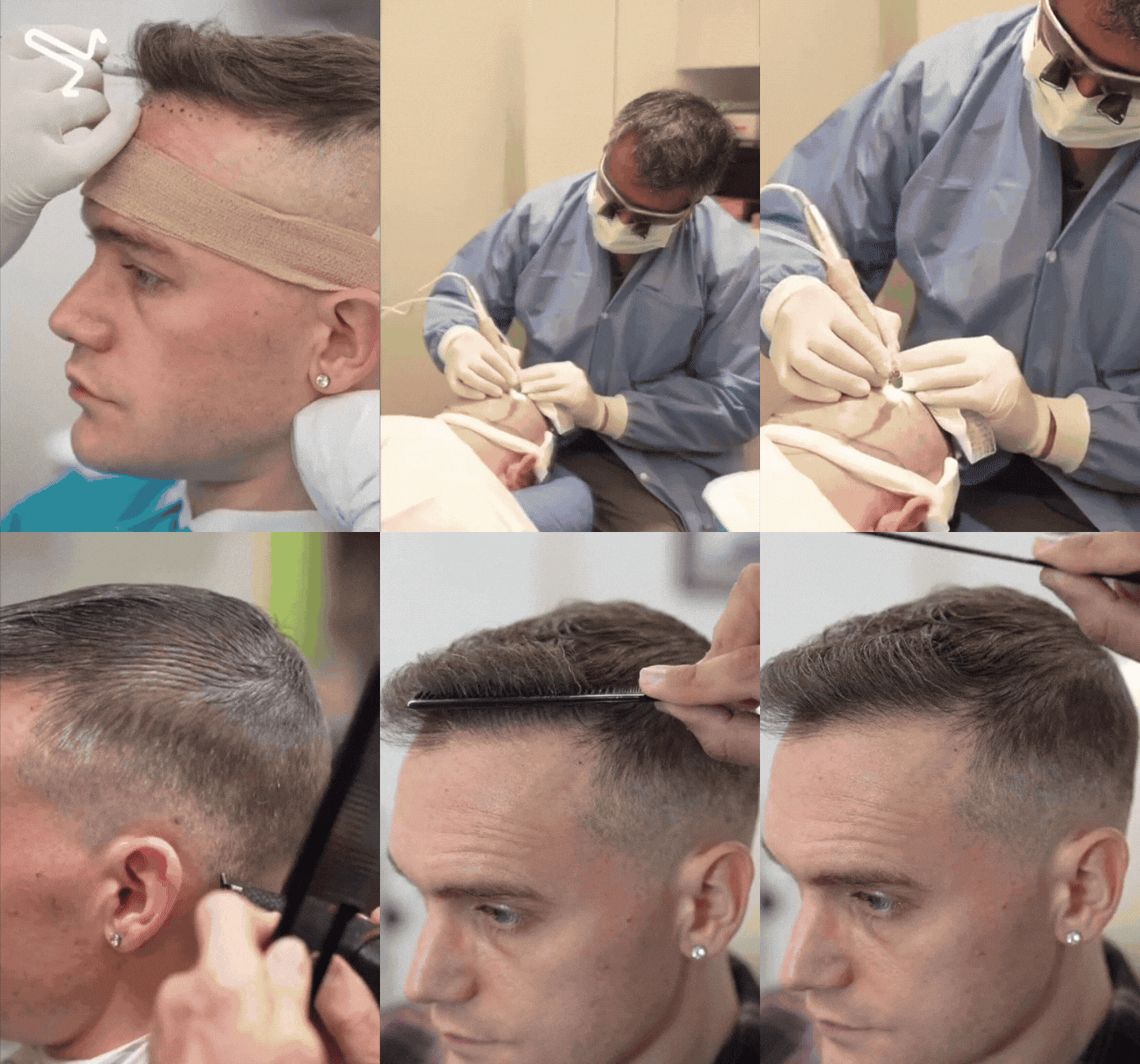
Day one through five, small scabs are forming in the recipient area, and the scalp is in early healing. A hat covers everything. Most patients feel well enough to handle light daily activity the day after the procedure.
Day five, you’re back in a baseball cap by choice rather than necessity. Day ten, the scabs have shed, the scalp looks normal, and you’re washing, styling, and genuinely presentable — not presentable-with-caveats, but actually fine.
After that, the result develops invisibly over twelve months. There’s a shedding phase in weeks two through four that doesn’t read as anything unusual to outside observers. New growth begins around months three to four. By months six through nine, density is noticeably improving. The full result arrives around month twelve.
What this means practically: you’re scheduling around a ten-day window of active concealment, not a months-long recovery. The rest of the timeline is biology happening quietly under hair that looks normal.
With that in mind, here’s how Chicago’s calendar stacks up.
Cubs Season (April – October): Plan Around the Ballpark, Not Away From It
For the Chicago baseball fan — and in this city, that population is significant — Cubs season runs April through October and represents a near-continuous calendar of weekend afternoons at Wrigley, rooftop gatherings, and the kind of extended outdoor socializing that makes Chicago summers worth enduring Chicago winters for.
The honest answer is that the Cubs’ season doesn’t make a hair transplant impossible. It just requires scheduling intelligence.
The early season window (April) is actually favorable. April in Chicago is still cool, sun exposure is moderate, and the season is fresh enough that the social intensity hasn’t yet peaked. A procedure in early-to-mid April gives you the ten-day recovery window in weather that’s still hat-appropriate without looking unusual, and you’re fully healed well before Memorial Day weekend kicks the summer calendar into high gear.
Mid-season (June through August) requires planning around specific events. The concern isn’t the ballpark — a Cubs hat over a healing scalp for the first week is functionally invisible, and most Wrigley regulars wear one anyway. The concern is the sustained sun exposure of rooftop days, beach trips, and extended outdoor time that characterize Chicago summers. UV on a healing scalp in the first month should be minimized. If your summer is a continuous rotation of outdoor events with no obvious gap, mid-season is more complicated to schedule around.
The practical move for the serious Cubs fan: target the early April window before the season peaks, or identify a natural gap in the schedule — an away-game-heavy stretch, a planned out-of-town trip that creates distance from the Wrigley social circuit — and use it. Ten days of intentional scheduling and you’re watching the playoff push with a healing scalp nobody can see under your cap.
Wedding Season (May – October): Front-Load or Wait It Out
 Wedding season in Chicago runs from late May through October, with the peak density in June, September, and early October. For anyone embedded in the demographic where most of their social circle is getting married — or for the person getting married themselves — this is the most schedule-intensive stretch of the year and the one that most frequently generates the question: can I fit this in before the wedding?
The answer depends on the role and the timeline.
If You’re a Guest
Being a wedding guest with a healing hair transplant is manageable if the procedure is timed correctly. The key variable is the ten-day active recovery window and whether it lands on or near a wedding date.
Schedule a procedure at least three weeks before a wedding you’re attending, and you’re fine — the scabs have cleared, you look normal, and by the time you’re in the photos, you’re simply a person whose hair has been improving gradually over the preceding months without anyone connecting the dots.
Schedule a procedure ten days before a wedding, and you’re in the tail end of the recovery window — technically presentable but closer to the margin than most patients prefer. Two weeks is a comfortable buffer for wedding guest appearances.
Schedule a procedure five days before a wedding, and you’re in a hat situation at someone else’s ceremony. That’s not a comfortable position, and it’s entirely avoidable with better timing.
The practical move: identify your wedding calendar for the season in January or February, map the gaps, and schedule the procedure in the window that gives you the most buffer on either side. A June procedure scheduled away from June and July weddings lands you at fall weddings with four to five months of early growth already visible — which means you’re not just recovered, you’re already seeing the result begin.
If You’re the One Getting Married
This deserves its own treatment because the stakes are different.
The question every groom asks is some version of: Can I be in my wedding photos looking the way I want to look from a hair restoration standpoint?
The honest answer involves the twelve-month timeline. Full results at Northwestern Hair mature by around month twelve. If you want to be at or near full results on your wedding day, you need to schedule your procedure approximately twelve to fourteen months before the date. That’s not a surprise — it’s simply what biology requires — and patients who plan for it arrive at their wedding with a natural, fully grown result rather than a partially developed one.
If the wedding is six months out, you’ll be in the middle of active growth — looking better than before the procedure, with visible progress, but not at the final density. Many patients in this window are genuinely happy with where they are at six months. Whether that’s acceptable depends on individual expectations, and it’s a conversation worth having explicitly in the consultation.
If the wedding is three months out, the procedure is probably better scheduled after the honeymoon — not because it can’t be done, but because the result at three months is still early and the patient deserves to see their full result without the pressure of a major event framing it.
The practical move for grooms: if the wedding is more than twelve months away, schedule the consultation now and book the procedure to land the result on your timeline. If it’s less than twelve months away, have an honest conversation about what’s realistic at the specific point in your growth arc that the wedding falls on — and whether that’s acceptable or whether a post-honeymoon schedule makes more sense.
Chicago Marathon Season (October): The Athletic Calendar
Chicago’s running community is substantial, and the Chicago Marathon in October draws both serious competitors and recreational participants who’ve spent months training for it. Endurance athletes considering hair restoration have a specific scheduling concern: the restriction on high-intensity exercise for approximately two weeks post-procedure.
For a marathon runner in peak training, a two-week exercise restriction isn’t an inconvenience — it’s a meaningful interruption to a training block that took months to build.
The practical move: schedule the procedure either significantly before peak training begins — giving the two-week restriction plenty of clearance before mileage ramps up — or after the marathon itself, using the natural post-race recovery period as the procedure window.
A procedure in late October or November, after the marathon, accomplishes two things simultaneously: it uses the natural physical downtime that follows a major race, and it puts the early healing in the winter months, where hat-wearing is unremarkable, and UV exposure is minimal. For the athletic patient, post-marathon November is close to an ideal window.
Holiday Season (November – January): The Overlooked Sweet Spot
The stretch from Thanksgiving through New Year’s has a complicated reputation as a scheduling window. On one hand, it’s socially dense — holiday parties, family gatherings, end-of-year events where photos are taken, and appearances are noticed. On the other hand, it offers some genuine advantages that don’t get enough acknowledgment.
Hats are completely natural. A beanie, a wool cap, or any cold-weather head covering is simply seasonal in Chicago from November through February. Nobody looks twice. The concealment window that requires some planning in summer is effortless in winter.
The calendar has a clear structure. Most professionals know their holiday commitments well in advance — the office party, the family travel, the New Year’s plans. The gaps between these events are often more schedulable than the general availability of summer, which can feel open but fills quickly.
The natural gap between Christmas and New Year’s. For professionals who take this period off, it’s one of the cleanest procedure windows in the year. The office is quiet, social commitments are largely complete, and a full ten-day recovery buffer fits neatly into the end-of-year pause. A December 26th or 27th procedure means you’re healed and fully functional before returning to work in January — and nobody connects the pre-holiday version of you to the post-holiday version because the holidays themselves provide a natural visual discontinuity.
The watch-out: scheduling too close to a major holiday event without an adequate buffer. A procedure on December 20th with a formal family Christmas on December 24th is tight. A procedure on December 27th, with nothing significant until mid-January, is comfortable. The structure is the same as any other scheduling decision — map the events, identify the gaps, and build the buffer.
St. Patrick’s Day and Spring Events (March): The Setup Window
 Chicago’s St. Patrick’s Day is not a quiet affair. The river dye, the South Side parade, the general citywide embrace of a holiday that starts at 8 am — it’s a legitimate Chicago cultural institution, and for many residents, it marks the beginning of the social spring.
March in general represents Chicago’s transition moment — the city shaking off winter, the social calendar beginning to accelerate, the first hints of outdoor events on the horizon.
For hair restoration timing, early March is an interesting window. A procedure in the first week of March:
- Clears the ten-day recovery window comfortably before St. Patrick’s Day
- Puts you at month three of growth by early June — early signs of new growth emerging right as summer begins
- Positions you at the six-month mark in September, with visible density improvement, just as the fall wedding and event season peaks
- Delivers a full twelve-month result the following March
The math of a March procedure stacks up well for patients who want to feel the result improving through summer and arrive at the following year’s full calendar with their result complete.
Lollapalooza, Taste of Chicago, and the Summer Festival Circuit
Chicago’s summer festival calendar — Lollapalooza in late July, Taste of Chicago in June, Pitchfork, Blues Fest, and the neighborhood festivals that populate nearly every summer weekend — represents exactly the kind of sustained outdoor exposure that requires planning around rather than scheduling into.
Multi-day outdoor festivals with extended sun exposure, heat, and the physical demands of standing in a crowd for hours are not ideal contexts for a healing scalp in the first month post-procedure. The concern isn’t catastrophic — it’s manageable — but it requires active attention to sun protection and scalp hygiene that can feel burdensome when you’re trying to be present at an event.
The practical move: either schedule the procedure far enough before the summer festival window that the active recovery is complete and the first month has cleared — a procedure in April or early May covers this — or wait until after the summer festival circuit wraps in August, using late August as the entry point to the fall scheduling window.
A late August procedure misses the festival circuit entirely, clears the ten-day recovery before Labor Day, and sets up a twelve-month result arc that lands the following August — with visible improvement developing through fall, winter, and the following spring.
New Year, New You: The January Reset
There’s a reason January consistently produces a surge in hair restoration consultations. The new year creates a genuine psychological reset moment — a window where decisions that have been deferred feel newly actionable, and where the gap between the person you are and the person you want to be feels worth closing.
January also happens to be a genuinely good scheduling window. Post-holiday professional calendars are quieter than they’ll be for months. Social commitments have naturally quieted. Hat weather continues without question through at least February. And a January procedure positions the twelve-month result arc to land the following January, which means the following holiday season, the following year of events and photos and professional appearances, features a result that is fully matured.
The patients who schedule in January and commit to the twelve-month arc consistently arrive at the following December with the clearest sense of having made a decision that paid off on a timeline they set for themselves at the beginning of the year. There’s a satisfying completeness to that arc that patients with less deliberate timing don’t always experience as cleanly.
The Practical Chicago Timing Guide
Pulling it together across the calendar:
January – February: Clean scheduling window. Cold-weather hat cover is natural. Post-holiday professional and social calm. Twelve-month result lands the following winter.
March – April: Strong window. Early growth develops through the summer. The weather is lingering. The full result lands the following spring. Best option for patients who want summer improvement visible in the same calendar year.
May: Viable with careful wedding season mapping. Gap-dependent. Requires explicit buffer planning around specific events.
June – August: Manageable with active planning. UV exposure requires attention. Best suited for patients with identifiable gaps in the summer social calendar or flexibility around outdoor commitments.
September – October: Excellent window. Fall weather reduces UV exposure naturally. Post-summer social calm. Full result lands the following fall — positioned perfectly for the following wedding and event season.
November – December: Underrated window. Hat weather eliminates the concealment challenge. End-of-year pause creates scheduling opportunity. The full result lands the following fall.
The Constant Across Every Window
Chicago’s calendar is never truly empty. There will always be a Cubs game, a wedding, a work event, or a festival that creates a reason to wait for a better window. Patients who approach the scheduling question this way tend to find that the better window keeps retreating.
The more useful frame is this: the procedure takes one day. The recovery takes ten days of active management. Everything after that is invisible biology working in the background while your Chicago life continues at full speed. Contact Northwestern Hair Restoration today for more information.
Find the ten-day window. The rest takes care of itself.