




What Chicago Patients Ask Most During Hair Transplant Consultations
A hair transplant consultation is a different kind of medical appointment.
Unlike most clinical visits, where the patient describes a problem and the physician prescribes a solution, a hair restoration consultation involves a decision the patient is still making. They’ve done research — sometimes a lot of it. They’ve formed opinions, developed concerns, encountered conflicting information online, and arrived with a set of questions that range from deeply practical to quietly anxious.
The quality of the answers they get in that room determines whether they leave with clarity or confusion — and whether the decision they make serves them well for the next twenty years.
After thousands of consultations at Northwestern Hair, certain questions come up consistently. Not because patients are reading from the same script, but because the concerns driving those questions are universal. The same fears, the same misunderstandings, the same gaps between what the internet says and what a surgeon actually tells you in person.
This piece answers those questions directly — the way they get answered in Dr. Vinay’s consultation room, without the hedging or the sales pressure that characterizes too many clinical conversations in this space. Contact Northwestern Hair Restoration today for more information.
“Am I Actually a Good Candidate for a Hair Transplant?”
This is usually the first real question — and the one patients are most anxious about, even when they don’t lead with it directly.
The honest answer is that candidacy involves several variables evaluated together, not a single pass/fail threshold.
 Donor supply is the foundational requirement. A hair transplant moves follicles from areas genetically resistant to loss — primarily the back and sides of the scalp — to areas where loss has occurred. If the donor area has adequate density, the procedure is supportable. If donor supply is compromised — by prior procedures, by diffuse loss patterns that have affected the donor zone, or by loss that has progressed into the donor area itself — the options narrow significantly.
Loss pattern stability matters for surgical planning. A patient whose loss is actively progressing rapidly presents different planning challenges than one whose pattern has been stable for several years. This doesn’t disqualify surgery, but it shapes the approach — how aggressively to restore, how much donor supply to preserve, and what role non-surgical treatment should play alongside or before surgical intervention.
Age and trajectory feed into the same calculation. Younger patients — those in their mid-twenties with active loss — are often better served by a period of non-surgical treatment and observation before committing to surgery, because the full extent of their eventual loss pattern isn’t yet knowable. The surgical plan for a 26-year-old who may progress to Norwood Stage 6 is fundamentally different from the plan for a 40-year-old whose Stage 4 pattern has been stable for a decade.
Realistic expectations are part of candidacy in a way that doesn’t always get acknowledged explicitly. A patient expecting surgery to deliver the hairline of their teenage years, or to produce density that exceeds what their donor supply can support, isn’t a poor surgical candidate — they’re a candidate for a more honest conversation about what the procedure can actually accomplish for their specific situation. That conversation is one of the most important things a good consultation delivers.
“How Many Grafts Will I Need?”
This question comes early and often, usually because patients have done enough research to know that graft count is the primary driver of procedure cost, and they want to understand the number before the price conversation begins.
The honest answer is that graft count can’t be determined accurately without a direct scalp evaluation — and any clinic that quotes you a number before seeing you should raise a flag. What can be said in general terms is that graft count is determined by three things working together: the size of the recipient area being restored, the desired density in that area, and the available donor supply to support it.
Rough ranges by Norwood stage give a general orientation:
A Stage 3 patient addressing early frontal recession typically requires somewhere in the range of 1,500 to 2,500 grafts. A Stage 4 patient with defined frontal and early crown loss might need 2,500 to 3,500. A Stage 5 or 6 patient pursuing comprehensive coverage can be looking at 3,500 to 5,000 or more, and in mega-session cases, Northwestern Hair has developed specific techniques, including ACS donor preparation and iso-hypothermal plasmonic preservation, that allow for the extraction and survival of significantly larger graft counts in a single procedure without compromising donor integrity.
What these numbers don’t capture is the difference between the maximum possible graft count and the optimal graft count. An experienced surgeon isn’t trying to use the most grafts possible — they’re trying to use the right grafts in the right places to produce the best long-term result while preserving donor supply for the future. Those aren’t always the same number.
“Will It Look Natural?”
This is the question underneath most of the other questions — the anxiety driving the consultation, even when it’s framed as something more clinical.
The answer is yes, when the procedure is executed correctly. But “correctly” involves two distinct components that both have to be right.
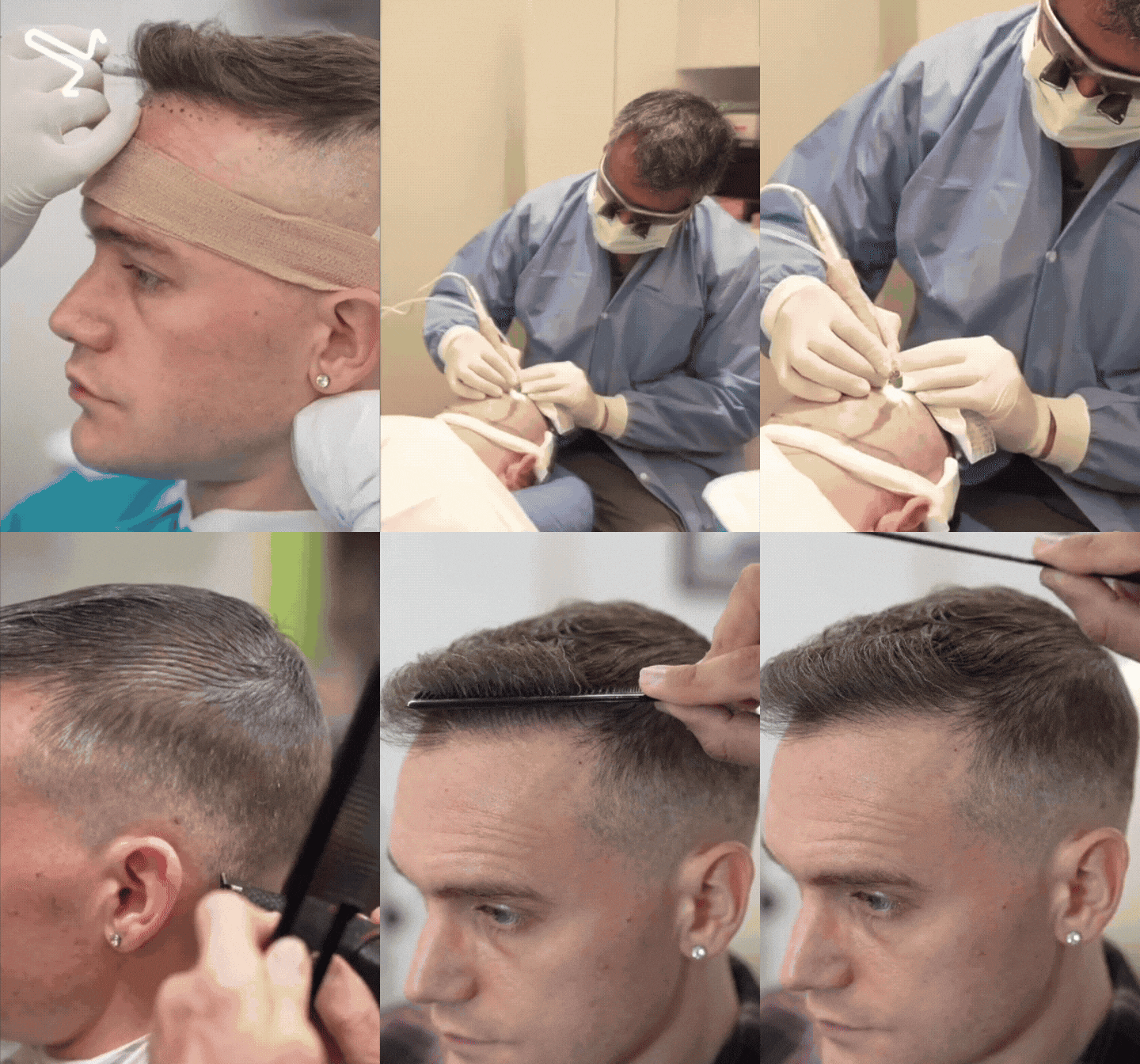
The first is technical: graft survival and growth. If grafts are damaged during extraction, they don’t grow — or they grow poorly, producing thin, kinked, or inconsistent coverage that reads as transplanted rather than natural. This is the problem No-Touch Micro PUE® was specifically designed to solve. By extracting grafts with vibration and suction rather than mechanical forceps and sharp punches, the follicular architecture is preserved. Grafts that arrive at the recipient site intact grow the way they’re supposed to grow — strong, consistent, and natural.
The second component is artistic: hairline design. A technically successful procedure with poor hairline design still produces an unnatural result. Natural hairlines have micro-irregularity at the leading edge. They have varied graft angles that mimic the multidirectional growth of real hair. They have proportions calibrated to the individual face, not derived from a template. And they’re designed with aging in mind — positioned and shaped to look right not just at twelve months but at ten years, twenty years, and beyond.
Both components have to be present. The patients who worry most about natural results are usually responding to examples of transplants where one or both were missing — technically adequate growth arranged in a hairline that looks obviously restored, or artistically well-designed placement that didn’t grow as planned because the extraction damaged the grafts. A consultation that addresses both dimensions specifically, with portfolio evidence to support the answers, is the one worth trusting.
“Does It Hurt?”
 Most patients ask this with genuine curiosity rather than deal-breaking anxiety — but it deserves a direct answer because the reality is considerably more reassuring than what patients often imagine.
The procedure is performed under local anesthesia. The administration of that anesthesia — a series of injections across the scalp — is the most uncomfortable part of the entire experience for most patients, and it’s brief. Once the anesthesia takes effect, the scalp is numb, and the procedure itself is painless. Patients are awake throughout, able to watch something, handle their phone, and engage with the team. The sensation is pressure and movement rather than pain.
Post-procedure discomfort is real but typically mild. Most patients describe it as tightness in the donor area and sensitivity in the recipient zone rather than significant pain. For the majority, any discomfort requiring medication resolves by the morning after the procedure. Patients who expect a difficult recovery are usually surprised by how manageable it actually is, which is one of the reasons Northwestern Hair’s patient reviews consistently mention this as a positive surprise.
The honest exception: the initial anesthesia injections are genuinely uncomfortable for most patients. Numbing the scalp requires injections across a significant surface area, and some areas are more sensitive than others. It’s worth being mentally prepared for this part. It’s also worth knowing that it’s the worst part — and that it lasts minutes, not hours.
“How Long Until I See Results?”
This question carries a lot of emotional weight because the answer — twelve months to full results — is longer than most patients want to hear.
The growth timeline is biological, and it doesn’t compress. Transplanted hair sheds in the first two to four weeks, which is expected and not a sign of failure. The follicles enter a resting phase. New growth begins emerging around months three to four. By months six to nine, density is noticeably improving, and the result is clearly taking shape. The final, fully matured result arrives somewhere around month twelve — sometimes a bit earlier for patients with fast growth cycles, occasionally slightly later for those who grow more gradually.
What this means practically is that patience isn’t optional. It’s built into the process. The patients who manage the waiting period best are those who understood the timeline clearly before the procedure and calibrated their expectations accordingly — not those who were told “results in six months” in a consultation designed to minimize the wait in the sales pitch.
The honest companion to this answer is that the result, once it arrives, is permanent. The transplanted follicles grow for the rest of the patient’s life. The twelve-month wait is a one-time investment in an outcome with no expiration date. Framed that way, most patients find the timeline more acceptable than their initial reaction suggests.
“What Happens to the Rest of My Hair — Will It Keep Falling Out?”
This question reflects a genuine and important concern that doesn’t always get addressed as directly as it should.
The transplanted hair is permanent. The follicles taken from the donor area carry genetic resistance to DHT — the hormone responsible for androgenic hair loss — and that resistance travels with them to the recipient site. They will continue growing for the patient’s lifetime regardless of the surrounding hair loss pattern.
The native hair — the hair that wasn’t transplanted — is not protected by the procedure. It continues whatever trajectory it was already on, subject to the same genetic and hormonal forces that produced the initial loss. For patients with active, progressive loss patterns, this means the area around and behind the transplant may continue thinning after the procedure.
This is the planning reality that distinguishes a thoughtful surgical approach from a reactive one. A surgeon who restores the hairline without accounting for likely future crown or mid-scalp progression may produce a result that looks excellent at year two and incongruous at year ten — the transplanted front holding strong while the surrounding native hair has thinned away behind it.
The answer to managing this reality is twofold: surgical planning that accounts for the trajectory rather than just the current state, and non-surgical treatment that actively supports the native hair alongside the transplant. ACS and exosome therapy are the primary tools for the latter — addressing the miniaturized follicles that are present but vulnerable, supporting their health and function, and slowing progression in ways that protect the overall result over time.
“How Is This Different From What I’ve Seen at Other Clinics?”
Patients who have done their research and consulted at multiple Chicago clinics ask this question often — and it’s one of the most useful questions in the consultation because the honest answer requires specificity rather than marketing language.
The differences that matter at Northwestern Hair are structural and clinical, not cosmetic.
One procedure per day. Dr. Vinay commits an entire day to a single patient. The surgical attention is undivided from consultation through extraction, placement, and post-procedure follow-up. This is not standard practice in the field — most clinics run multiple simultaneous procedures — and the impact on outcome quality is direct.
No-Touch Micro PUE®. The extraction mechanism eliminates the graft damage that standard FUE introduces through mechanical forceps and sharp punch instruments. Vibration and suction replace contact that crushes and severs. The grafts that get placed are the grafts that were extracted — intact, viable, and positioned to grow as they’re supposed to grow.
Surgeon involvement at every step. The physician who designed the hairline in the consultation is the physician extracting the grafts and placing them ten hours later. There’s no hand-off to technicians for the parts of the procedure that most directly determine the outcome.
Post-procedure continuity. Dr. Vinay is directly reachable after the procedure — not through a staff intermediary managing a patient queue. Patients who have questions at week two or month four are communicating with the surgeon who performed their procedure, not a coordinator who has to look up their chart.
These aren’t differentiators that show up in before-and-after photos or price comparisons. They show up in outcomes — and in the experience of having a result that was genuinely cared about by the person responsible for it.
“What About Turkey? Should I Just Go There?”
This comes up in almost every consultation, and the answer it deserves is an honest one rather than a defensive one.
Some patients who travel to Istanbul find skilled surgeons performing careful procedures and come home with results they’re genuinely happy with. That’s real. It would be dishonest to suggest otherwise.
What’s also real is that the international market has enormous variance — between the surgeon-led, careful operations that established Istanbul’s original reputation and the high-volume technician-led clinics that now dominate the market numerically. Identifying which category a specific clinic falls into from a website, a video consultation, and a set of curated before-and-after photos is genuinely difficult, and the downside of guessing wrong involves compromised donor supply, revision costs, and permanent limitations on what can be corrected.
The practical arguments for staying in Chicago center on three things: continuity of care before and after the procedure, the technique difference between No-Touch Micro PUE® and the standard FUE most international clinics use, and the ability to have direct access to your surgeon throughout the twelve-month recovery arc. None of these show up in the price comparison. All of them show up in the result.
The consultation is the right place to have this conversation in depth — not because it ends with a sales pitch, but because a patient who understands the full picture is in a better position to make a decision they’ll be confident in for the next twenty years.
“What Happens If I’m Not Happy With the Result?”
This question takes some courage to ask, and patients who ask it are usually the most thoughtful ones in the room.
The honest answer has two parts.
The first is that Northwestern Hair’s approach to the procedure — one patient per day, surgeon involvement at every step, No-Touch Micro PUE® protecting graft integrity — is specifically designed to minimize the scenarios where the result falls short of expectations. The majority of patients who complete the twelve-month arc are genuinely satisfied with what they see.
The second part is that Dr. Vinay stands behind his work directly and personally. When Northwestern Hair takes on a case, it sees it through. If a result isn’t what it should be — if density falls short in a specific area, if something didn’t develop the way the plan anticipated — the conversation happens between the patient and the surgeon, and it’s handled with the same commitment to the outcome that characterized the original procedure. That’s not a policy statement. It’s how Dr. Vinay operates.
What this guarantee doesn’t cover is the progression of native hair beyond the transplant zone — that’s biology, not surgical outcome. And it doesn’t cover outcomes shaped by patient non-compliance with aftercare. What it does cover is the result of the procedure itself, evaluated honestly and addressed directly when it falls short.
“How Do I Know I’m Ready to Do This?”
This one usually comes near the end of a consultation, and it’s less a clinical question than a human one.
The patients who ask it have usually resolved their factual questions. They understand the technique, the timeline, the cost, and the recovery. What they’re navigating is the gap between knowing something makes sense and feeling ready to commit to it.
The most honest answer Dr. Vinay gives is this: readiness isn’t a feeling that arrives fully formed. It’s the product of having the right information and trusting the surgeon and team you’re working with. A consultation that leaves you with unanswered questions or vague discomfort about the approach isn’t the foundation for a decision you’ll be confident in. A consultation that leaves you with clarity — about what’s planned, why it’s planned that way, and who’s accountable for the outcome — usually produces the readiness that wasn’t there at the beginning.
The other honest component: there’s no perfect moment. Chicago’s calendar is always full. The professional calendar is always demanding. The social calendar always has a reason to wait. The patients who are happiest at the twelve-month mark are almost uniformly the ones who found a window, made the decision, and stopped waiting for a better time that was never going to arrive on its own.
One Final Note on What the Consultation Is For
The best consultations aren’t sales presentations. They’re conversations — between a patient with a set of real concerns and a surgeon with the experience to address them honestly.
At Northwestern Hair, the consultation starts with an assessment of where you are, not a predetermined recommendation about where you should go. The questions you bring are welcome. The hard ones — about Turkey, about natural results, about what happens if it doesn’t work — get direct answers rather than deflections.
The goal is a patient who leaves the room with a clearer picture than they walked in with, and a decision they made from genuine understanding rather than from pressure, incomplete information, or the fading anxiety of a first impression.
That’s what the consultation is for. Bring your questions.
Ready to get your questions answered directly? Book a consultation with Dr. Vinay at Northwestern Hair — one patient, one conversation, no pressure.