




What Does a Hair Transplant Cost in Chicago? Factors That Affect Pricing
If you’ve started researching hair transplants in Chicago, you’ve probably noticed something frustrating: nobody seems to give you a straight number.
Some clinics advertise cost per graft. Others quote flat procedure fees. Some won’t give you any number at all until you’re sitting in a consultation chair. And if you’ve done any searching online, you’ve likely come across international pricing from clinics in Turkey or Eastern Europe that looks dramatically lower than anything you’d find locally.
So what does a hair transplant actually cost in Chicago — and why does it vary so much?
This guide breaks down the real factors that drive pricing, what a fair range looks like for the Chicago market, and what questions you should be asking before you commit to any surgeon. Contact Northwestern Hair Restoration today for more information.
The Short Answer: Why There’s No Single Price
Hair transplantation isn’t a standardized procedure with a fixed menu price. The cost is determined by a combination of factors unique to you — your degree of hair loss, the technique used, the number of grafts required, and the experience level of the surgeon performing the work.
That’s why any clinic that quotes you a firm price before evaluating your scalp should raise a flag. Pricing before assessment typically means pricing before care.
Factor 1: Number of Grafts Needed
The most significant driver of cost in any hair transplant procedure is graft count — the number of individual follicular units extracted and transplanted.
 In Chicago, most clinics price procedures on a per-graft basis. Average cost per graft at a reputable Chicago clinic typically falls somewhere between $5 and $12, depending on the surgeon and the technique involved. That means:
- A 1,500-graft procedure might run $7,500–$15,000
- A 2,500-graft procedure might run $12,500–$25,000
- A 3,000+ graft procedure can push $15,000 and above
These aren’t arbitrary ranges. Graft count directly determines procedure length, the number of technicians needed, the complexity of extraction, and the total time a surgeon is hands-on with your case.
How Many Grafts Will You Need?
This depends largely on where you fall on the Norwood Scale, the standardized classification system for male pattern baldness — and the equivalent assessment system used for female hair loss patterns.
- Stage 2–3 (early recession, minor thinning): 1,000–2,000 grafts are often sufficient
- Stage 4 (moderate baldness, defined bald areas): 2,000–3,000 grafts typically
- Stage 5–6 (significant crown and frontal loss): 3,000–5,000+ grafts may be needed
Women typically present with diffuse thinning rather than well-defined bald zones, which considerably changes the graft-planning approach. A skilled surgeon evaluates donor density, scalp laxity, and recipient area needs together — not just the visible thinning.
Factor 2: Technique — Why It’s the Most Important Variable Nobody Talks About
When most people research hair transplants, they encounter two names: FUE and FUT. But what the industry doesn’t always tell you is that not all FUE is the same — and that difference has a direct impact on both what you pay and what you get.
The Problem with Standard FUE
Standard FUE has become the dominant technique in hair restoration for good reason — it leaves no linear scar and offers a faster recovery profile than older strip methods. But it isn’t without real limitations that most clinics don’t discuss openly.
In standard FUE, tweezers can crush grafts and sharp punches can sever key structures — leaving hairs dry, kinked, or scarred. When grafts are compromised during extraction, the damage doesn’t announce itself immediately. You only discover it months later when growth is sparse, uneven, or simply doesn’t materialize the way you expected.
This is the central flaw in standard FUE that high-volume, assembly-line clinics — including many international providers — rarely acknowledge: the technique itself, when executed without sufficient care and precision, can undermine the very outcome you’re paying for.
No-Touch Micro PUE®: The Standard at Northwestern Hair
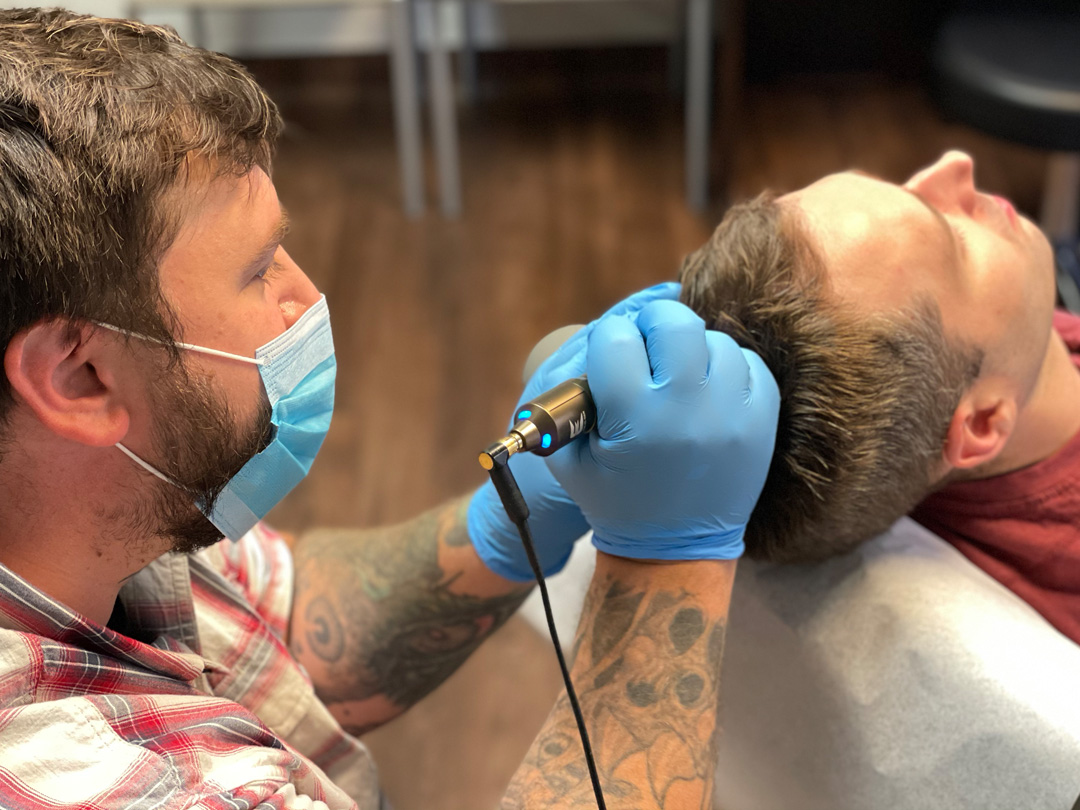
No-Touch Micro PUE® uses vibration and suction to gently extract each graft without damaging its natural architecture. The result is a perfected graft that grows strong and looks effortlessly natural.
This isn’t a marketing reframe of the same procedure. It’s a fundamentally different approach to the most critical step in the entire surgery — getting the graft out of the donor area alive, intact, and ready to grow.
Where standard FUE relies on mechanical gripping and sharp punch instruments that can stress follicles, No-Touch Micro PUE® eliminates that contact. Micro PUE uses gentle vibration to collect healthier hairs. The downstream effect is a graft with preserved architecture, stronger growth potential, and results that look natural — not just adequate.
From a pricing standpoint, Micro PUE® requires more time, more precision, and a higher level of surgical skill than standard FUE. It costs more. It also produces meaningfully better outcomes, which is why it’s the only surgical technique Dr. Vinay performs at Northwestern Hair.
Advanced Techniques That Expand What’s Possible
Beyond the core extraction method, Northwestern Hair has developed a suite of proprietary techniques that expand what a single procedure can accomplish:
- ACS donor preparation increases blood flow and tissue strength, while iso-hypothermic plasmonic preservation keeps grafts consistently cooled and supported in plasma throughout the procedure — critical for protecting graft viability during longer sessions.
- Sequential extraction targets the exact graft types needed, while ACS recipient therapy improves survival and high-density graft placement techniques maximize coverage while maintaining natural spacing.
- For patients who need discretion, oscillating notched-tip extraction and custom concealed haircut designs keep donor areas discreet and allow patients to return to daily life without an obvious haircut.
- For long-term results, intra-follicular grafting reinforces thinning areas without damaging existing hairs, while ridge density equalization balances high-density donor regions for a more even, long-term appearance.
Each of these adds a layer of precision — and in some cases, capability — that generic FUE clinics simply don’t offer. When you’re evaluating pricing, understanding what the technique actually includes is far more important than comparing a per-graft number in isolation.
Factor 3: Surgeon Experience and Credentials
This is the factor patients most often underweight — and the one that matters most.
Hair transplantation is a surgical procedure. The outcome you live with for the rest of your life is directly shaped by who is holding the instruments. In Chicago, you’ll find a range of providers: board-certified hair restoration surgeons with decades of experience, general dermatologists who offer transplants as one of many services, and medspas operating at the lower end of the market.
The price difference between these tiers is real, and it’s not just about prestige. An experienced hair restoration specialist brings:
- A trained eye for natural hairline design — angles, density distribution, and the precise mimicry of how hair actually grows
- The ability to handle complications or unusual anatomy without improvising
- A body of documented results across diverse hair types and loss patterns
- Surgical judgment that protects your donor supply for future procedures if needed
Dr. Vinay is part of every step — from consultation to aftercare. Northwestern Hair has committed to only one procedure per day so all attention is on you. That’s not a boutique selling point. It’s the structural difference between a surgeon who is fully present for your case and one who is supervising three rooms simultaneously.
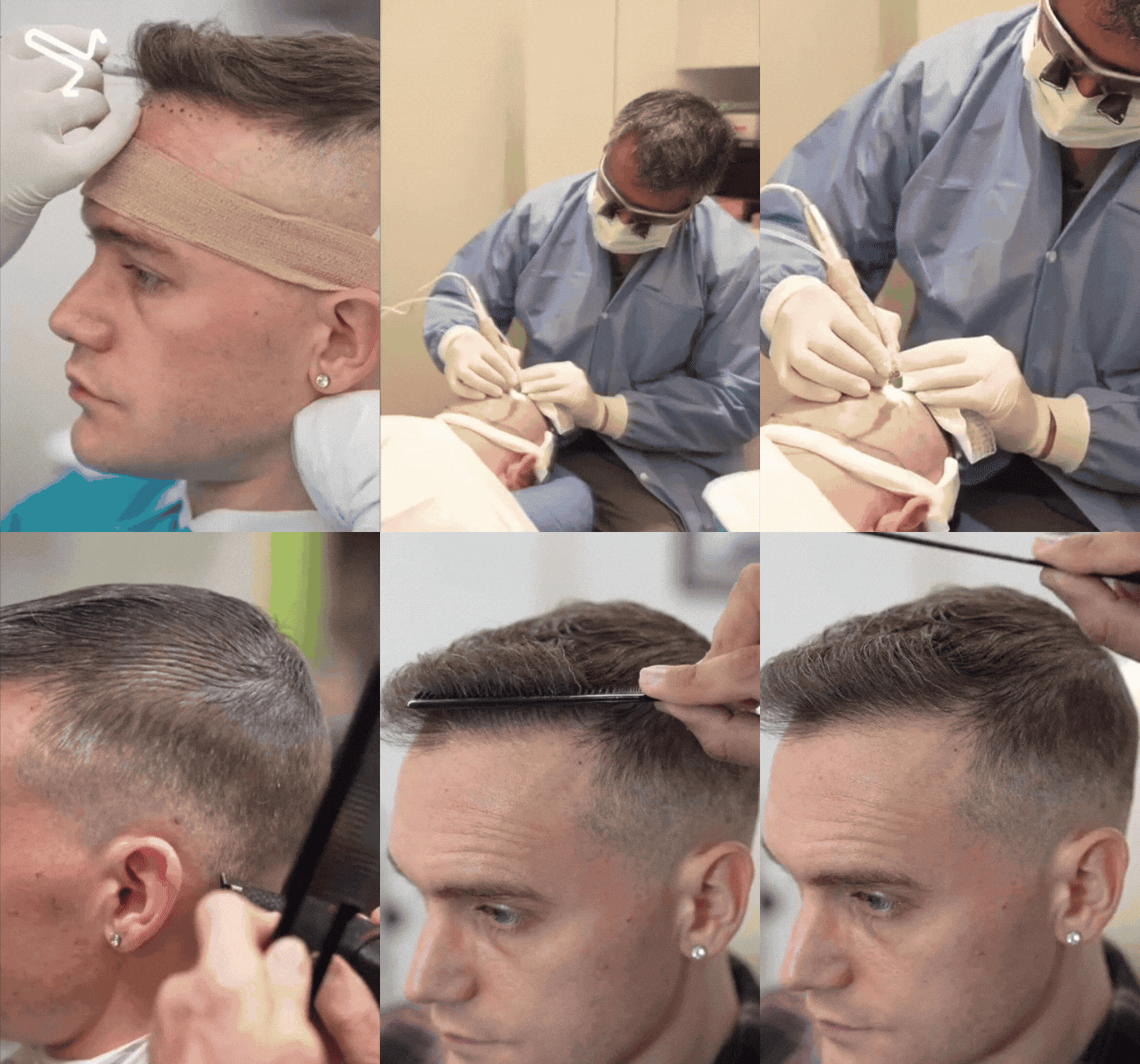
Hairline design at Northwestern Hair treats the work as hand-drawn artistry — the three-dimensional shape, its proportions, angles, and flow must fit your face precisely, with a fourth dimension of time: designing a hairline that will evolve naturally as you age.
When evaluating any Chicago surgeon, ask to see a portfolio of real patients — before-and-after — across multiple hair types. Ask specifically about their experience with cases similar to yours. A willingness to show real results and discuss real tradeoffs is one of the strongest indicators of a surgeon you can trust.
Factor 4: Clinic Infrastructure and Team
A hair transplant isn’t a solo procedure. The surgeon works with a trained team whose quality has a direct impact on graft survival rates and the density of your final result.
Higher-end Chicago clinics invest in:
- Dedicated, full-time surgical teams rather than rotating staff
- Temperature-controlled graft storage to maximize viability during longer procedures
- Advanced imaging and scalp analysis tools for pre-surgical planning
- Sterile, purpose-built surgical suites rather than converted exam rooms
These aren’t luxuries. They’re the infrastructure that protects the grafts you’re paying for and the results you’re counting on.
Factor 5: Non-Surgical Adjunct Treatments
 Many patients pursue non-surgical treatments either before a transplant, after, or instead of surgery altogether. These are priced separately and can meaningfully affect your total investment:
- ACS (Autologous Cellular Serum): Northwestern Hair’s regenerative treatment, which uses your own cellular biology to stimulate hair growth and support recovery. ACS is also used to prepare both donor and recipient areas in surgical cases — enhancing graft survival and overall density outcomes rather than functioning purely as a standalone treatment.
- A newer regenerative approach that introduces growth-signaling proteins to the scalp to promote follicle activity. Often used to enhance surgical results or address early-stage thinning non-surgically.
- PRP (Platelet-Rich Plasma): A well-established injectable treatment, though many Northwestern Hair patients ultimately transition to ACS once they understand the difference in mechanism and outcomes.
- Scalp Micropigmentation (SMP): A non-surgical option that uses micro-pigmentation to simulate the appearance of a shaved head or add visual density. Priced separately from surgical procedures.
If a non-surgical path is appropriate for your situation, the total cost of treatment looks very different than a surgical case — and in some early-stage scenarios, a well-designed non-surgical protocol may be the right starting point before surgery is ever necessary.
This will get ads rejected.
What About Financing?
Hair transplantation is an elective procedure not covered by insurance in most cases, which means financing options matter.
Most reputable Chicago clinics — including Northwestern Hair — work with third-party medical financing partners to offer payment plans that spread the cost over time. Common options include:
- 12–24-month interest-free financing for qualified applicants
- Longer-term plans with low fixed interest rates
- Consultation packages that apply toward procedure costs
When evaluating financing, read the terms carefully. Deferred-interest arrangements can become expensive if not paid off within the promotional window. Ask about what happens if your procedure requires a follow-up session — and whether any aftercare is included in your original pricing.
The Turkey Question
It would be dishonest to write a Chicago hair transplant pricing guide without addressing this directly.
Clinics in Turkey and other international destinations advertise procedures at prices that appear to be a fraction of U.S. costs — sometimes $2,000–$4,000 all-in for a procedure that would run $15,000–$20,000 in Chicago. For some patients performing their first round of research, the gap is impossible to ignore.
Here’s what that gap actually reflects:
Lower labor costs in international markets allow clinics to operate at lower margins. That’s legitimate. But it’s also how many high-volume international clinics run eight to ten procedures a day with limited direct surgeon involvement — using technician-led models where the physician’s hands-on time is minimal.
More importantly, most international clinics operate with standard FUE. Which means the graft damage problem described above — the crushing, the severing, the dry and kinked follicles — is built into the procedure before you ever board the flight home.
Revision risk is real. A percentage of patients who travel abroad for hair transplants return to U.S. surgeons needing corrective work. Revision procedures are among the most technically demanding in the field — and some poor outcomes cannot be corrected. The cost of a failed transplant, financially and emotionally, can far exceed what was saved on the initial procedure.
Donor supply is finite. You have a limited number of healthy grafts available for extraction over your lifetime. A procedure that harvests grafts carelessly or places them poorly permanently limits what future interventions can accomplish.
For patients who are genuinely price-constrained, a thoughtful conversation about non-surgical options — or a staged approach starting with a smaller procedure — is a far better path than chasing the lowest possible number on a surgical outcome you’ll live with permanently.
What to Ask in a Chicago Hair Transplant Consultation
When you sit down with a surgeon, price should be one of the last things you discuss — not the first. Here’s what to ask before cost ever comes up:
- What extraction technique do you use, and why? Specifically, ask whether they use standard FUE or a more advanced approach — and what protections are in place during graft extraction.
- Who performs the surgery? Is it the surgeon named on the website, or technicians operating under loose supervision?
- How many grafts do you estimate I need, and how did you arrive at that number?
- Can I see before-and-after photos of patients with similar hair types and loss patterns?
- What does your follow-up process look like after the procedure?
- If I need a second session down the road, how do you factor donor supply into your planning now?
Once those questions are answered to your satisfaction, then ask about pricing — and you’ll be in a far better position to evaluate whether the number makes sense.
Final Thought: What You’re Really Paying For
The cost of a hair transplant in Chicago isn’t really about the clinic’s square footage or the neighborhood it’s in. It’s about the caliber of the surgeon, the precision of the technique, the quality of the team, and the planning that goes into treating your specific case.
When Northwestern Hair takes on a case, we see it through. We’re critical of our work, relentless in our pursuit of perfection, and fair in our approach.
A well-executed hair transplant is one of the few procedures that, when done right, look better with time. Hair grows, blends, and naturalizes in a way that makes the result increasingly invisible as a “procedure” — it just looks like your hair.
That outcome has a price. And it’s worth understanding what that price is built on before you make the decision.