




Choosing a Hair Restoration Clinic in Chicago: 7 Questions to Ask
Chicago has no shortage of options when it comes to hair restoration. A quick search turns up surgical clinics, medical spas, dermatology practices, and national chain operations — all competing for the same patient, often with similar language, similar before-and-after galleries, and similar promises about natural-looking results.
The challenge isn’t finding a clinic. It’s knowing how to evaluate one.
Most patients walk into a consultation without a framework for what they’re actually trying to learn. They look at photos, they ask about price, and they make a decision based on a combination of gut feeling and whatever the clinic’s sales process was designed to produce. That’s not a criticism — it’s just the reality of researching a medical procedure in a market where every provider sounds credible on the surface.
These seven questions cut through that. They’re designed to surface the information that actually separates a surgeon and clinic worth trusting from one that will disappoint you — and to give you a basis for comparison that goes beyond aesthetics and pricing. Contact Northwestern Hair Restoration today for more information.
Question 1: Who Actually Performs the Procedure?
This is the single most important question you can ask — and the one most patients never think to raise.
At many clinics, particularly high-volume operations and national chains, the surgeon you consult with is not the surgeon performing your procedure. In some cases, they’re not performing much of the procedure at all. Technicians handle extraction, placement, and the majority of hands-on work while the physician moves between multiple operating rooms, checking in periodically and signing off on the outcome.
This model exists because it’s economically efficient. A surgeon who books four or five procedures a day generates far more revenue than one who commits an entire day to a single patient. The patient absorbs the risk of that efficiency.
What you want to hear in response to this question is simple and specific: the named surgeon is present and personally involved in every step — from the consultation through the hairline design, the extraction, the placement, and the post-procedure follow-up.
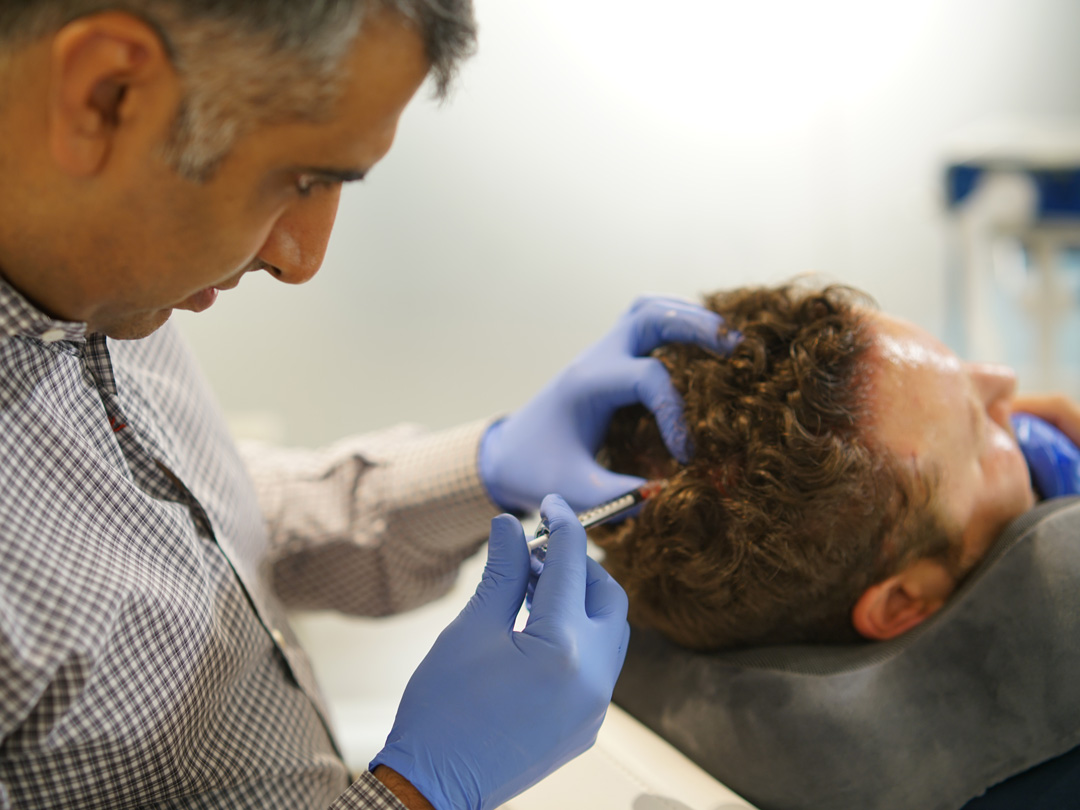
At Northwestern Hair, Dr. Vinay commits to one procedure per day. That’s not a marketing line — it’s a structural decision that has a direct impact on what happens in the operating room and what your result looks like twelve months later. When you ask this question at other Chicago clinics, listen carefully to how the answer is qualified.
Question 2: What Extraction Technique Do You Use — and Why?
 Most patients have heard of FUE. Fewer understand that not all FUE is equivalent — and that the extraction step is where outcomes are won or lost before a single graft is ever placed.
In standard FUE, tweezers are used to handle grafts, and sharp punch instruments extract follicles from the donor area. Both create real risk: tweezers can crush the graft, and an aggressive punch can sever the follicular structures that make growth possible. The damage isn’t visible to the naked eye and won’t show up until months later when growth is sparse, uneven, or simply doesn’t materialize.
Ask any Chicago clinic you’re evaluating: what specific technique do you use for extraction, and what does it do to protect graft integrity? A surgeon who can’t answer this in concrete, clinical terms — or who defaults to “we use the latest FUE technology” without specifics — is worth being skeptical of.
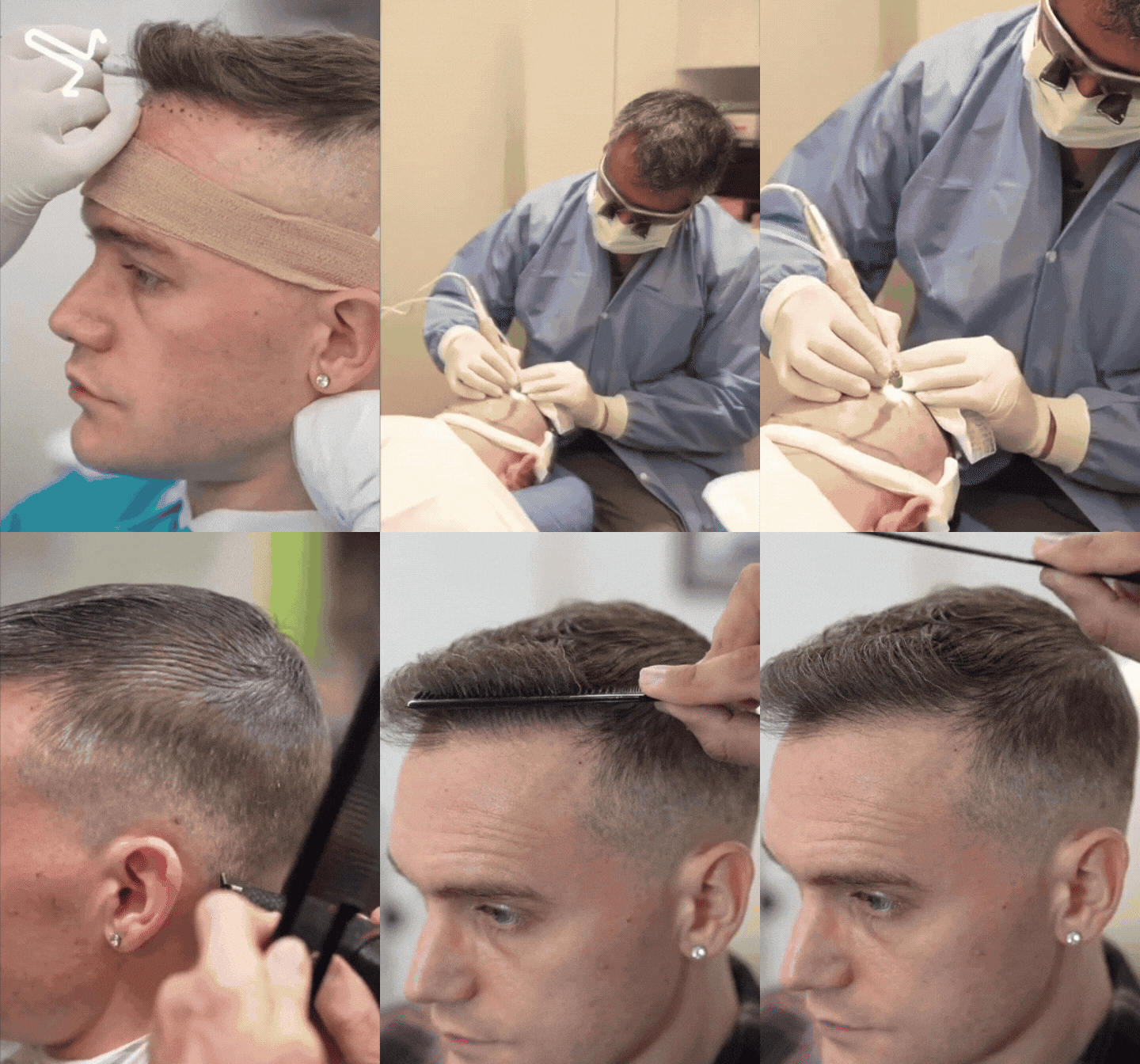
At Northwestern Hair, the answer is No-Touch Micro PUE®. Vibration and suction replace mechanical gripping entirely. Grafts are extracted without contact that could compromise their architecture, which means what gets transplanted is intact, viable, and positioned to grow. It’s a fundamentally different mechanism than standard FUE — not a variation of it.
The technique question also opens a useful follow-up: what happens if a graft is compromised during extraction? A surgeon with real standards and real quality control will have a direct answer.
Question 3: Can I See Real Patient Results — Specifically Cases Like Mine?
Before-and-after galleries are standard practice in hair restoration marketing, and they’re genuinely useful. But how a clinic presents them matters as much as what they show.
What you’re looking for is not the best-case result the clinic has ever produced — it’s representative results from patients whose starting point resembles yours. If you’re a Norwood Stage 4 with moderate crown loss, you want to see what that looks like twelve months post-procedure, not a dramatic Stage 6 transformation or a hairline refinement on someone with minimal loss.
Ask specifically:
- Can I see results from patients with a similar Norwood stage to mine?
- Do you have cases with my hair type — texture, curl pattern, density?
- How many of the photos in your gallery are from the last twelve months versus older cases?
Also, ask what the photos don’t show. A surgeon confident in their results will tell you honestly about cases that required a second session, areas that took longer to fill in, or outcomes that didn’t meet the initial target. That honesty is a stronger indicator of trustworthiness than a curated gallery of the clinic’s best work.
If the answer to any of these questions is evasive, or if the portfolio is thin on cases similar to yours, that’s meaningful information.
Question 4: How Do You Approach Hairline Design?
The technical execution of a hair transplant matters enormously — but so does the artistic judgment behind it. Extraction technique determines whether grafts survive. Hairline design determines whether the result looks like your hair or like a procedure.
A natural hairline isn’t a straight line drawn at a fixed point on the forehead. It’s a three-dimensional structure with irregular edges, varied graft angles, intentional irregularity at the transition zone, and proportions calibrated to the individual face. It also needs to account for time — a hairline that looks right at 40 may look incongruent at 60 if it wasn’t designed with aging in mind.
Ask any clinic you’re considering: how do you approach hairline design, and who makes those decisions? Is it template—based on standard measurements and ratios — or is it drawn specifically for your face, your bone structure, and your long-term hair loss trajectory?
At Northwestern Hair, hairline design is treated as the artistic commission that defines the entire case. The shape, proportions, angles, and flow are calibrated to fit the patient’s face precisely. The hairline itself is hand-drawn — not templated — because the final line is what separates a result that looks genuinely natural from one that looks restored.
This is worth probing in any consultation. Ask the surgeon to describe what your hairline design would look like and why. The quality of that answer tells you a great deal about how they approach the work.
Question 5: What Does Your Post-Procedure Support Look Like?
 What happens after you leave the clinic matters more than most patients anticipate. Recovery from a hair transplant involves a sequence of healing milestones — scabbing, shedding, early growth, density development — that span twelve months and raise questions at every stage. How accessible your surgeon is during that period has a direct bearing on both your actual outcome and your experience getting there.
Ask specifically:
- Who do I contact if I have questions or concerns in the first week?
- Is the surgeon directly reachable, or does post-procedure communication go through staff?
- What does the follow-up schedule look like over the first year?
- Is aftercare included in the procedure cost, or is it billed separately?
At Northwestern Hair, Dr. Vinay is personally involved through the entire continuum — consultation, procedure, and aftercare. Post-procedure communication goes directly to him, not through layers of staff. Patients receive structured follow-up at key milestones and have direct access throughout the recovery arc. That level of continuity isn’t standard in the industry, and it’s worth asking about explicitly at every clinic you visit.
A surgeon who hands you off entirely after the procedure is done has a different relationship to outcomes than one who stays with you until the final result is in.
Question 6: What Are Your Limitations — and What Can’t You Fix?
This question makes most patients uncomfortable asking. It shouldn’t.
Every surgeon operates within real constraints. Donor supply is finite. Some hair types respond differently to transplantation than others. Some patients’ loss patterns are progressive enough that a single procedure won’t produce the coverage they’re imagining. Some previous procedures done elsewhere have compromised the donor area in ways that limit what’s possible going forward.
A surgeon who tells you honestly about these limitations — and who adjusts the treatment plan accordingly — is operating with integrity. A surgeon who promises a full head of hair, maximum density, and no need for follow-up procedures regardless of your situation is telling you what you want to hear.
Ask directly: given my specific hair loss pattern, donor density, and goals, what are the realistic limitations of what a procedure can accomplish? Are there scenarios where a non-surgical approach would serve me better right now? What would disqualify me as a good surgical candidate?
The willingness to answer these questions honestly — including the willingness to recommend against surgery when the situation calls for it — is one of the strongest signals that a surgeon is prioritizing your outcome over their procedure volume.
Question 7: Why Shouldn’t I Go to Turkey?
If you’ve researched hair transplant pricing at all, you’ve encountered international options — primarily clinics in Turkey that advertise all-inclusive procedures at a fraction of Chicago pricing. It’s a legitimate question, and any clinic that dismisses it without engaging the substance isn’t giving you the honest conversation you deserve.
Ask any Chicago surgeon you’re evaluating to walk you through the actual tradeoffs. What you’re listening for isn’t a defensive sales pitch — it’s a clinical and practical argument that addresses the real variables.
The strongest version of that argument centers on three things:
Technique. Most international high-volume clinics operate with standard FUE. The graft damage problem — crushing, severing, compromised architecture — is built into those procedures before you ever board the flight. The per-graft price is lower partly because the level of care applied to each graft is lower.
Donor supply. You have one donor area, and the grafts in it are finite. A poorly planned or carelessly executed procedure doesn’t just produce a suboptimal result — it consumes grafts you’ll need later and may never get back. That cost doesn’t show up on an invoice.
Revision reality. Corrective hair transplant work is among the most demanding in the field. Some outcomes from international clinics can be improved; others cannot. The patients who return to Chicago surgeons after an unsuccessful procedure abroad often find that the total cost — financially and emotionally — exceeded what a quality domestic procedure would have cost from the start.
A surgeon who engages this question directly and honestly, without pressure or condescension, is the kind of surgeon worth trusting with the decision.
What These Questions Are Really For
The goal of asking these seven questions isn’t to catch a clinic in a mistake or to create an adversarial consultation dynamic. It’s to give yourself a basis for comparison that goes beyond what any website, gallery, or intake form can tell you.
The right surgeon for you answers these questions with specificity, honesty, and zero pressure — who tells you what’s realistically possible for your case, explains the clinical reasoning behind their approach, and treats the consultation as the beginning of a relationship rather than the close of a sale.
That’s the standard to hold every Chicago clinic you visit to. And it’s the standard Northwestern Hair holds itself to every day.
Ready to ask these questions in person? Book a consultation with Dr. Vinay at Northwestern Hair — one conversation, one patient, no pressure.