



Micro PUE vs. FUE: Is There Really a Difference? A Chicago Surgeon’s Honest Breakdown
If you’ve been comparing hair transplant options in Chicago, you’ve probably noticed that different clinics use different terminology — FUE, Micro FUE, Micro PUE, No-Touch extraction — and it’s not always clear whether these represent genuinely different techniques or just different ways of marketing the same thing.
Fair question. The honest answer is: it depends on the clinic. Some of what gets branded as “micro” or “advanced” FUE is cosmetic differentiation with little substance behind it. But the distinction between standard FUE and true No-Touch Micro PUE® — the technique used at Northwestern Hair — is real, measurable, and shows up directly in how transplanted hair looks and behaves. Contact us today for more information.
Here’s the breakdown, without the sales spin.
What Standard FUE Actually Does
FUE — Follicular Unit Extraction — is the dominant hair transplant method today, and it’s a genuine improvement over the older strip method (FUT). No linear scar, faster healing, and more natural distribution of grafts. The basics are sound.
The process: a small punch tool rotates around each follicular unit to separate it from the surrounding tissue, then tweezers extract the graft and place it into a holding solution before implantation.
Where it falls short is in what that rotation and extraction do to the graft itself.
Hair follicles don’t exist in isolation. They’re surrounded by oil glands (sebaceous glands) and connective tissue that keep the hair nourished, lubricated, and growing normally. Standard FUE blades and tweezers can cut and crush these vital structures during collection. The follicle survives the extraction — technically — but it arrives at the recipient site already compromised. It may still grow. But the hair it produces can be drier, coarser, kinkier, or less predictable than native hair. In some cases, grafts don’t survive at all.
This isn’t a fringe criticism of FUE — it’s a documented limitation that the field has been working to address for years. Micro PUE is Northwestern Hair’s answer to it.
What No-Touch Micro PUE® Actually Does Differently
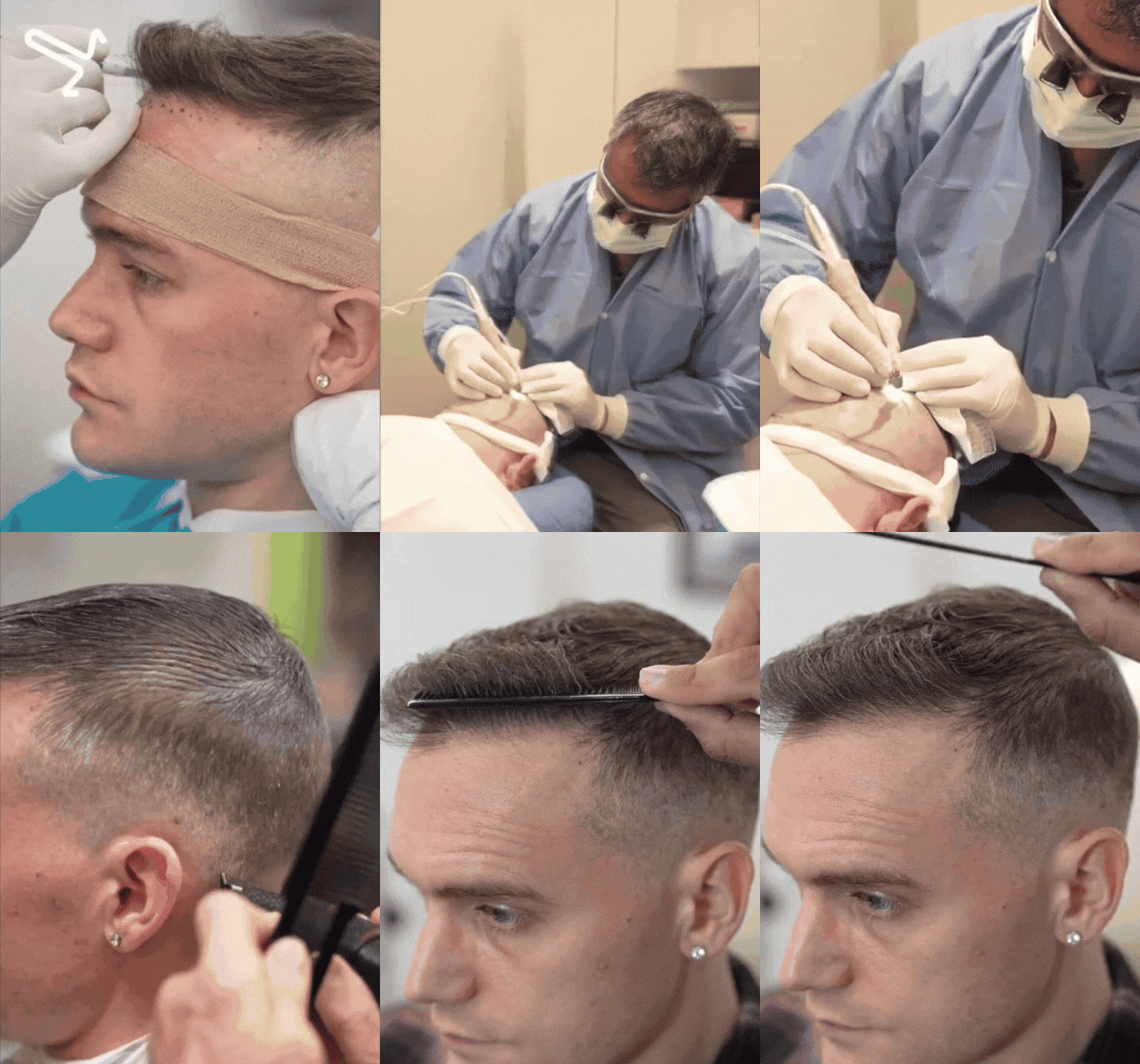
 The name contains the core distinction: No-Touch. Where standard FUE uses tweezers that can crush grafts and sharp punches that can sever key structures, No-Touch Micro PUE® uses vibration and suction to gently extract each graft without damaging its natural architecture.
No blades are cutting across the graft. No tweezers gripping and compressing the follicular unit. Instead, oscillating vibration loosens the graft from surrounding tissue with minimal mechanical force, and suction — rather than physical contact — lifts and transfers it.
The result is a graft that arrives at the recipient site with its oil glands and connective tissue intact. Under a microscope, the difference is visible: Micro PUE cells develop extensions that allow them to stimulate growth more effectively, while standard FUE cells remain comparatively passive. And in head-to-head testing by Northwestern Hair’s physicians, Micro PUE caused 50% less injury to hair than traditional FUE.
Fifty percent. That’s not a marginal refinement. That’s a fundamentally different outcome at the cellular level.
How That Difference Translates to Real Results
Graft health isn’t just a technical metric — it directly determines what your hair looks and feels like after it grows in. Here’s where the gap between Micro PUE and standard FUE becomes visible to patients:
Hair texture and behavior. FUE hairs can end up dry, frizzy, or kinked because the extraction process damages vital structures. Micro PUE grafts, with oil gland function preserved, produce hairs that grow with normal texture and behave like the surrounding native hair — not like transplants.
Hairline naturalness. With healthier hair, hairlines look more natural and are easier to keep looking natural over time. A hairline built from compromised grafts may look acceptable in a photo but noticeably different in motion, in certain lighting, or as years pass.
Density appearance. High-density grafts placed with standard FUE can look like sprouts of grass or mini plugs. With micro-grafting, density is created in a way that looks natural. The difference is especially visible at the hairline and temples, where scrutiny is highest.
Graft survival rate. More grafts surviving means better results from fewer grafts placed, which in turn preserves more of your donor supply for the future. For patients whose hair loss is likely to continue progressing, donor conservation is a long-term strategic consideration, not just an aesthetic one.
Micro PUE vs. FUE: Direct Comparison
| Factor | Standard FUE | No-Touch Micro PUE® |
| Extraction method | Rotating punch + tweezers | Vibration + suction |
| Physical contact with the graft | Yes — gripping and compression | No — suction transfer only |
| Graft injury rate | Baseline | ~50% lower |
| Oil glands preserved | Often damaged or severed | Preserved |
| Hair texture post-growth | Can appear dry, frizzy, kinked | Natural — matches native hair |
| Density appearance | Risk of plug-like appearance | Blends naturally |
| Sessions required | Often 2 days for large cases | 3,000–5,000 grafts in one session |
| Donor supply preservation | More grafts needed per result | More preserved for future use |
| Hairline longevity | Variable as the patient ages | Better-equipped to age naturally |
The Session Efficiency Difference
 One practical advantage that often surprises patients: No-Touch Micro PUE® allows Northwestern Hair to perform 3,000–5,000 grafts in a single session, eliminating the need for two-day procedures that standard FUE often requires.
Two-day FUE cases aren’t just inconvenient. Splitting extraction and placement across two days introduces additional out-of-body time for grafts and cumulative stress on the donor area — both of which can have compounding negative effects on outcomes. Completing the procedure in a single session removes those variables entirely.
Northwestern Hair also performs only one procedure per day, with Dr. Vinay personally involved at every step. That commitment to undivided attention for each patient is part of what makes single-session precision work — you’re not sharing surgical bandwidth with another case running in parallel.
What About Clinics That Call Their FUE “Micro”?
This is worth addressing directly because the terminology can be confusing.
“Micro FUE” is used loosely across the industry. Some clinics use smaller punch sizes than traditional FUE and market this as “micro,” — and smaller punches do cause less scarring to the donor area, which is a real benefit. But smaller punches alone don’t solve the extraction mechanism problem. If tweezers are still physically gripping the graft, the compression damage to oil glands and connective tissue still occurs.
True No-Touch Micro PUE® eliminates physical contact with the graft during extraction entirely. That’s the distinction that matters — not just punch size, but the entire extraction philosophy.
When evaluating any clinic’s “advanced FUE” claims, the right question is: how is the graft actually extracted and transferred? If tweezers are still in the picture, the graft quality ceiling is the same regardless of how the technique is branded.
Who Is Micro PUE Best Suited For?
Micro PUE is the right choice for most surgical hair restoration candidates, but it’s particularly well-matched for:
Patients who prioritize natural results above all else. If you want transplanted hair that genuinely looks and behaves like native hair — not just hair that grows — graft quality is the deciding factor, and Micro PUE wins that comparison clearly.
Patients with enough hair loss to require a larger graft count. The single-session capacity of Micro PUE means cases requiring 3,000–5,000 grafts don’t need to be split, compromising neither convenience nor outcomes.
Patients are thinking about long-term donor supply. Getting more from fewer grafts means more banked for the future — important for anyone whose hair loss pattern is likely to continue evolving over the next decade.
Patients who’ve had standard FUE elsewhere with mixed results. If previously transplanted hairs look off in texture, density, or naturalness, graft quality at extraction is frequently the root cause. Micro PUE addresses that directly.
The Honest Bottom Line
Standard FUE is a legitimate, effective procedure. Compared to the strip method, it’s a clear step forward. But the extraction mechanism has a real, documented limitation — one that shows up in graft survival rates, hair texture, and long-term naturalness.
No-Touch Micro PUE® was developed specifically to solve that problem. The 50% reduction in graft injury isn’t a marketing number — it’s the measurable result of removing the most damaging step from the extraction process entirely. For patients who want the best possible outcome from their investment, that gap is meaningful.
The right next step is a consultation where your donor characteristics, hair loss pattern, and goals can inform a specific recommendation — not a generic comparison chart.
Schedule your consultation with Dr. Vinay at Northwestern Hair →