




Why Northwestern Hair Uses ACS Instead of PRP — And What the Research Shows
If you’ve been researching hair loss treatments, PRP has probably come up more than once. It’s one of the most searched non-surgical hair restoration options in Chicago, and for good reason — it’s been around for years, it’s widely offered, and there’s legitimate science behind it. Contact Northwestern Hair Today for more information.
So why doesn’t Northwestern Hair offer PRP?
The short answer: because Autologous Conditioned Serum (ACS) is more effective — and the research backs it up. Here’s the full explanation.
First — Does PRP Actually Work for Hair Loss?
Yes. PRP (Platelet-Rich Plasma) is a real, clinically studied treatment. It works by concentrating platelets from your own blood and injecting them into the scalp, where those platelets release growth factors that can stimulate follicle activity and improve blood supply.
For patients with early androgenetic alopecia, PRP has shown measurable improvements in hair density and thickness across multiple studies. It is not a gimmick.
But effective and optimal are two different things. PRP has a ceiling — and that ceiling is set by biology. Specifically, by the quality and quantity of your own platelets, and by what platelets alone can actually do at a cellular level.
What Is ACS — and Why Is It Different?
 Autologous Conditioned Serum (ACS) is also derived from your own blood, so, like PRP, there are no foreign substances involved. But the processing method is fundamentally different, and that difference matters enormously.
Where PRP isolates and concentrates platelets, ACS goes further: it activates and conditions the serum to harness your blood’s active regenerative cells — the cells your body actually uses during wound healing and tissue repair.
Backed by the science of wound care, ACS reactivates dormant hair follicles by stimulating hair and skin cells to replicate and grow, just as they naturally do when healing a wound.
The key distinction happens at a microscopic level. Under a microscope, platelet therapy cells remain relatively passive. ACS-conditioned cells behave differently — they develop what appear to be cellular extensions that allow them to interact with and stimulate surrounding follicular tissue far more aggressively. Typical platelet therapies are still effective, just not as powerful as ACS.
What the Research Shows
ACS has a peer-reviewed clinical foundation. A published study available through the National Institutes of Health (PMC10460780) documents its application in hair restoration and the regenerative mechanisms behind it.
The core finding that makes ACS compelling isn’t just that it works — it’s how it works. Hair loss is fundamentally a follicle metabolism problem. Testosterone causes follicles to thin and slow their metabolism, which the body responds to by decreasing blood flow to the scalp. If the metabolism is not increased and blood flow is not re-established, the follicle cannot survive.
PRP addresses blood supply and growth factor delivery. ACS goes deeper — targeting follicle metabolism directly, not just stimulating the surface environment around it. That’s the clinical gap that makes the difference in outcomes.
How ACS Compares to PRP in Practice
| Factor | PRP | ACS |
| Derived from your own blood | Yes | Yes |
| Cell type used | Platelets only | Active regenerative cells |
| Targets follicle metabolism | Indirectly | Directly |
| Cellular activity level | Passive | High — cells become actively interactive |
| Result timeline | 4–6 months typical | First signs often visible at 3 months |
| Sessions | 3–4+ | 4 structured sessions |
| Downtime | None | None |
What to Expect from ACS at Northwestern Hair
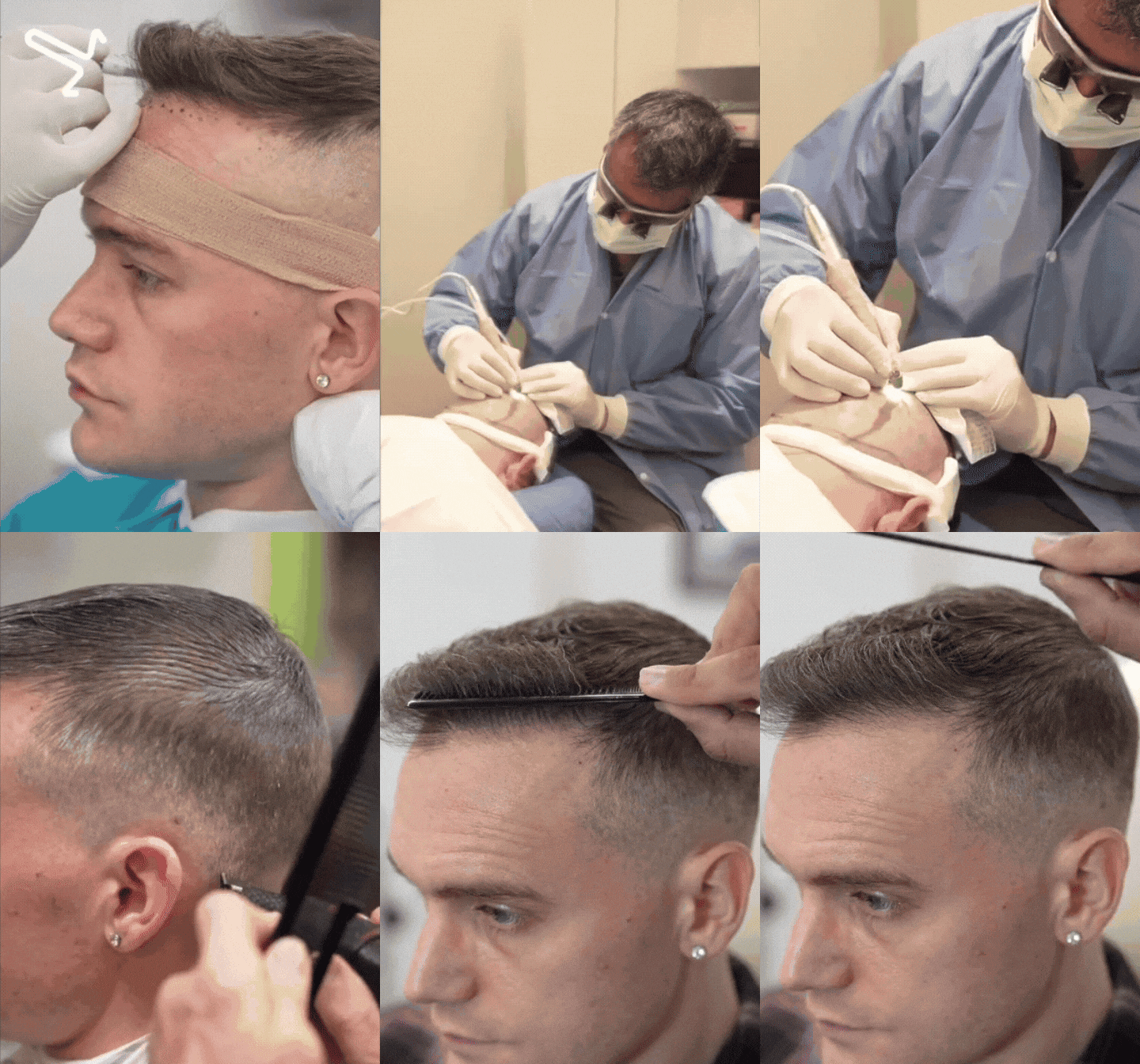
 The program involves four ACS treatments, each taking 1.5–2 hours with no downtime. Between sessions, Dr. Vinay trials personalized at-home maintenance protocols — topicals, medications, and devices — to build a complete, individualized approach alongside the in-office treatment.
Almost everyone has a response, with first signs typically visible at 3 months and peaking at 9 months. By the end of the program, you have a tailored long-term plan — not just a series of injections with no roadmap.
That structure is another thing that separates ACS at Northwestern Hair from most PRP programs, which are often administered as standalone sessions without a coordinated at-home strategy.
So, is PRP Good for Hair Loss in Chicago?
It can be. If you’ve had success with PRP, that’s real. But if you’re researching your options before starting treatment — or if you’ve tried PRP and found the results underwhelming — ACS is worth understanding as the more advanced alternative.
The question isn’t really whether PRP works. The question is whether you want a treatment that only uses part of what your blood can offer, or one that activates the full regenerative potential behind it.
At Northwestern Hair, Dr. Vinay’s answer has been clear — and the patient results reflect it.
Ready to Move Beyond PRP?
If you’ve been searching for PRP for hair loss in Chicago, you’ve found something better. Schedule a consultation with Dr. Vinay to see whether ACS is the right fit for your hair loss pattern and goals.