
A message from Dr. Vinay Rawlani
Most people treat the consultation as a formality — a step to get through before the real thing. I’d ask you to think about it differently.
The consultation is the only part of this process you get to see. Everything after it happens without you: the planning, the technique selection, the decisions made in the room while you’re sedated. What you learn during your consultation is all you will ever know about how your procedure was built.
So the question isn’t just what you’ll be told. It’s who is telling you, and what happens to that information after you leave. Contact Northwestern Hair Restoration today for more information.
Whoever sits across from you is defining your surgery. They are taking your history, forming an impression of your scalp, and translating all of it into a plan that someone will execute weeks later.
At most clinics, that person sells procedures for a living. The surgeon may stop in to shake your hand. You will not see them again until the morning of your surgery — and by then, every meaningful decision has already been made by someone else.
Ask yourself what happens to your information in between. Who carried it. What got lost. Whether the person holding the instruments ever heard what you actually said.
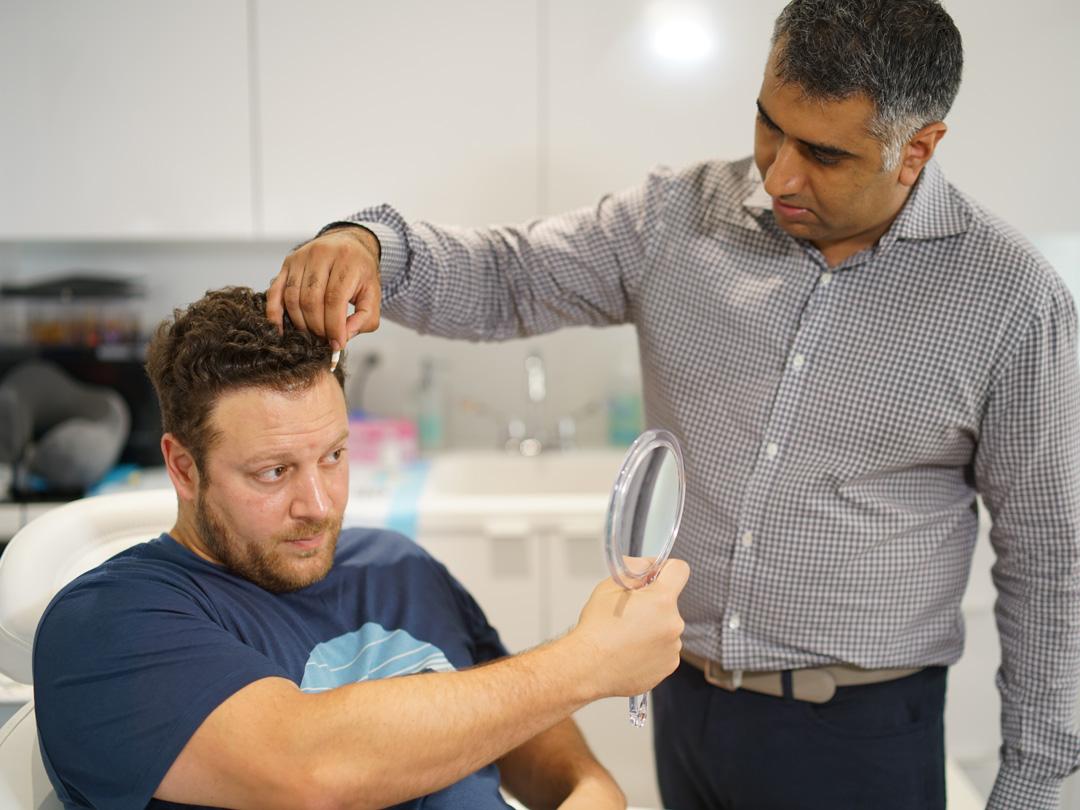
At Northwestern Hair, I meet you at the elevator.
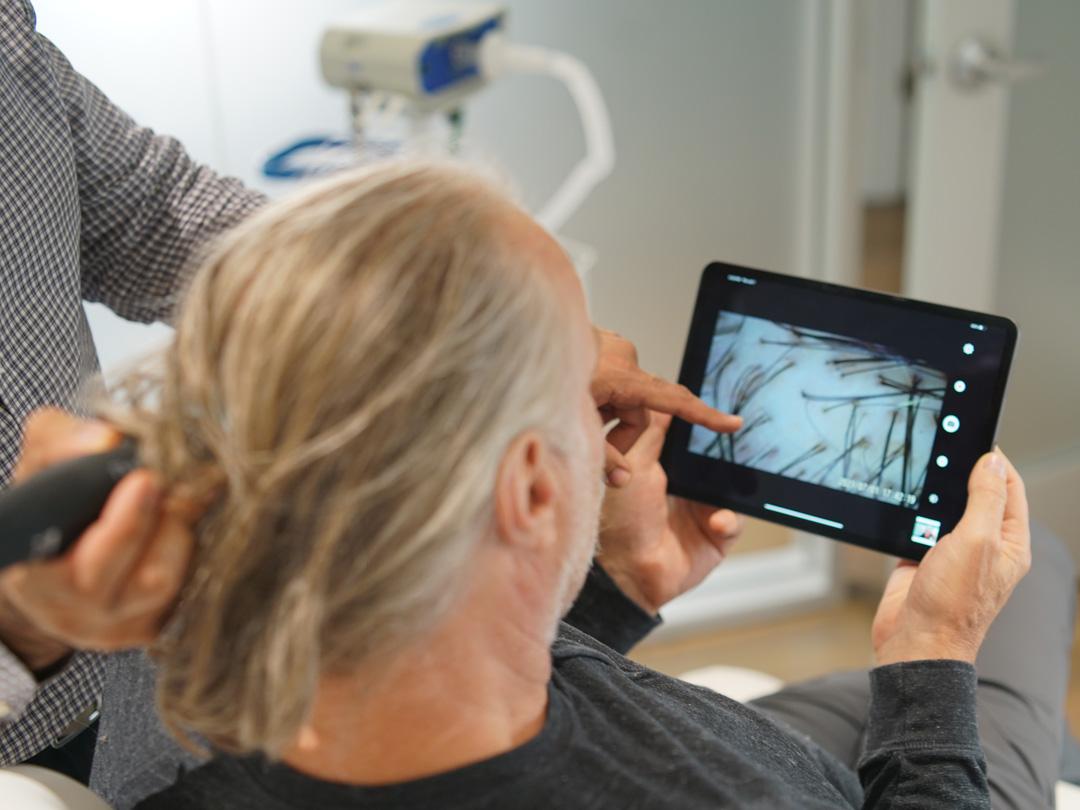
From the moment you step off it, I am your source of information. I take your history. I examine your scalp. I design your hairline. I build the plan, and I carry that plan into your procedure myself. If there is any conversation between your consultation and your surgery, I am part of it.
You work one-on-one with your doctor. I do it this way because I guarantee the work. If I am performing your procedure, I am the one who tells you what is right, what is wrong, and what is possible.
You may never have thought about it this way, but consider what it means when a surgeon isn’t in the consultation at all. They have chosen not to be involved in the part of your care that determines everything else.

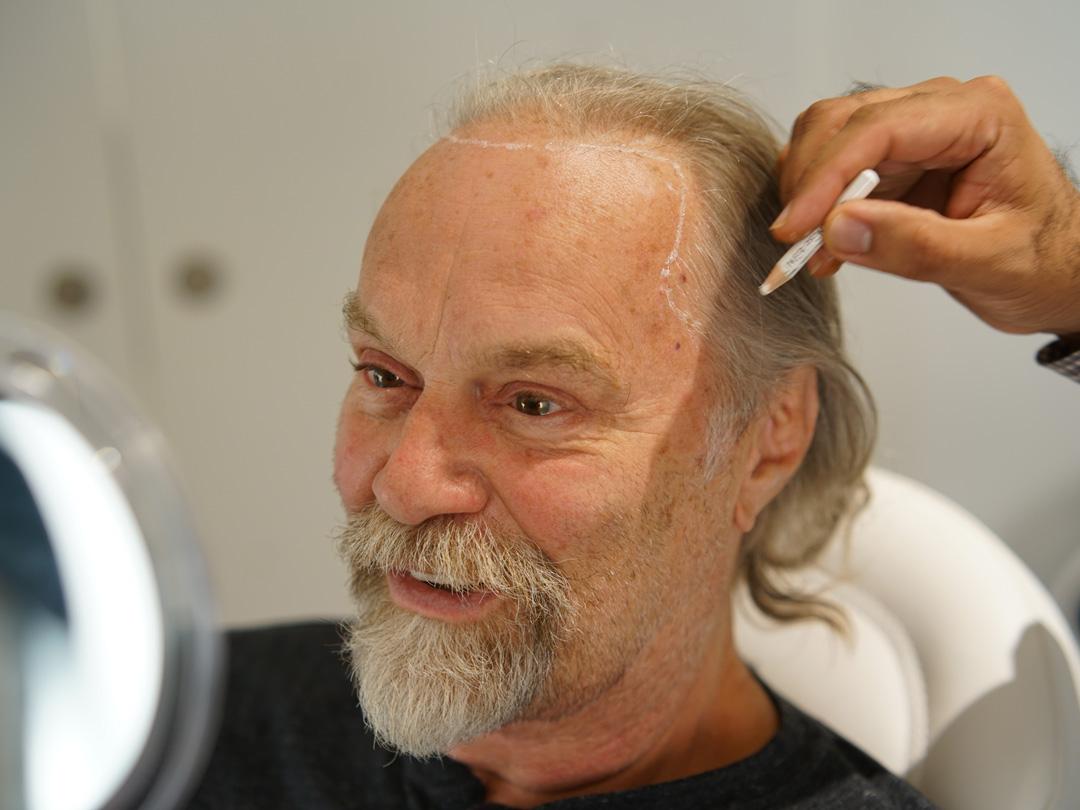
The other half runs in the opposite direction, and it’s the half that determines your result. I am asking you what I need to know to plan a procedure. I am assessing your donor supply. I am designing. I am selecting which instruments and techniques your scalp calls for. That work has to happen with you in front of me — I cannot plan a procedure from someone else’s notes.
Other offices let sales drive the consultation. I can’t imagine not being the primary source of information for a procedure I’m the one performing. That’s the standard I hold myself to, and the only way to meet it — and beat it on the next case — is to be in the room.
It also decides whether I take your case. This work is my passion, and I choose my projects. I turn a case down only when the answers tell me I can’t deliver my best on it, and I have no problem sending you to someone better suited.
So the consultation answers two questions, not one. Whether I’m the right surgeon for you. And whether you’re the right patient for me.
Four types of FUE to achieve natural, discreet, and long-lasting hair restoration.
Clinically proven treatments delivered directly to your home, plus access to dermatological and functional medicine specialists, including Dr. Elizabeth Kiracofe and Dr. Kate Volmir.
In-office treatments that strengthen existing hair and improve the scalp it grows from are used on their own or alongside surgery.
Scalp treatments, scalp micropigmentation, and CNC hair systems are all provided through our collaborative partners.
I’m not only a hair transplant surgeon. I manage medications. I perform non-surgical procedures. I work alongside dermatologists, trichologists, and scalp micropigmentation artists.
That changes what your consultation is for. I’m not evaluating whether you need a transplant — I’m evaluating what you need, with every tool in hair restoration available. I know these clinicians, I know what each of them does well, and I know what each treatment can and cannot deliver.
Sometimes the answer is surgery. Sometimes it’s medication, a non-surgical treatment, or a referral to someone else on that list. You’ll get the honest version either way, including when the honest version means you don’t work with me.


Estimate Your Foundation
Want to know your starting point? Use our interactive Hair Transplant Graft Calculator to estimate the number of grafts your specific hair profile requires.
I don’t run one standard procedure. I’ve developed tools and techniques over the years — some take longer, some use different technology — and I keep all of them available because different scalps need different things. Which of them makes sense for you is partly clinical and partly financial.
So I ask about your budget directly, and I want an honest number. Then my job is to fit as much procedure as possible inside it and still deliver a result worth having.
What I don’t want is for you to leave without that conversation, then quietly revise your budget on your own, without the person who is going to perform the work. Price determines which techniques I can use and how long I can spend on you. That makes it a clinical variable, not a billing detail — which is why I discuss it with you, in the room, while I can still redesign around it.
Here is what I don’t like about this industry.
I don’t understand how a salesperson with no medical training, paid to sell transplants, is supposed to act in your interest. When I recommend surgery, I have to perform it. Then I have to answer for the result. If it isn’t good, I owe you a fix — and I owe the next patient a revised process, so the same thing doesn’t happen twice.
A salesperson’s obligation ends when your check clears. From there, you’re passed to a surgeon hired for the day, or by the case, or by the hour. After surgery, you’re passed again to whoever administers recovery and follow-up. Every person in that chain holds a different incentive, and not one of them carries your result from beginning to end.
At Northwestern Hair, I’m responsible for your result. I’m more responsible for it than you are.



First we establish what kind of hair loss you have and whether it’s treatable. Then your history — what you’ve tried, what didn’t work, and, just as useful, what did.
Then I design it. The design comes first, because the design determines the technique — not the other way around.
A base procedure, and the best procedure I can deliver for you.
I’ll introduce you to our administrative staff for scheduling and start planning your procedure with the clinical team. We’ll speak again before your procedure, and we may see each other for a pre-treatment.
Not every patient wants surgery. I need to know where your limits are before I recommend anything.
We numb the donor area. This is the part patients report as briefly uncomfortable for about five minutes, with the typical pain score being 3 to 4 out of 10.
Based on what you tell me, I redesign around your number and fit everything I can inside it.
I’ll hand you to our administrative staff, and no one will chase you. I’m confident in the consultation and in the work. If you’re looking for the best, I don’t think you need to be pushed toward it.
First we establish what kind of hair loss you have and whether it’s treatable. Then your history — what you’ve tried, what didn’t work, and, just as useful, what did.
Not every patient wants surgery. I need to know where your limits are before I recommend anything.
Then I design it. The design comes first, because the design determines the technique — not the other way around.
From standard FUE at the base, up through Micro PUE, Discrete PUE, and Long PUE. And we talk about what you’re actually optimizing for, because these pull against each other: coverage, density, naturalness, longevity.
A base procedure, and the best procedure I can deliver for you.
Based on what you tell me, I redesign around your number and fit everything I can inside it.
I’ll introduce you to our administrative staff for scheduling and start planning your procedure with the clinical team. We’ll speak again before your procedure, and we may see each other for a pre-treatment.
I’ll hand you to our administrative staff, and no one will chase you. I’m confident in the consultation and in the work. If you’re looking for the best, I don’t think you need to be pushed toward it.
Every Northwestern Hair procedure is fully customized. Your accurate graft count, technique recommendations, and final price come from an in-person or virtual evaluation with Dr. Vinay.