
A hairline transplant that looks natural today, and for every year you have left to look in a mirror. Designed by Dr. Vinay at Northwestern Hair.
Northwestern Physician · Inventor of Timeless Hairline Design + Micro PUE® · A Physician’s Personal Guarantee


260+ Five-Star Reviews
Making a hairline transplant is two things at once. It is a design — and it is the clinical technique that delivers the design into the scalp. In a hairline transplant, the art defines the science. Every decision we make about how to extract, sort, handle, and place a graft is dictated in advance by a design choice made before the day of surgery began.
Making a hairline transplant is two things at once. It is a design — and it is the clinical technique that delivers the design into the scalp. In a hairline transplant, the art defines the science. Every decision we make about how to extract, sort, handle, and place a graft is dictated in advance by a design choice made before the day of surgery began.
There are standard ways of performing a hair transplant that produce great results. There are also ways of performing a hair transplant that produce the most natural results — results you have never seen, because you cannot detect them. These are the techniques we deploy for every hairline transplant we design: specialized methods to prepare the scalp, to remove and transfer the entire hair unit rather than just the follicle, to create a hairline that is both feathered and dense, and to maximize the yield of the transplanted grafts.
Before
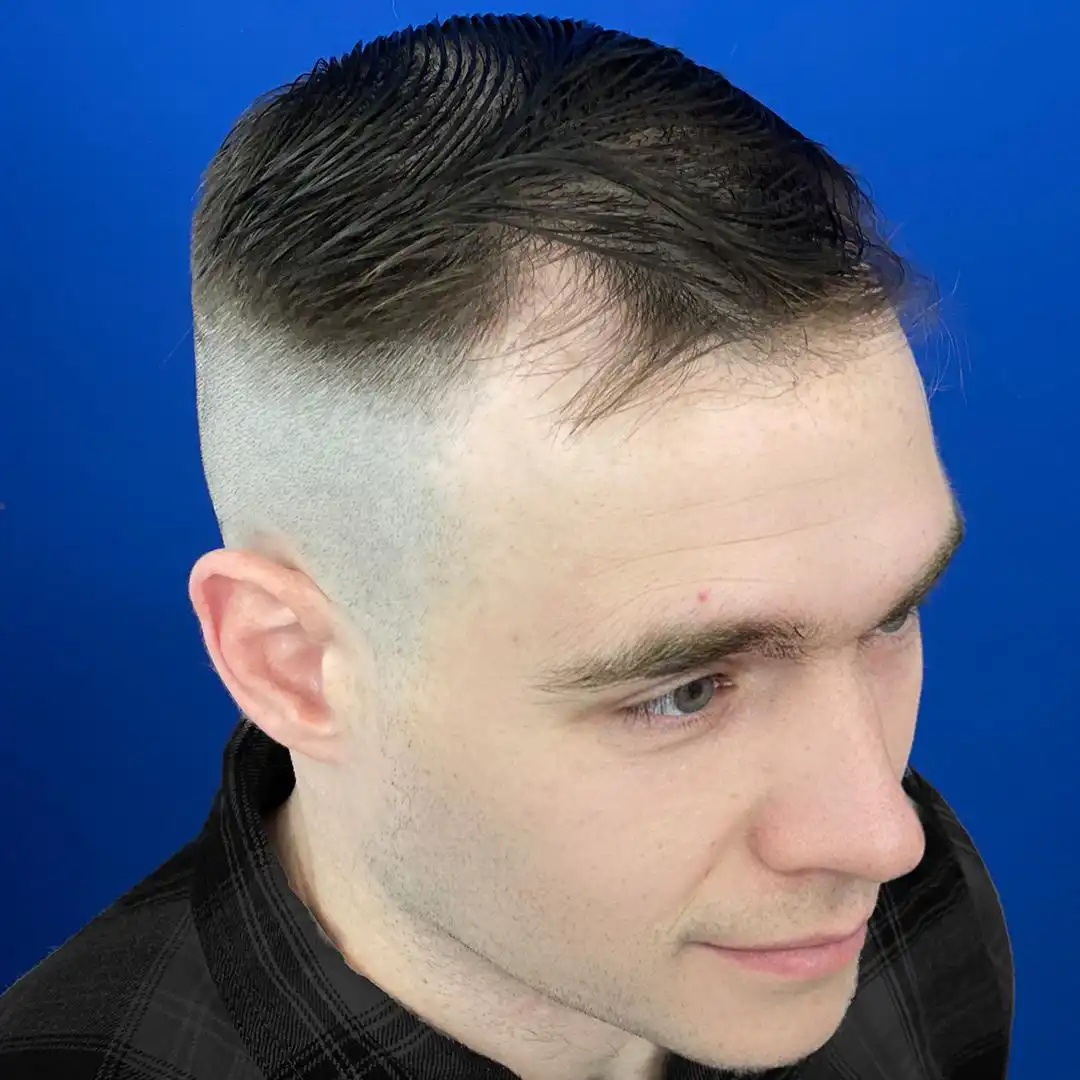
After
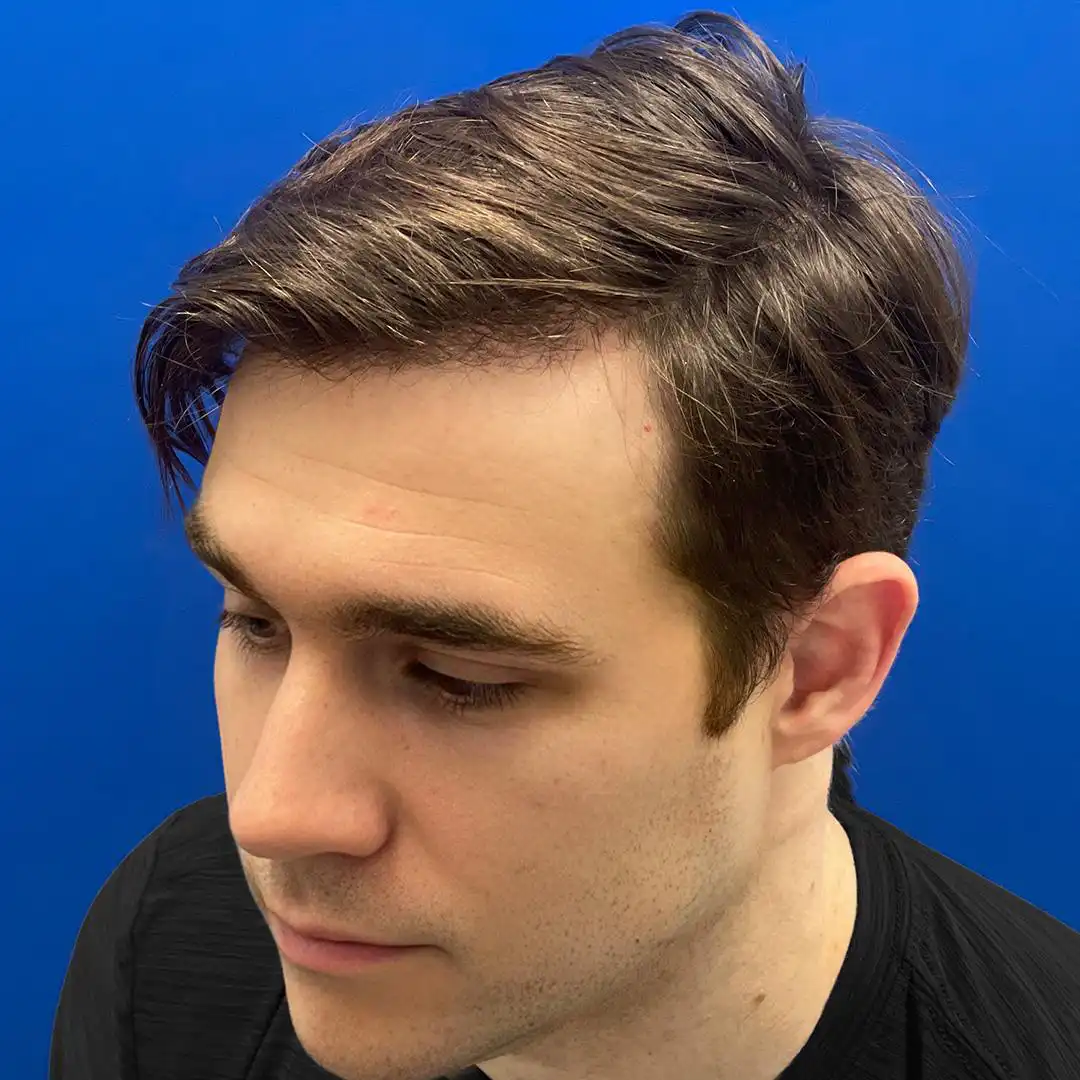
It is more than a line drawn in three dimensions. It accounts for the proportions of the face, the angles of hair exit, and the way the hairline must evolve as the face matures and the surrounding hair recedes — redefining the front half of the scalp all the way back to the crown so the patient looks natural from every direction, not just from the front. It is the design that determines what the clinical procedure must be capable of doing.
Combined, the art and clinical execution of hairline transplantation allow us to serve any patient who wants a hairline — regardless of ethnicity, hair texture, color, or type. Either the design or the technique creates the natural result in nearly every patient.
What follows is both. The art first — its philosophy, and its nine-step design methodology. Then the science — the six clinical techniques that turn design into result.
The hairline is the most consequential line ever drawn on a human face — and the design of a hairline transplant, more than any other surgical decision, determines whether the result looks natural for the rest of the patient’s life. The hairline defines youth, frames identity, and quietly tells the world how a person is aging — sometimes years before the person is ready to say it themselves. Most hair restoration surgeons treat that line as a geometric problem. Measure the face, find the thirds, apply the proportions, draw the line. The math is honest. The result, too often, is not.
A hairline is not a line. It is two things at once.
The first is position — the literal lowest hair on the head, the geometric edge where scalp becomes skin. The second is presence — where the eye perceives the hairline to begin. A person looking at a face does not read position. They read presence. They register weight, density, and the impression of where the hair starts, and they make a judgment about youth or age, fullness or loss, without ever consciously locating the line itself. These two things are not the same, and confusing them is the original sin of conventional hairline restoration.
Timeless Hairline Design — the philosophy behind every natural hairline transplant we perform — begins with a different commitment: we are not moving the position. We are changing the presence.
This matters because position and presence age differently. When the position of the hairline is moved forward, the presence of the hairline becomes weaker — the same hairs are spread over a greater area, making it appear less dense. The hairline may never reach the critical threshold to look full, and the new hairline may look as thin as the original, just at a lower position — which will eventually become unnatural. A position pushed too far forward at age forty becomes a receding hairline stranded in midair at age fifty-five, surrounded by the recession that geometry could not predict.
Timeless Hairline Design begins with the opposite assumption: the patient sitting in the chair today will be older tomorrow, and older still in ten years, and the hairline being drawn must look natural at every point along that journey. It must solve the appearance of hair loss now, without committing to a position the face will outgrow. That is the central design problem of every natural hairline transplant. It is also the hardest one in hair restoration, because the solution exists not in a single static line but in a family of lines — every hairline the patient will pass through as they age — and only a curve that produces a natural appearance at every state of recession can be called timeless.
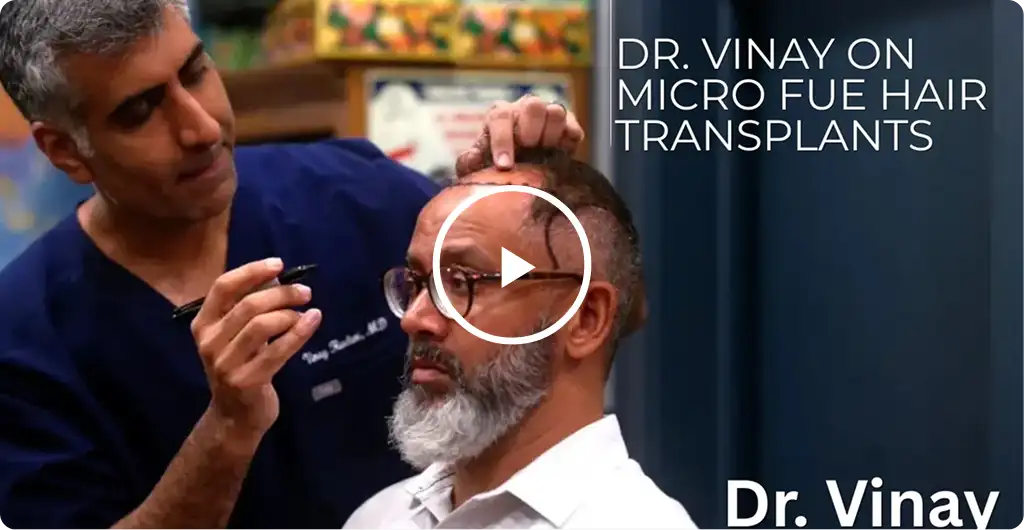
Full hairline transplant design process by Dr. Vinay at Northwestern Hair Chicago
Patients are asked to arrive with their hair already cut and styled. That haircut tells Dr. Vinay the length the patient will be wearing, and reveals any styling considerations the design will need to account for.
For Wasif, the design is happening in our restored 1950s barbershop. Eddie Diebold of Salon DJ joins us live to perform the haircut and consult on the design in real time. Eddie cuts the sides and back into the ideal shape Wasif wants to wear — the canvas the front hairline will eventually be designed against. The video captures one of the first times Eddie was part of the design itself, but this collaboration has since become a regular part of how Northwestern Hair works. Dr. Vinay invites a master stylist into the design whenever he believes the stylist’s input adds value to the line being drawn.
The work begins with the donor hairs — the hairs at the bottom of the scalp, along the sides and the back. They are the permanent hairs. They do not recede, because they are resistant to the hormones that cause male pattern hair loss. They are the foundation of every hairline transplant for men, because every restoration must live upon them in harmony.
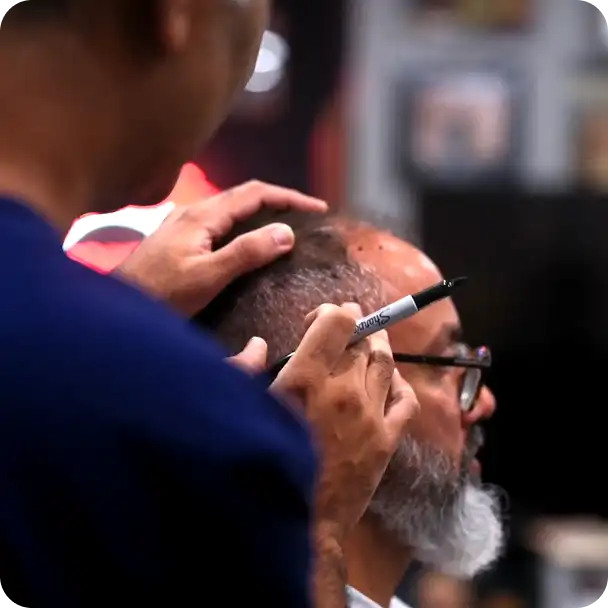
The recession line is the boundary between the two. It is the point where the hairs programmed to recede meet the donor hairs that will not. It can be identified scientifically — through palpation and experience — long before the recession itself becomes visible. Dr. Vinay’s fingers find where the thick, dense hairs give way to the finer, more vulnerable ones. That transition, traced from the sideburn upward along the side of the scalp, across the mid-scalp, and down toward the crown, is the recession line.
It is the patient’s future, rendered visible. Every hairline ever drawn must terminate in the recession line. And these recession lines — left and right — are already the sides of the design. The work of defining the sides of the hairline transplant begins right here.
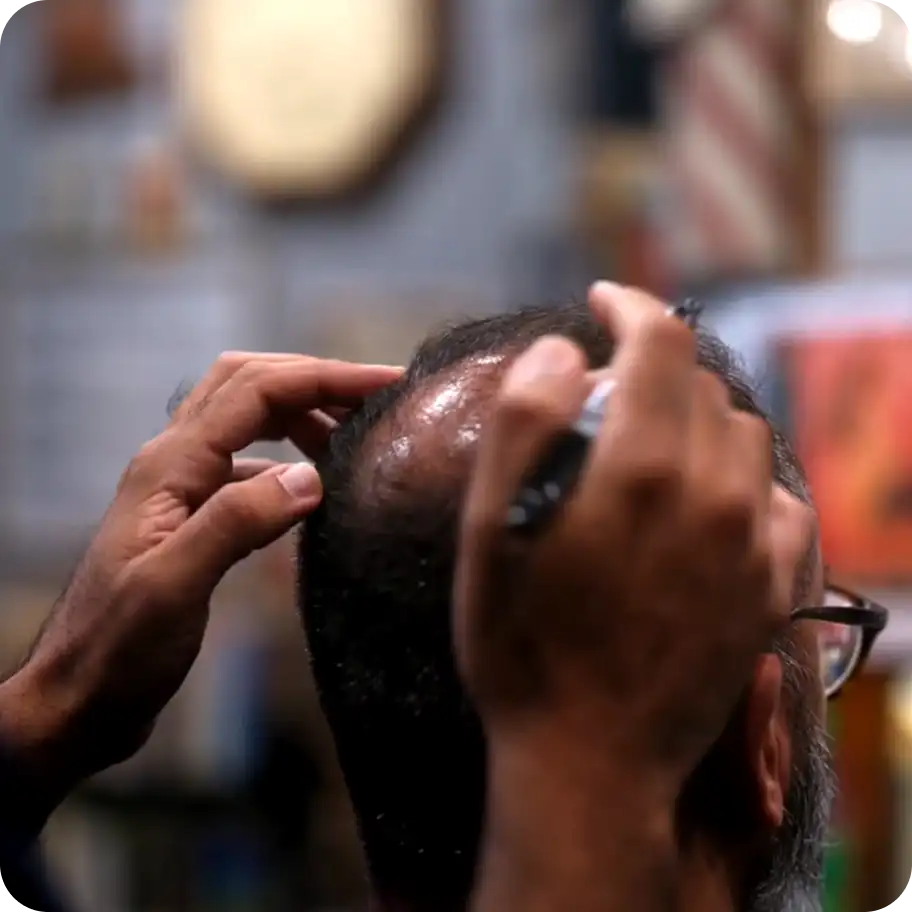
Before the front of the hairline is drawn, the crown is mapped. This is because the hairline extends back to the crown. Restoring a hairline that stops short of the crown produces an unnatural shape — a line that terminates in the middle of the scalp, where no real hairline ever has.
When the patient still has hair in the mid-scalp — as Wasif does — that hair is an advantage. It serves as a natural transition into the crown. But it will recede. The question is whether to address it now, while it still looks natural, or later, after the recession has made it look unnatural. This is because only two shapes age naturally and aesthetically over a lifetime. The first is full coverage — front to crown, all filled in, the complete restoration. The second is the man with an isolated bald crown and good hair elsewhere. These are the patterns many men with good hairlines have naturally; the world sees it every day and reads it as normal. Any other shape — a hairline that stops between the front and the crown — looks transplanted, because that shape does not exist in nature.
Restoring the crown is possible, but the timeless crown design is in development and not yet ready for public explanation. In principle, it challenges what is being done in hair restoration today. The crown should be restored from the outside in — making the bald area continuously smaller, the way the crown once grew — not from the inside out, which creates an unnatural halo of restored hair around a residual bald center. That methodology is a discussion for another day, when we begin to understand it the way we now understand the hairline.
With the recession lines drawn in Step 1, the sides of the design are already mapped. But there is a practical refinement that determines how far the restoration must actually extend on each side.
Technically, the restoration should reach all the way to the recession line. Practically, a gap of up to one and a half centimeters can be left between the new restoration and the recession line — because the part of the scalp comfortably tolerates that width without the gap becoming visible. The patient combs across it, and the gap disappears.
There is a second consideration. If the hairs sitting directly above the recession line are still too thick and coarse to safely graft into today, those hairs cannot be incorporated into the current procedure. They will eventually recede. When they do, the restoration will need to extend into that zone — which means donor hair must be calculated and reserved now for a possible future procedure. The future need is part of today’s design, even if today’s procedure cannot address it.
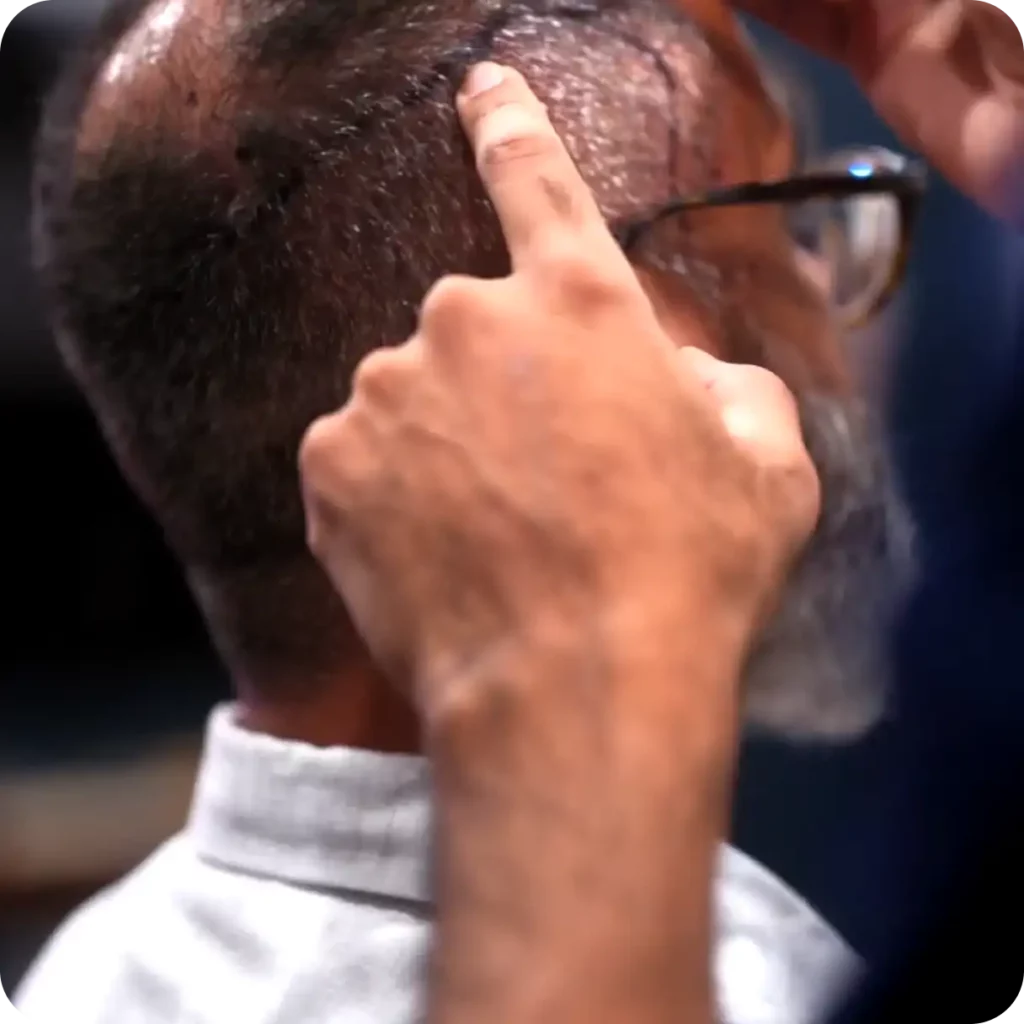
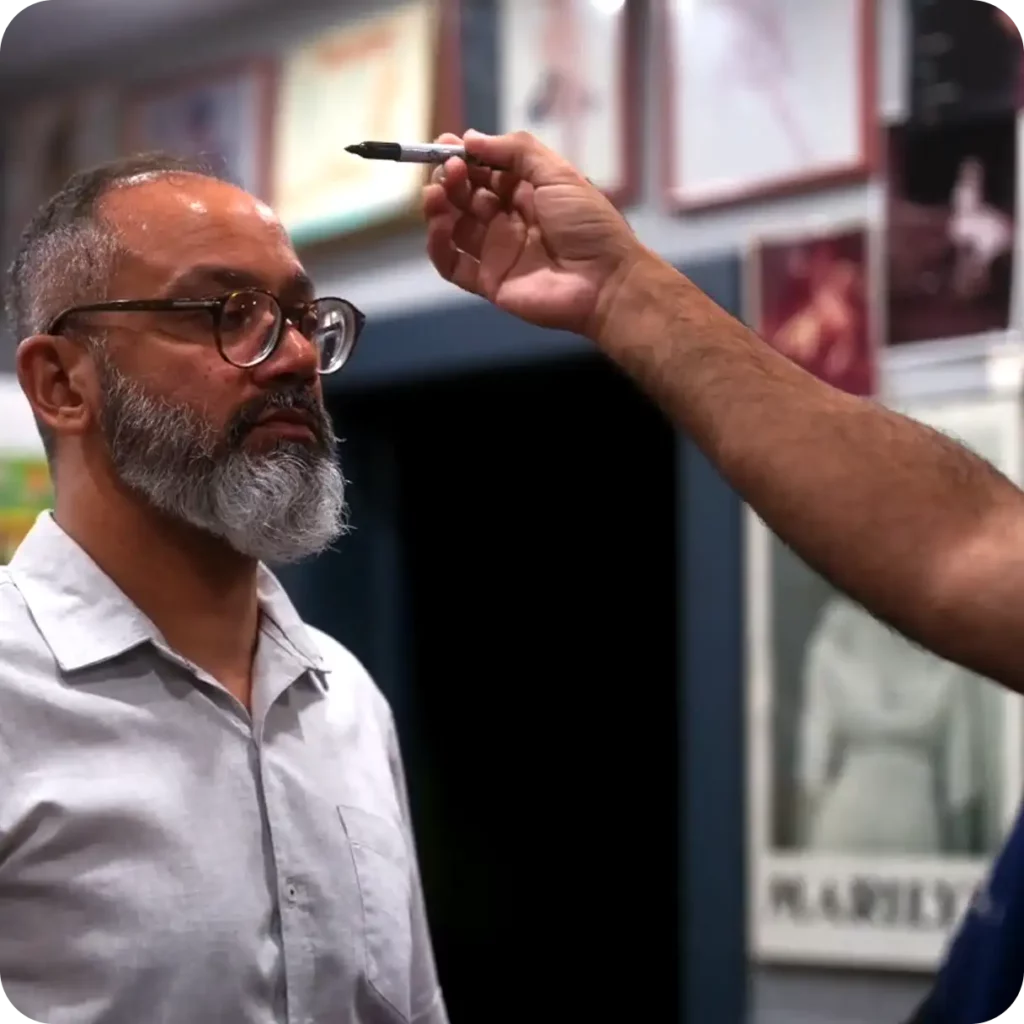
Dr. Vinay asks the patient to stand. He stands directly in front of them and looks them in the eye. Then he rises onto his toes, going from six feet tall to six foot four — the height of most of the world looking back at the patient — and looks down. How far back can he see across the top of the patient’s head? That is the horizon.
Any observer taller than the patient will see at least this far. The hairline restoration must reach at least this far back, or the horizon drops off and the design looks unfinished from above. The horizon is the minimum acceptable restoration when someone is looking the patient straight in the face.
Marking the horizon takes only a moment. Understanding what the horizon represents — and what lies beyond it — is the work of the next step.
The foundation is the natural shape that lives between the four sides of the design — the recession line on each side, the crown at the back, and the front hairline. It is the area that must be filled to produce a natural restoration. The foundation is not the lines themselves. The foundation is everything inside them.
The horizon is only relative on the front view, and for clinics with a graft limitation up to 3,000 in a single session. From the front view, a hairline restoration up to the horizon looks normal. From every other angle — top down, side, behind — the horizon is insufficient. The foundation is defined by the crown, the natural shape of a man with a good hairline and bald crown. Reaching only the horizon and stopping leaves the back of the head looking incomplete to anyone who is not standing directly in front.
Reaching the horizon takes approximately 3,000 grafts. Most clinics can perform this. Reaching the crown takes 6,000 to 8,000 grafts. This is the difference between a restoration that satisfies the patient looking in the mirror and a restoration that satisfies every angle the world will see. Northwestern Hair developed the ability to perform 6,000 to 8,000 graft procedures because reaching the crown is what produces a natural shape. The only argument against doing it is that other clinics cannot do it. A natural restoration beats an unnatural one any day of the week, and for the rest of someone’s life.
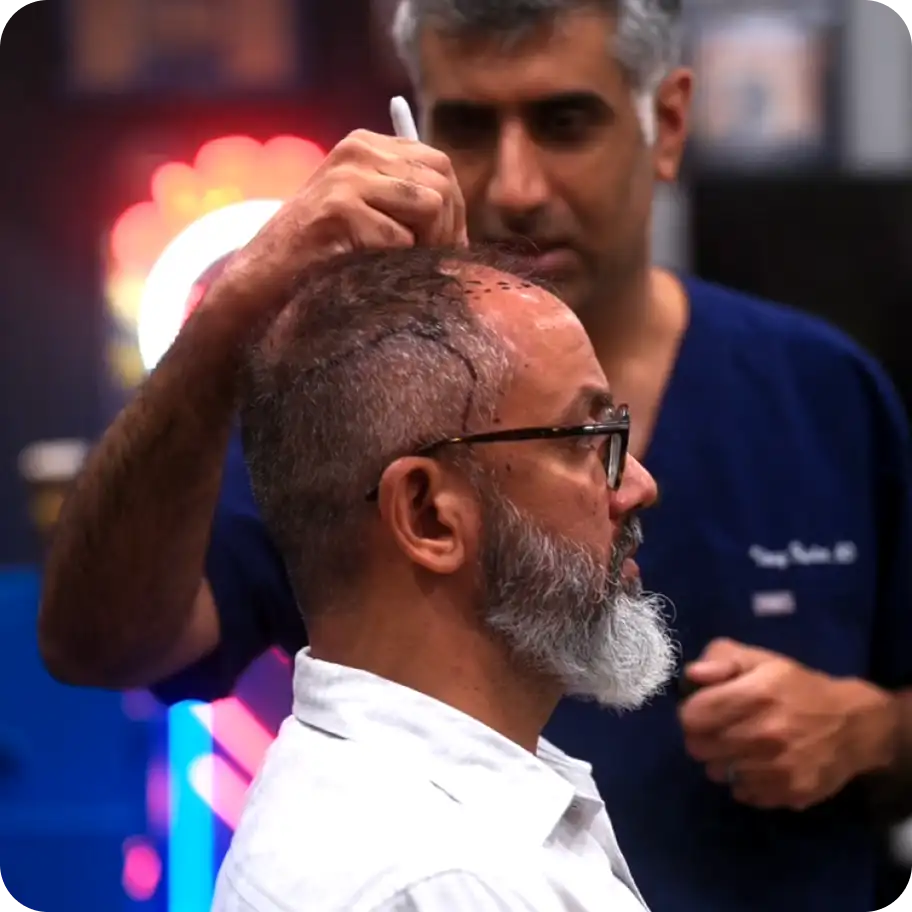
This is also where the position of the hairline becomes a structural decision, not a stylistic one. The position of the hairline eats grafts. Every millimeter pushed forward costs 150 to 200 grafts that would otherwise extend the restoration backward toward the crown. If a clinic can only perform a limited number of grafts, and the hairline position is pushed aggressively forward, two failures cascade: the restoration never reaches the crown, and the front itself may never reach the density required to look natural. The hairline should be positioned at its highest point such that the entire foundation can still be filled.
This is why presence beats position. The presence of the hairline is where the hairline feels in the right place and leaves enough grafts to complete the natural shape. A hairline position dictated by geometric thirds, rulers, or templates often steals from the crown and leaves the design incomplete.
Once this foundation is laid, future procedures can get more ambitious. The crown can be filled in. Density can be added across the entire restoration. The hairline can even be advanced forward. But only because the foundation is solid enough to allow those tactical decisions. Without the foundation laid first, none of those options remain open.
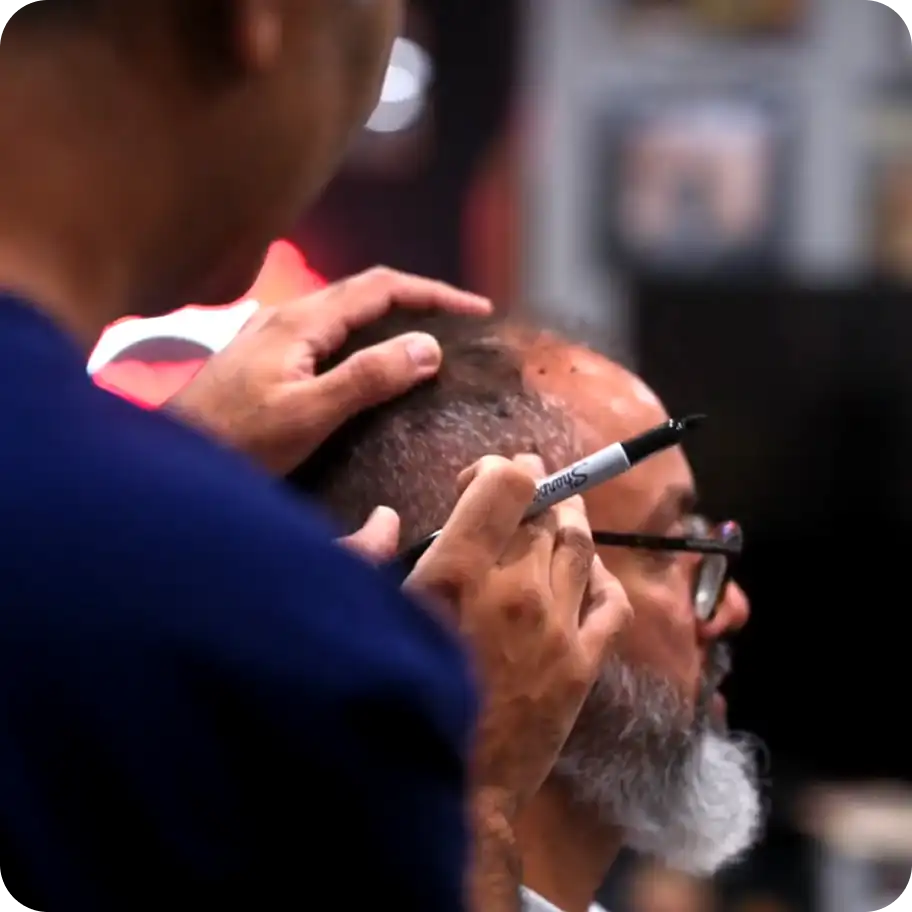
With the foundation defined, the work returns to the front. The first front mark to go down is the center point — the most forward position of the new hairline.
The usual starting reference is facial proportion: the chin-to-nose-to-forehead thirds that anatomists have used for centuries to describe a face. But the thirds, applied directly, will usually place the position too low because they apply to youths.
If the patient still has hair, you can demonstrate the presence of the new hairline. Dr. Vinay presses the existing hairs down against the scalp and forward. The presence of the hair moves with them. He looks at the face and finds where the new presence reads as natural at the patient’s current age and beyond — the most conservative point a natural-looking restoration would allow. That point becomes the center point of the hairline.
When the patient does not have hair for demonstration, Dr. Vinay explains what is being drawn. The line marked on the scalp is where the hairs will exit. It is not where the final presence of the hair will read to the world. The hairstyle defines where the presence will eventually land. A forward-facing hairstyle projects the presence in front of the position. Tying the hair back places the presence at the position of the hairline and often requires a more aggressive line.
The center point is then checked from every angle at once. From the front view, the position cannot be too high or too low. From the profile view, the position cannot project too far forward — a central hairline that comes too far out can look like an elongated, down-turning nose. The shape of the forehead helps. The forehead rises and curves backward at some point. Pushing the hairline into that curve sacrifices very little apparent height but saves the profile from an exaggerated projection.
Once the ideal point is reached, the center of the hairline is confirmed. Attention turns to the sides.
With the center point marked, the two sides of the front hairline are drawn. These two sides are where the timelessness of the design lives.
Drawing the sides requires the surgeon to hold two reference points in view at all times: the current temporal hairline as it exists today, and the future recession line that was drawn first. The side of the hairline must intersect the current temporal hairline — connecting to the patient’s existing hair — and continue backwards into the recession line. The shape of that connection must look like the hairline is naturally evolving from where it sits today to where it will sit decades from now.
This is what timeless means as a drawn shape. The line is not just where the hairline sits today. It is the path of every hairline the patient will pass through as they age — drawn in advance, so that no future state of recession will reveal a transplanted edge. A line that works at year one but fails at year ten is not a line. It is a deadline.
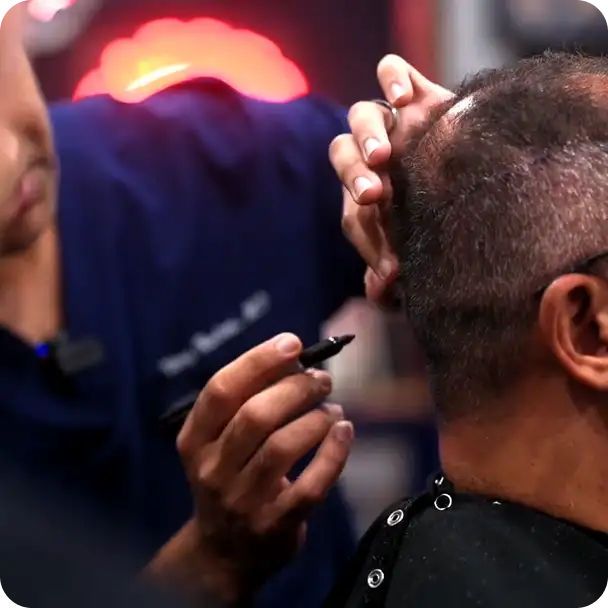

The hairline has two basic shapes, but can exist as any possibility in between.
The convex shape bows outward across the front. It is forward-facing, aggressive, and youthful. It matches faces with angular features. Seen in two dimensions — which is, paradoxically, how the eye reads a hairline from any one particular angle — it reads as flat.
The sigmoidal shape, or S-curve, projects outward at the center and recedes back along the sides. It is more natural, more flowing, and less aggressive. It matches faces with rounder features. Because it recedes at the sides, it also flows into the future recession line more gracefully than the angular convex shape ever can. The sigmoidal shape carries more character than the convex. It never resets to flat — which is itself uncharacteristic of a human face — and for the patients who choose it, the S-curve becomes its own signature.
In practice, even the slightest sigmoidal curve added to a convex line breaks up the flatness and gives the hairline character. Almost every natural hairline design carries at least some sigmoidal character, unless the patient’s ethnicity calls for a flatter line — as it often does for African American and Chinese hairlines, where a naturally flatter shape is what respects the patient’s heritage.
Dr. Vinay draws both — convex on one side of the head, sigmoidal on the other — and asks the patient which they lean toward. Both shapes are designed to be safe for the patient’s future; Dr. Vinay will not allow a patient to choose a shape that fails over time.
“Which way are you leaning?” Dr. Vinay asks. “Would you like something more in between?”
The final hairlines on the two sides are drawn independently of each other. They are not matched to one another. The human face is not symmetric, and the recession lines that already define the sides of the design are not symmetric either. The asymmetric front hairline lands on already-asymmetric sides because the entire anatomy carries that asymmetry.
Every millimeter matters at this stage. Each millimeter Dr. Vinay advances the hairline forward costs another 150 to 200 grafts. On a high-density hairline, that can mean as many as 800 grafts saved by moving the line back four millimeters.
For Wasif, the four-millimeter pullback saved approximately 800 grafts. Those grafts went directly to restoring the full shape up to the crown — completing the foundation that the entire design was working to lay. The pullback was not an aesthetic compromise. It was the resource shift that made the natural hairline transplant possible. The position appeared identical from the front. The restoration extended fundamentally further back.
In millimeters, the line shifts. The final shape emerges. The position where the hair will exit the scalp is set. From there, the presence of the hairline enters the hairstyle, and the final appearance is the meeting of the two.
Once every line is drawn, Dr. Vinay verifies the design from every angle. He sits the patient down. He stands them up. He walks around — lateral, back, top. Some problems are easier to see in photographs than with the eye itself. A series of two-dimensional images is evaluated before confirming this is the right presence of the new hairline. Only then can we begin to build the Timeless Hairline we have designed.
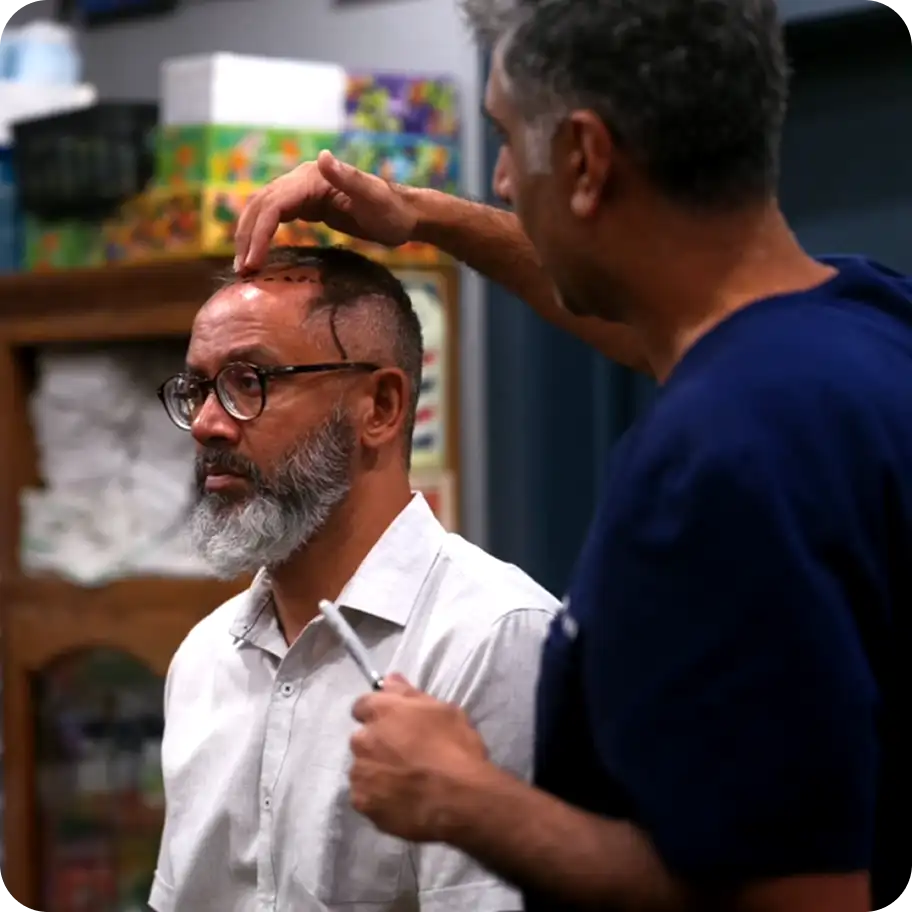
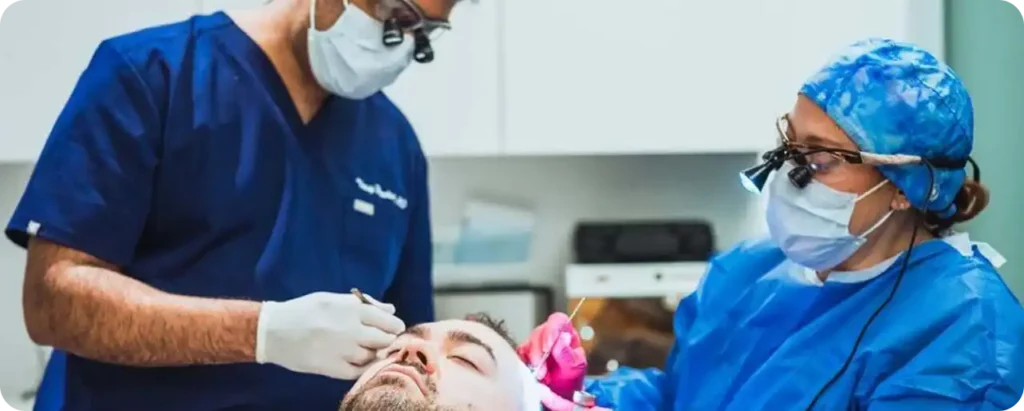
Making a hairline transplant is two things at once. It is the design — the nine-step methodology above — and it is the clinical technique that delivers the design into the scalp. Every hairline restoration we perform is built on both. What follows are the six techniques that make it possible to deliver a Timeless Hairline in practice — each one developed because the demands of the design would not survive standard FUE alone.
The hairline needs single-hair grafts placed close together. That is what makes it feathered, and that is what makes it look natural at every distance the eye is likely to see it from. How many grafts, and how close together, depends on the patient’s donor hair. Thicker hair needs fewer grafts to reach visual density. Thinner hair needs more. Dark hair on light skin needs the most, because the contrast between hair and scalp makes every gap visible.
More grafts require more incision sites, and there is a physiological limit to how many sites the scalp can support before the tissue between them cannot heal properly. When a hairline design calls for a density approaching that limit, we prepare the scalp in advance. ACS is delivered to the hairline area before the day of surgery to increase local blood flow. A better-vascularized scalp can safely receive more incisions in the same square centimeter of tissue. The hairline density that would not have been possible on an unprepared scalp becomes possible on a prepared one.
This is a technique defined by the outcome we want. The art dictated the density. The science made the density placeable.
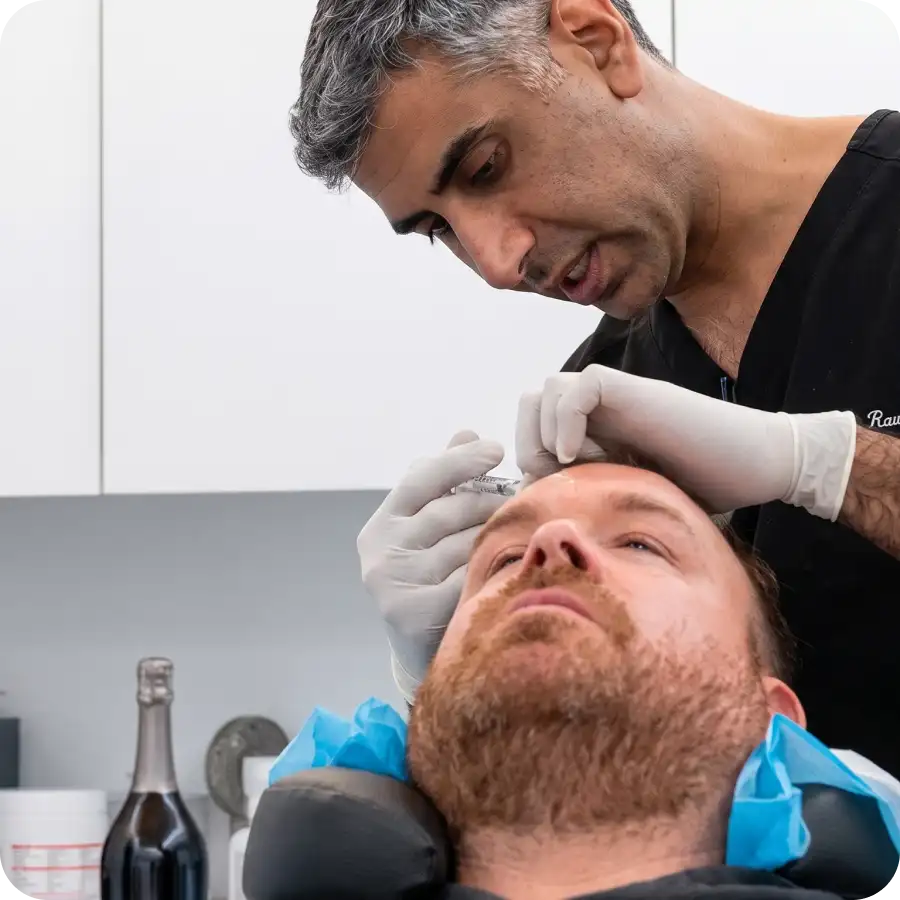
A standard FUE hair transplant extracts the follicle and transfers it into the recipient site. Micro PUE® — the technique developed at Northwestern Hair — extracts the entire pilosebaceous unit. The follicle, the oil glands that lubricate the shaft, the stem cell reservoir that regenerates the hair over its lifetime, the connective sheath that anchors the hair into the skin. Everything that makes a hair function as a hair, and everything that makes it appear the way a native hair appears, travels with the graft into its new position.
The difference between a follicle transfer and a full pilosebaceous unit transfer is most visible at the hairline. The leading edge is where the scalp is most exposed, where light hits the hair most directly, and where every follicular imperfection registers with the eye. A Micro PUE® graft placed at the hairline arrives with the full biological machinery it had in its donor position. The hair grows in with its native character, native caliber, and native oiliness. It reads as native because, structurally, it is.
For patients who select Micro PUE® for their hairline transplant, the hairline is where the technique repays its investment most visibly.
A Timeless Hairline is not built from grafts of the same size. The leading edge is a feathered zone of single-hair follicular units — nice and fine, spaced closely together, refracting light the way a natural hairline does. A few millimeters behind that leading edge, the design shifts. Density and visual weight begin to matter more than feathering. Two-hair grafts, three-hair grafts, and larger units carry that density.
These graft types are structurally different sizes. A single-hair graft is small. A three-hair graft is significantly larger. Extracting them with the same punch bit produces one of two failure modes. A punch bit sized for the single-hair grafts will extract them cleanly but strip the follicular tissue off the larger multi-hair units — a compromise we have seen and can document on video. A punch bit sized for the multi-hair grafts will preserve them well but make the single-hair grafts too bulky to place at the density the hairline requires. Either way, the outcome the design called for cannot be delivered.
Sequential Extraction is our answer. Before extraction begins, we calculate the exact number of grafts required in each category: fine single-hair grafts for the leading edge, thicker single-hair grafts for the transition zone behind it, two-hair grafts for density in the second row, and three-hair grafts for weight further back. Each category is then extracted in sequence with a punch bit sized specifically for that graft type. The doctrine is straightforward: match the tool to the graft, not the graft to the tool.
The basic principles of No-Touch FUE apply to every procedure Northwestern Hair performs, but they matter most at the hairline. These are the hairs the world sees. Every follicle along the leading edge is scrutinized by the eye — hair by hair, at close range, from every angle — for the rest of the patient’s life. A graft that fails at the hairline has nowhere to hide.
A graft’s tolerance for handling is limited. Every time a graft is touched — with forceps, with the tip of an implanter, with anything at all — is a potential injury point. Injury damages the follicle. It damages the oil glands that lubricate the hair, the stem cell reservoir that regenerates it, and the sheath that anchors it into the skin. A graft that survived extraction and made it through sorting can still fail if it is handled carelessly in the window between the two. Micro PUE® preserves the entire pilosebaceous unit at the moment of extraction; No-Touch discipline preserves it every moment thereafter.
Our discipline is straightforward. No graft is touched more than twice during the procedure. Once at extraction. Once at insertion. Everything between those two moments — sorting, staging, holding — is designed to eliminate a third touch. Pre-sorting the grafts by category as Sequential Extraction proceeds means no re-sorting later. Atraumatic insertion transfers the graft directly from staging into the incision site without an intermediate handoff. The less a graft is touched, the less it is injured. The less it is injured, the more it looks and behaves like a native hair when it grows in.
This principle applies everywhere on the scalp. At the hairline, it is non-negotiable.
High-density grafting is also where the last piece of design happens — not on the drawing board, but on the scalp itself in the moments before the first incision is made. The staggering is a planned part of the procedure. The process of drawing it is specifically unplanned and artistic.
Dr. Vinay takes a different-colored marker to the scalp and draws the natural irregularity directly over the designed line. The stagger is not invented. It is referenced from the patient in front of him — the way their existing hairline breaks up along its own edge, and just as importantly, the way their beard grows in. The beard tells the same story as the scalp: which hairs stand slightly proud of the leading edge, which fall slightly behind, the rhythm of the irregularity unique to that patient’s follicular biology. The stagger drawn on the hairline matches that rhythm.
Only then do the SP89 slits go in — each one placed through the staggered line rather than the original design line. This is where the art of the hairline returns for its final moment, nested inside the technical execution. Every hairline gets its own stagger, drawn in the moment, referenced from the patient in front of us.
Yield — how much of the transplanted hair grows back, and how thick it grows — matters in every transplant we perform. At the hairline, it matters most. The grafts placed along the leading edge are the finest, thinnest hairs we transfer, and every micron of thickness they regain is visible in the final result.
After the procedure, the transplanted hairs go dormant. What is less understood is what happens to their blood supply. The vasculature that fed those hairs in the donor area does not travel with the graft. In the recipient site, a new blood supply has to be built — and the hairs will only grow back as thick as that new blood supply allows. The blood supply itself, however, only develops to meet the metabolic demand of the hairs it is being built to serve. It is a catch-22. Does the hair grow first, or does the blood vessel grow first?
ACS enters the procedure a second time to break the loop. Delivered to the scalp in the days and weeks after the transplant, ACS increases local blood flow and supplies growth factors directly to the transplanted grafts — stimulating their metabolism during the exact window when the vascular network is being rebuilt. Both sides of the catch-22 accelerate simultaneously. The hairs signal the demand. The vasculature responds to it. The hairs grow back at their maximum possible thickness.
This matters most at the leading edge, where we deliberately chose the thinnest grafts for the sake of a natural appearance. Every fine hair that returns at its full caliber is the difference between a hairline that reads as restored and a hairline that reads as native. ACS bookends the procedure — preparing the scalp before, optimizing growth after — so that the hairline we designed is the hairline that grows in.
The Timeless Hairline Design is a binding philosophy: the vision for the hair restoration must be complete before the work begins. It is a display to the patient that Dr. Vinay — as the best hairline transplant doctor in Chicago he aspires to be — has not only taken responsibility for today’s procedure but for every time they look at themselves in the mirror for the unforeseen future.
This is where the art defines the technique. Before a single graft is extracted, Dr. Vinay visualizes the result — over two hours, in an environment purpose-built for design. The restored 1950s barbershop returns the room to a mindset that predates the pressure of the modern clinic: unhurried, tactile, attentive. The result is imagined in full before the science is asked to build it. The design takes up to two hours, but yields decades of natural results. It is the first task of every procedure morning — or, for mega-sessions, the work of the evening before. The session is solely between Dr. Vinay and the patient. There are no distractions.
And then the feedback loop begins. The better our clinical technique gets, the further we can push the art toward perfection. Creating natural hairlines requires the ability to extract exceptionally fine hairs and place them exceptionally close together. That is a scientific feat — one that opens the door for more artistic influence in the procedure. A hairline the surgeon can imagine but the science cannot execute is not a design. A hairline the science can execute but the surgeon has not learned to imagine is a missed result. Only when both sides advance together does the ceiling rise.
Over the last five years at Northwestern Hair, it has been this feedback loop that has defined our practice. The art has pushed the science further. The science has pushed the art higher. Each cycle has produced a new upper echelon of procedures and techniques — a level of hairline transplant work that no other clinic really matches. Timeless Hairline Design is the essence of Dr. Vinay’s art-before-science approach to hair restoration. Its impact has proved universal. It is the reason our most proprietary technique is included with every hairline transplant we perform.
A Timeless Hairline is the only type of hairline worth signing one’s name to.
The Timeless Hairline Design extends far beyond aesthetics. Its value applies across every patient Northwestern Hair has the privilege of treating, and is the reason we offer the best hairline transplant for every face that walks through our doors.
Before
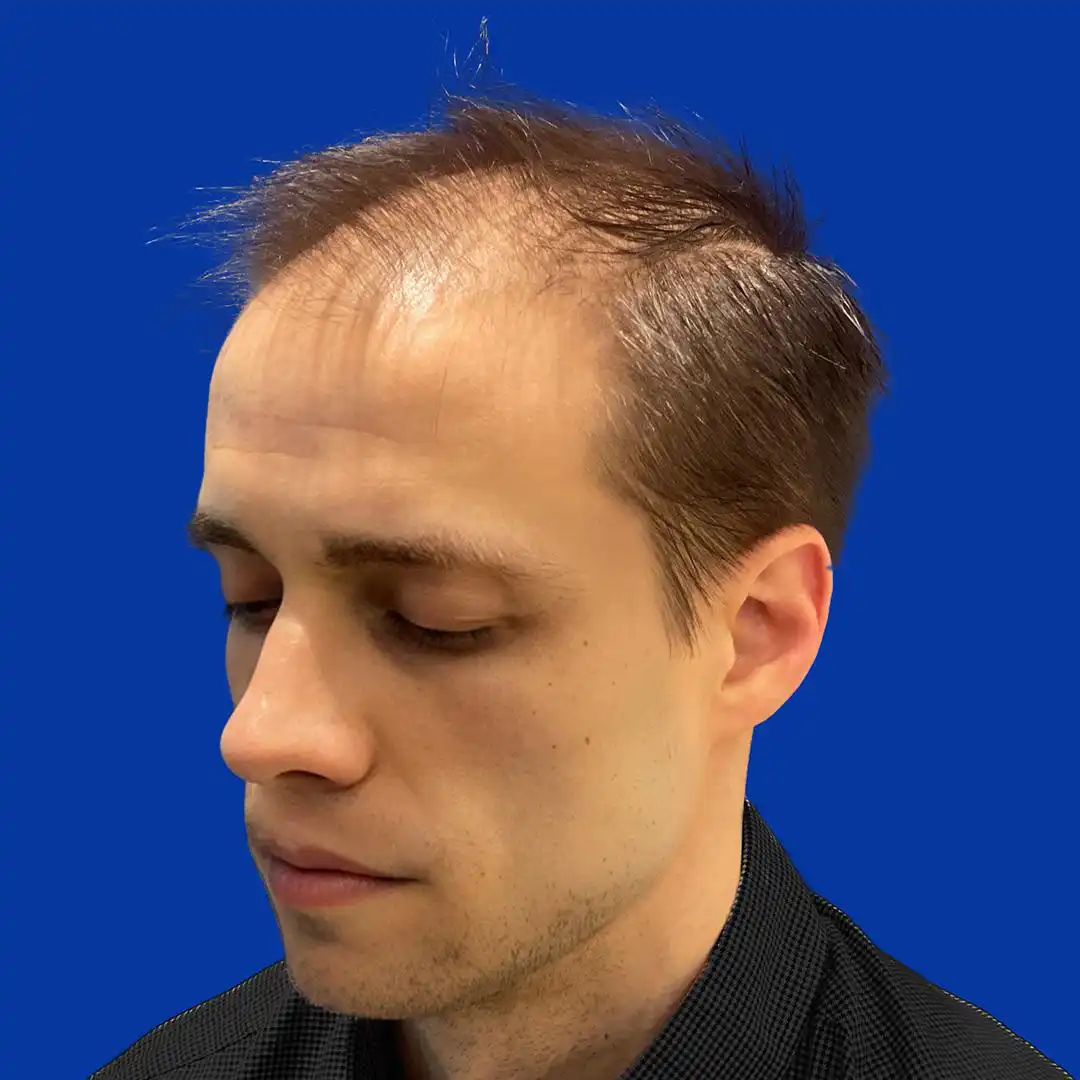
After
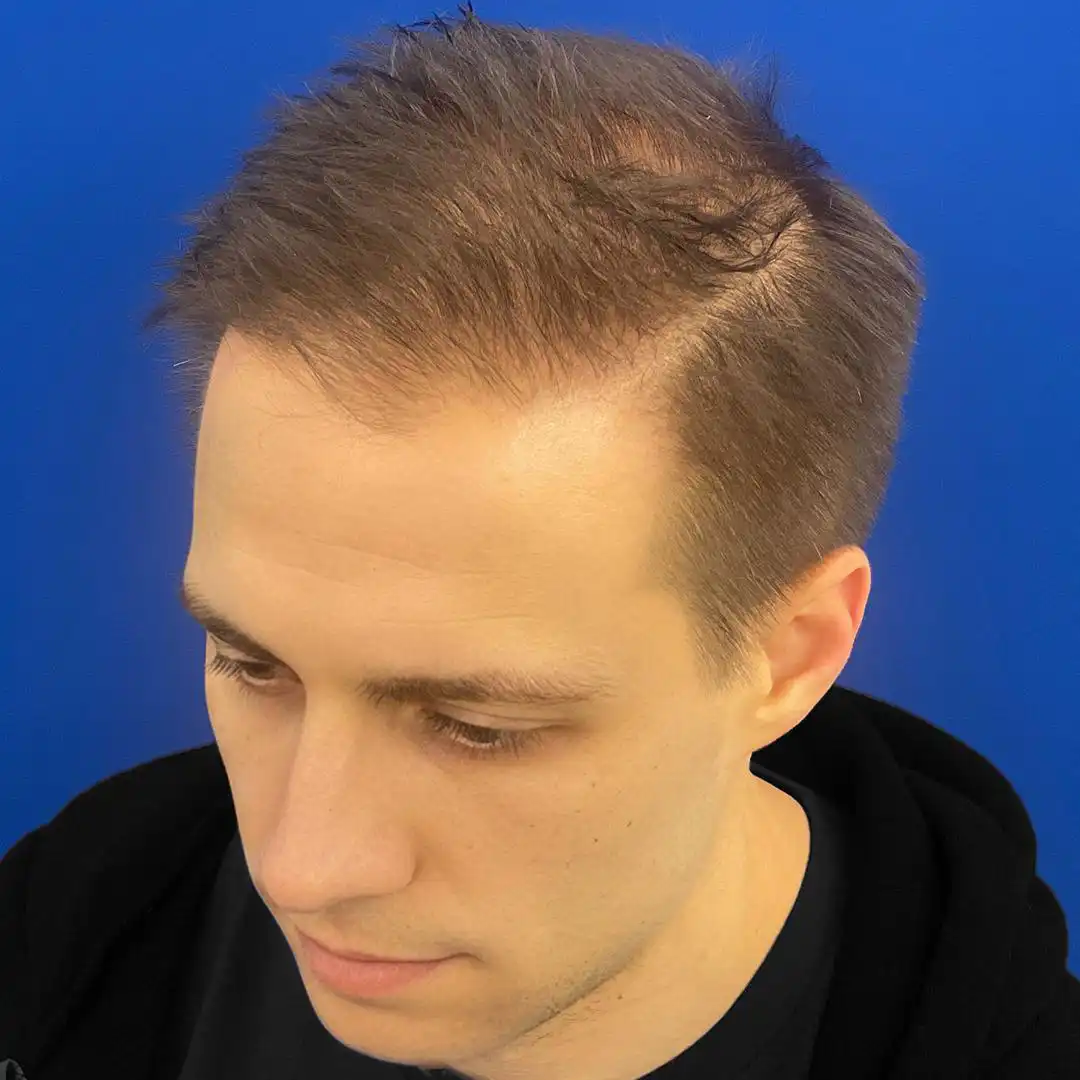
Before

After

Before
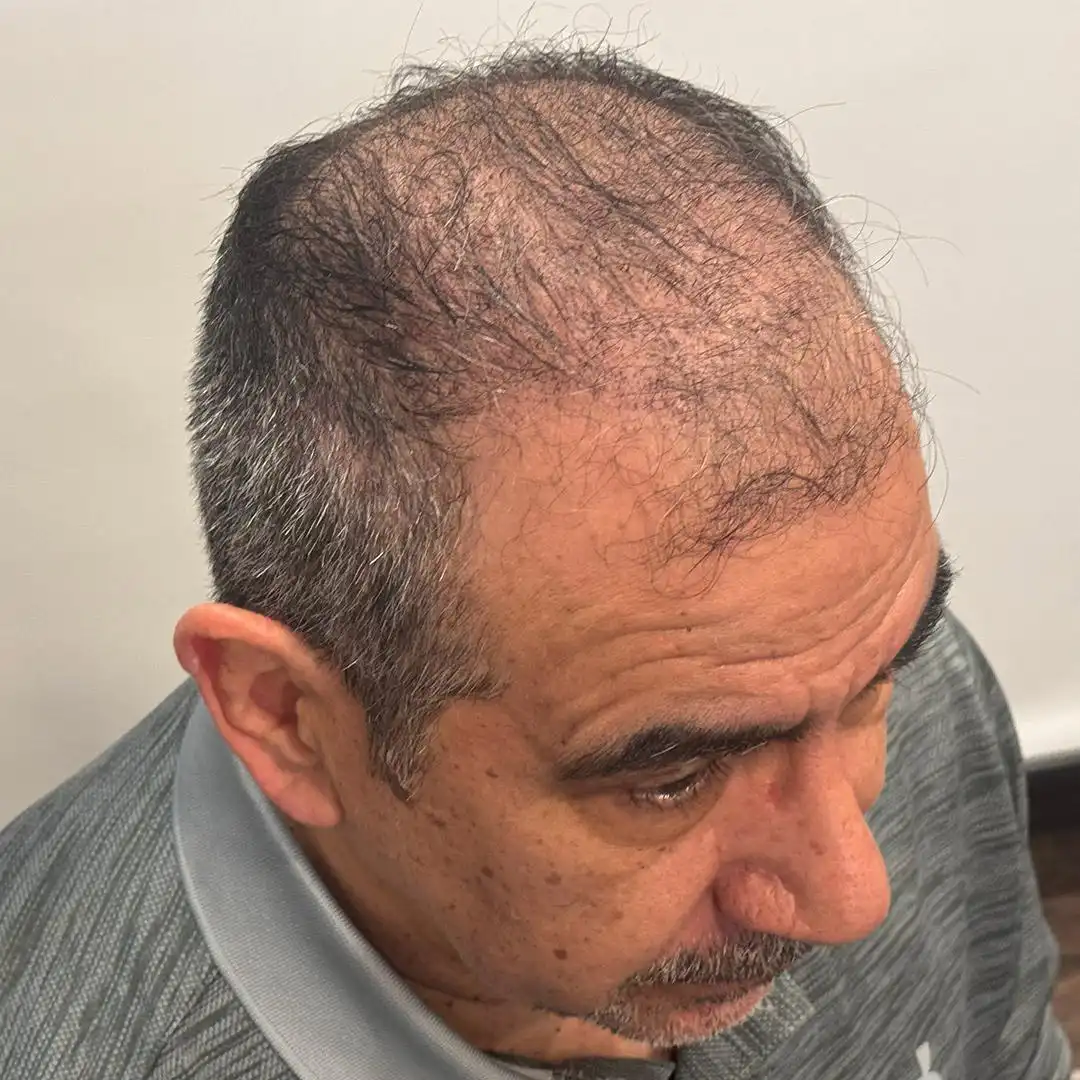
After
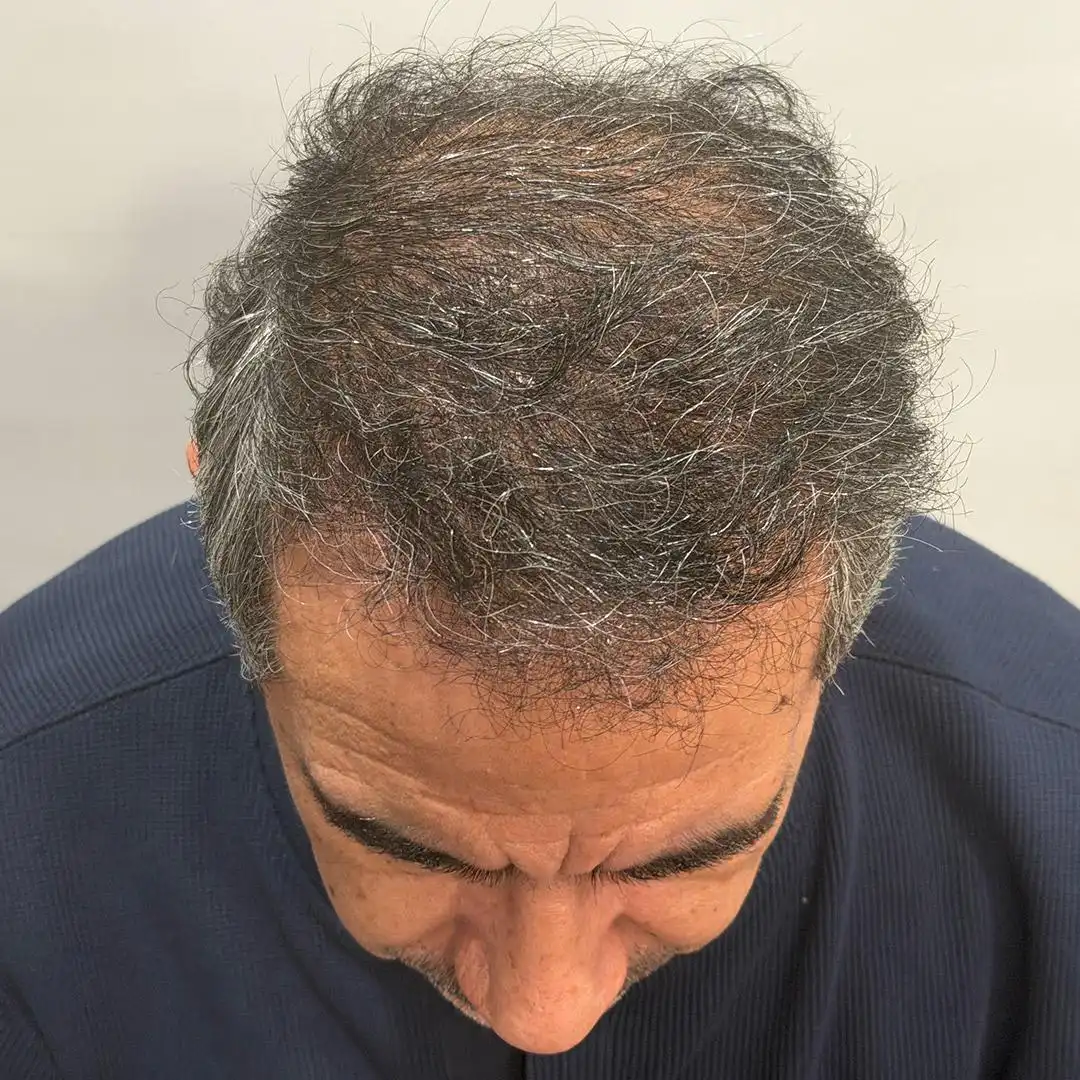
Before
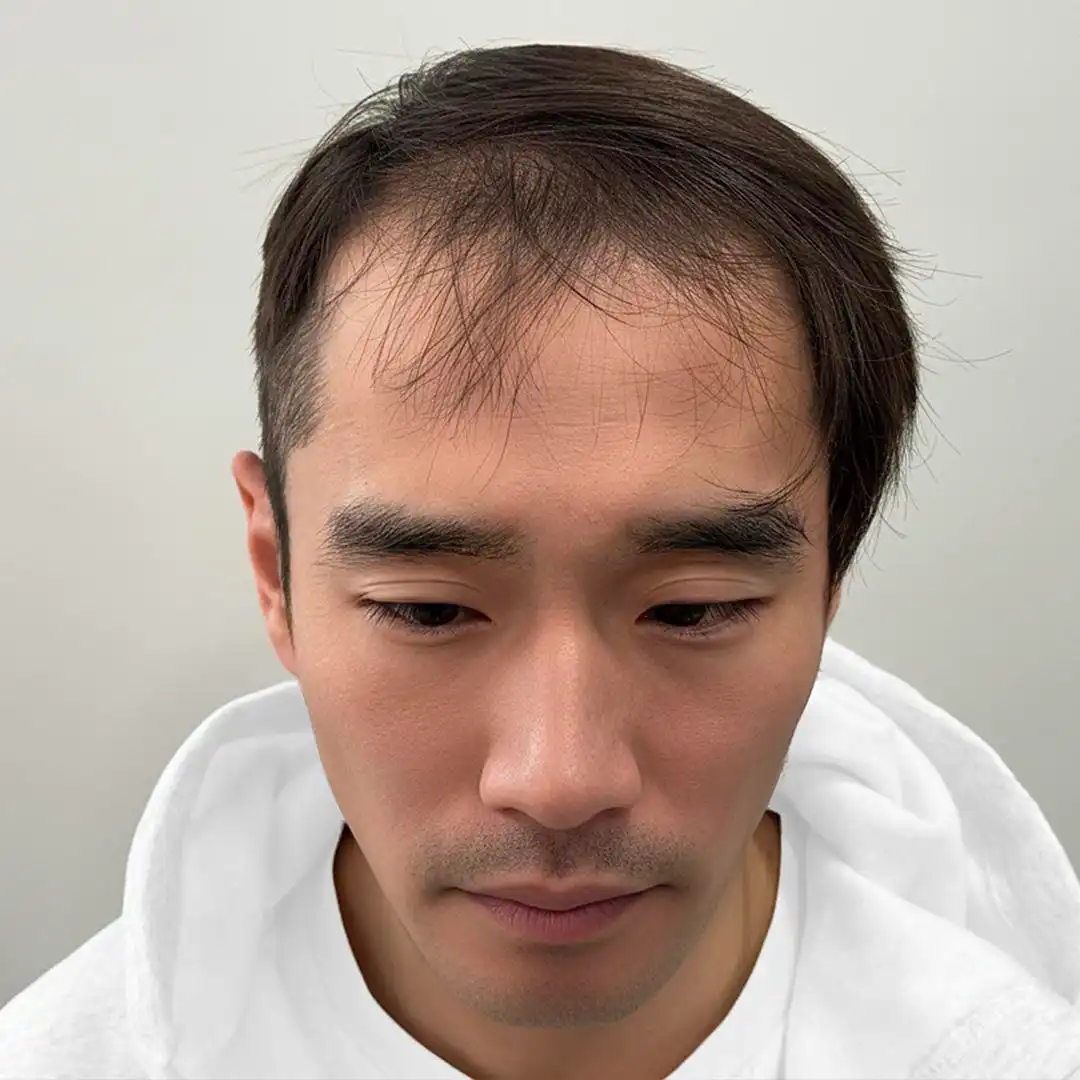
After

Before
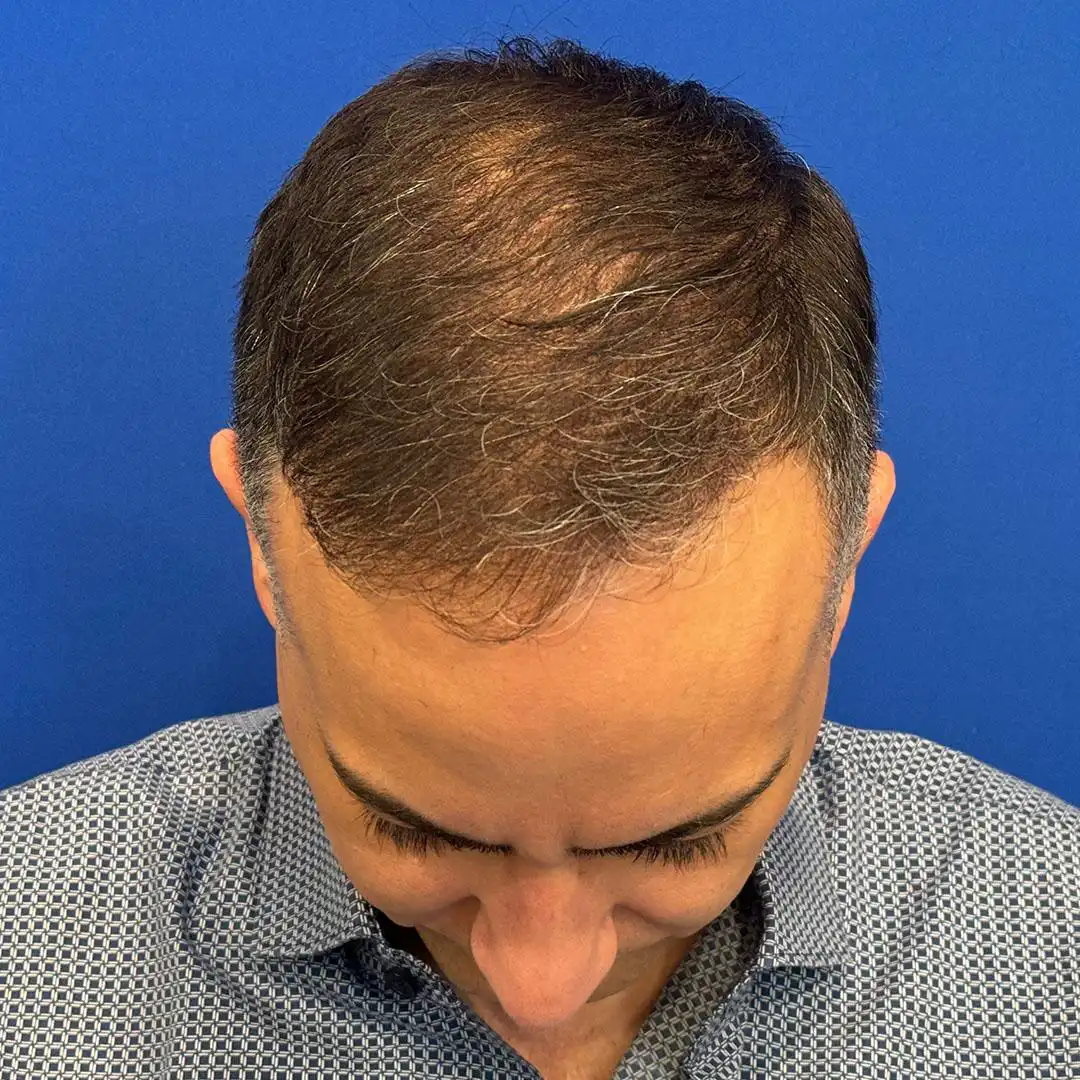
After
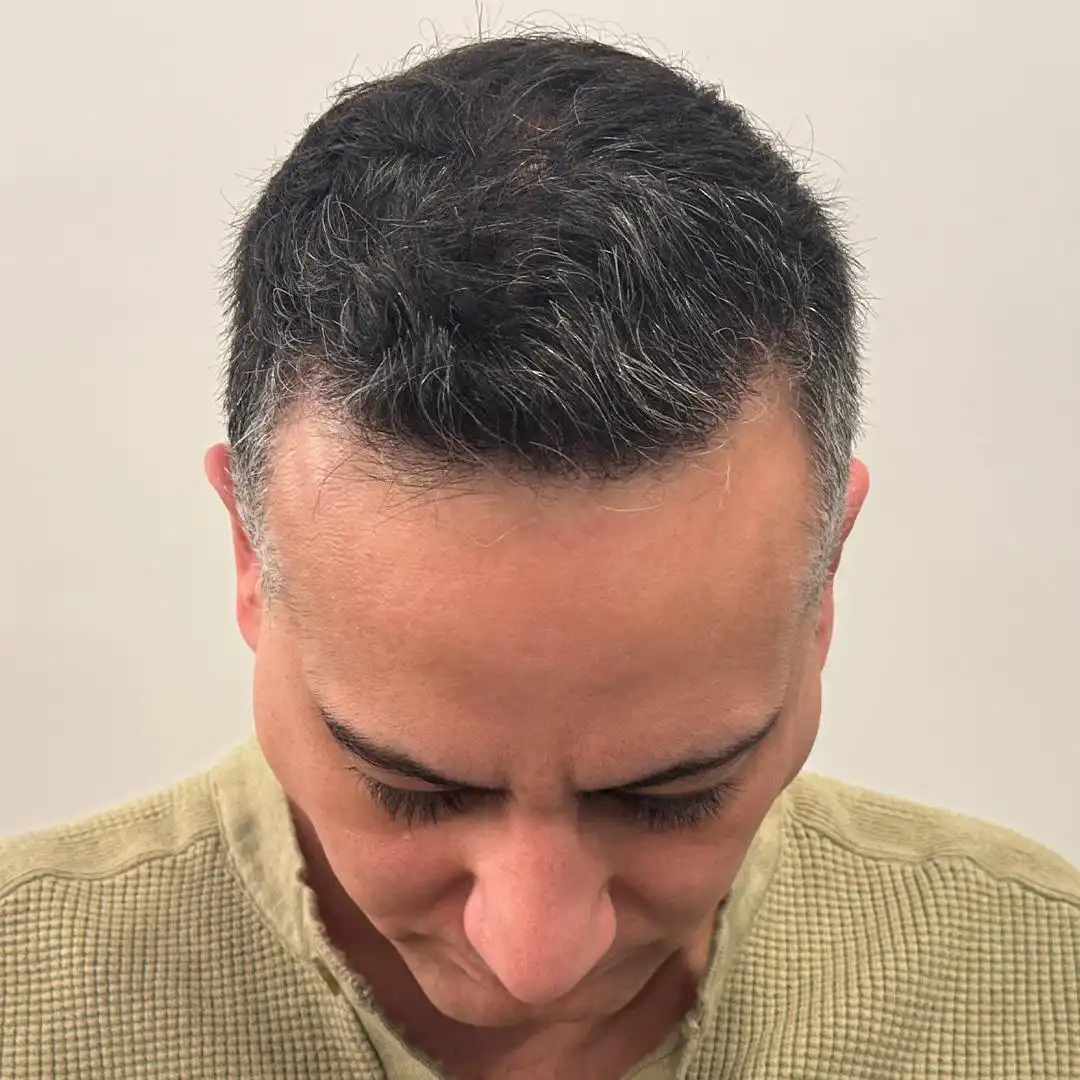
Every single line and reference point established during the Timeless Hairline Design is anatomically based. The recession line — where the hairs transition from thick to thin. The temple — where the temporalis muscle defines the natural strong point. The forehead — where the bone stops rising and curves backward. These anatomical points are also what define the patient’s ethnicity. The hairline transplant that lives on a Black, Asian, Latino, or Southeast Asian patient has different reference points than the hairline that lives on a White patient, because the underlying anatomy is different.
Because the methodology follows anatomy, the resulting hairline transplant preserves the patient’s heritage automatically. The flatter, straighter hairline of an African American patient is not a stylistic decision. It is the line defined by the temporalis muscles along the temples — the anatomy doing what only it can do. The more sigmoidal curve of a Southeast Asian hairline is not a stylistic decision either. It is the line defined by the higher recession at the temples — the anatomy speaking through the design. Asians with flatter foreheads have matching flatter designs.
Following the principles of Timeless Hairline Design allows any surgeon to design a natural hairline transplant for any ethnicity. The methodology does not impose a single ideal across all faces. It listens to the face it is designing for.
The Timeless Hairline Design erases the concept of age. The methodology identifies the patient’s recession line, which means we know where his hair journey ends before we begin. With that endpoint defined, age stops mattering. We are no longer making assumptions about what a young patient’s hair will look like in twenty years. We have drawn what it will look like. The hairline transplant is performed against that future, not against a guess.
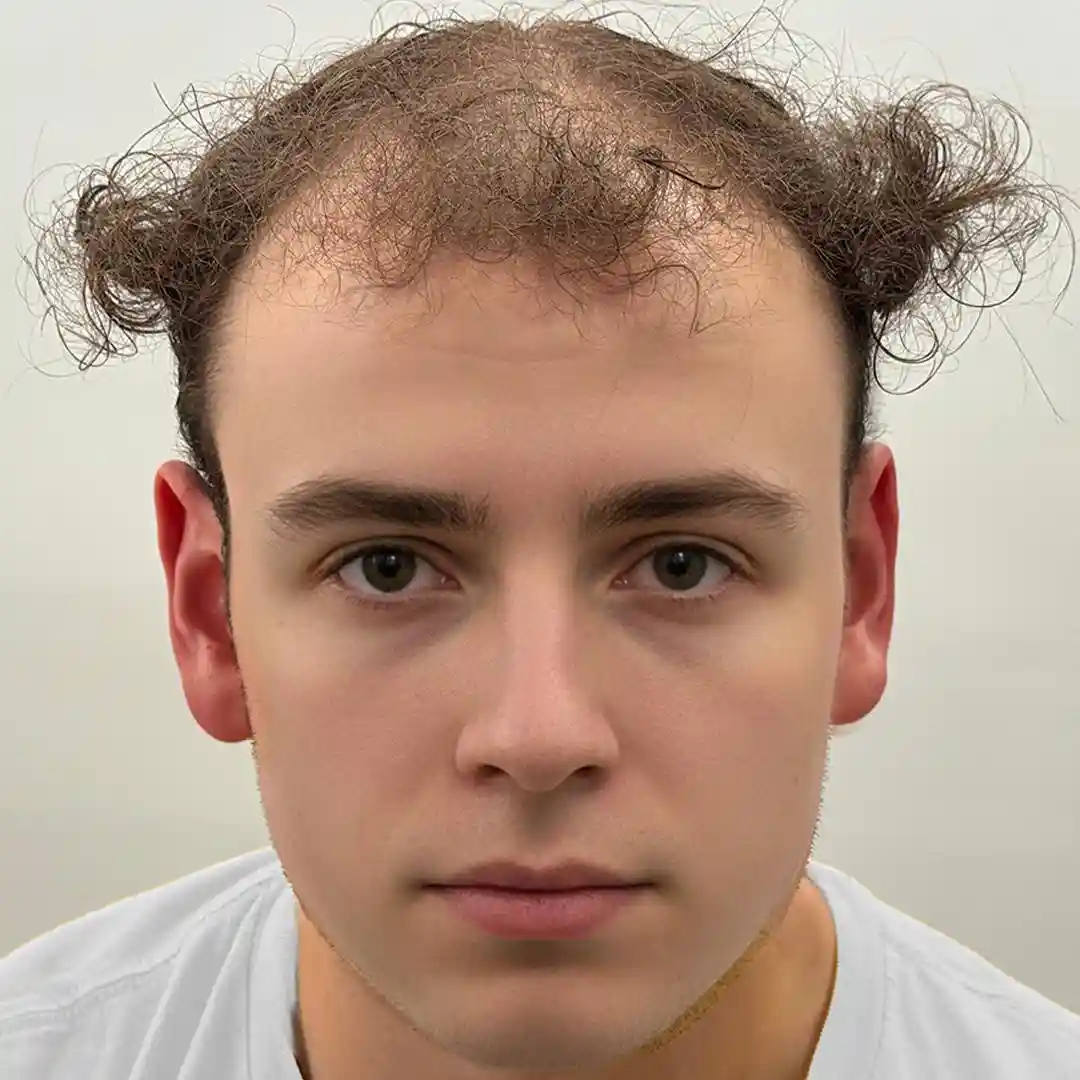
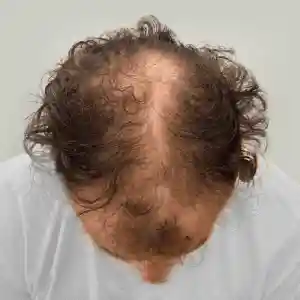
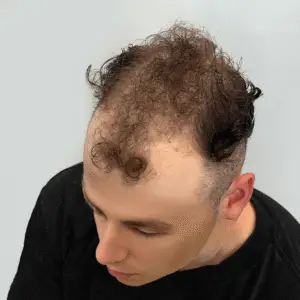
This changes who Northwestern Hair can confidently treat. A young man losing hair is not the same patient as an older man losing hair. He is heading to college. He is entering the dating world. He is interviewing for his first jobs. He is building the confidence that the rest of his life will rest on — at the exact moment hair loss is taking it away from him. Most clinics turn these patients away. They push them toward non-restorative treatments — medications, topical solutions, light therapies — that slow the loss without restoring what has been lost. The young patient who needs his hair restored, at the moment in life when restoration matters most, is told to wait.
Northwestern Hair does not ask the patient to wait. Because Timeless Hairline Design draws the recession line from the very start, the methodology has already accounted for where the patient will end up — at any age. The young man can be restored now, with a hairline transplant designed for his future, with no risk of the hairline aging poorly. The design has matched our technical capabilities of executing the procedure well.
This is also where the presence-over-position philosophy becomes most operationally important. Many of our young patients meet with Eddie before surgery to confirm they are willing to adopt a forward-facing hairstyle. That confirmation is what allows the position of the hairline to sit further back. The foundation gets completed. The grafts go to the crown, to the sides, to the structure the patient will rely on for the rest of his life. And the presence of the hairline still reads prominently on his face. He looks the way he wanted to look — full, restored, forward — because the hairstyle is carrying the visual weight that the position would have had to carry otherwise. The position served the structure. The presence served the patient. This is what a young men hairline transplant should deliver, and why Northwestern Hair is built to deliver it.
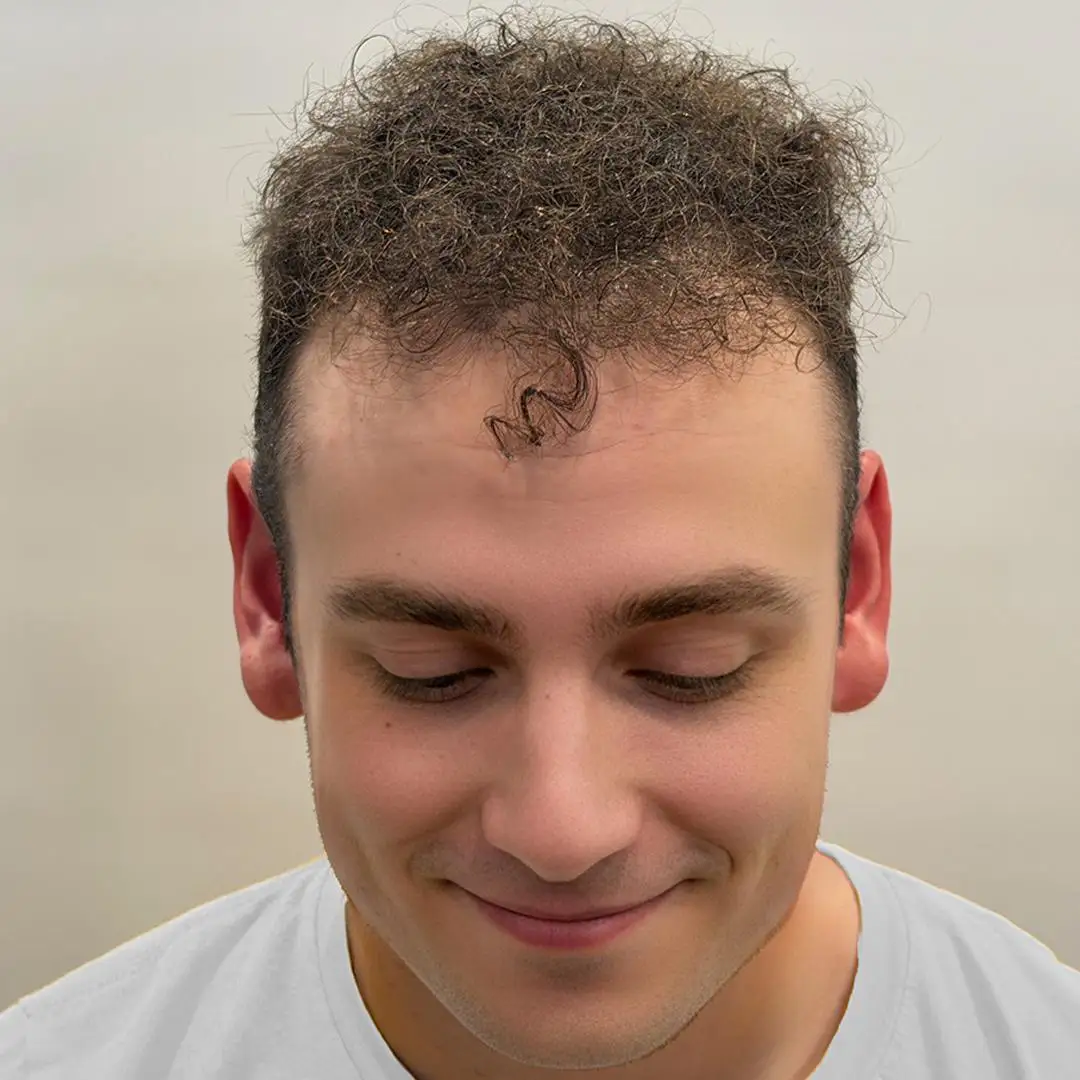
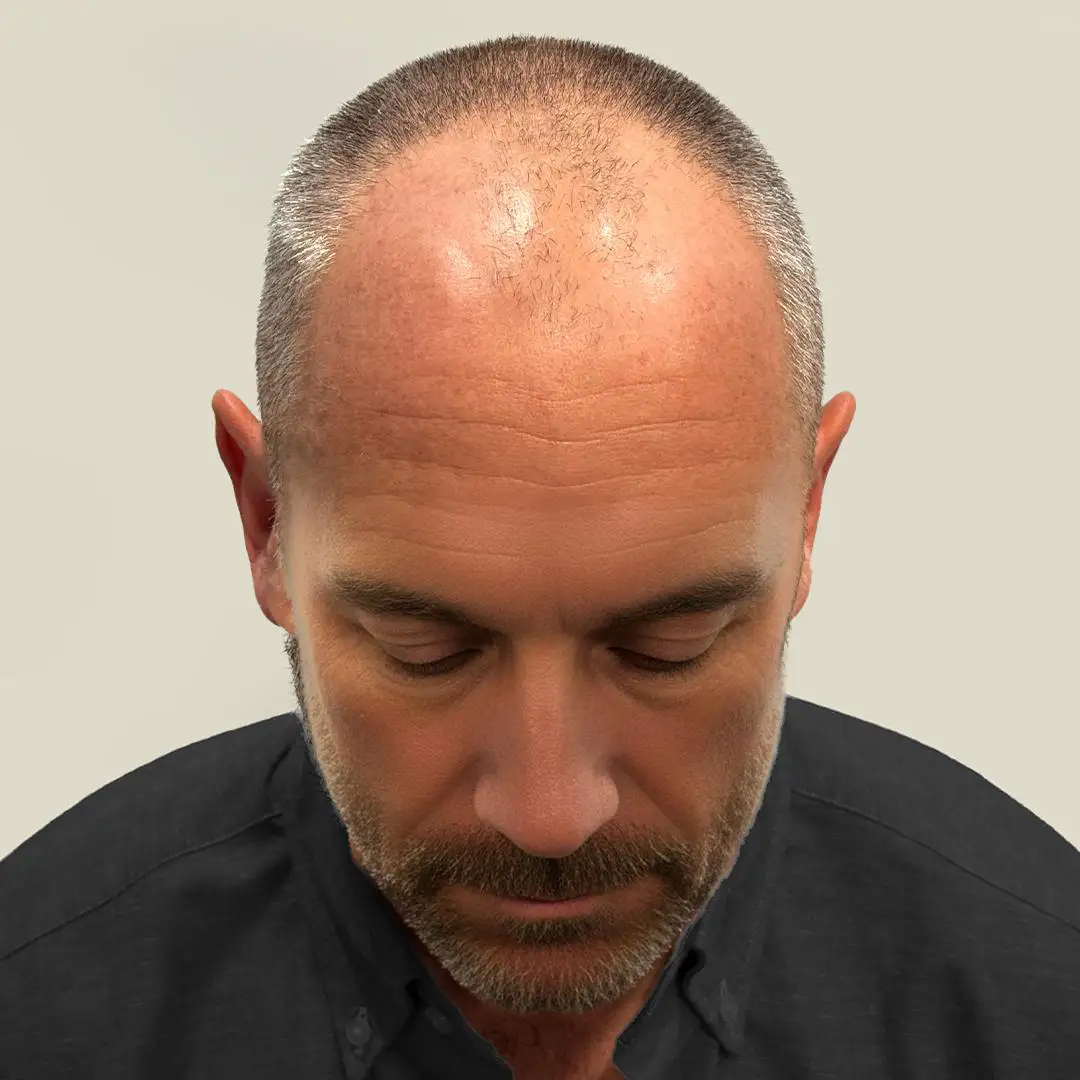
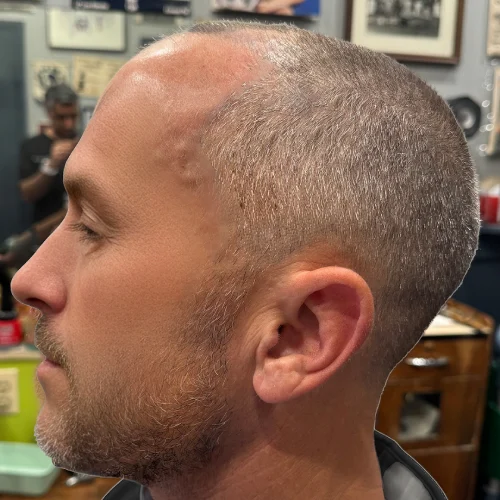
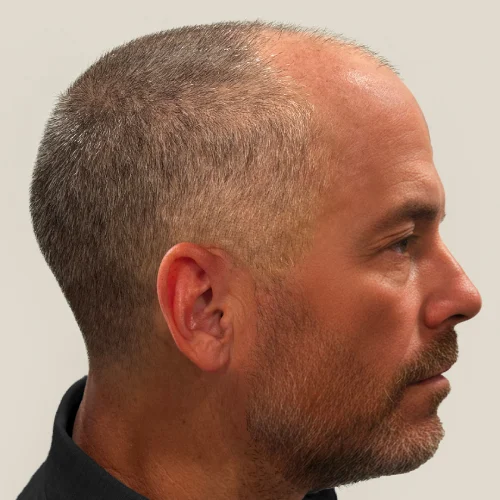
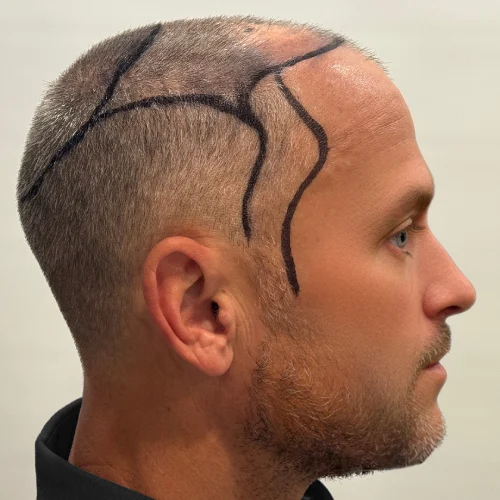
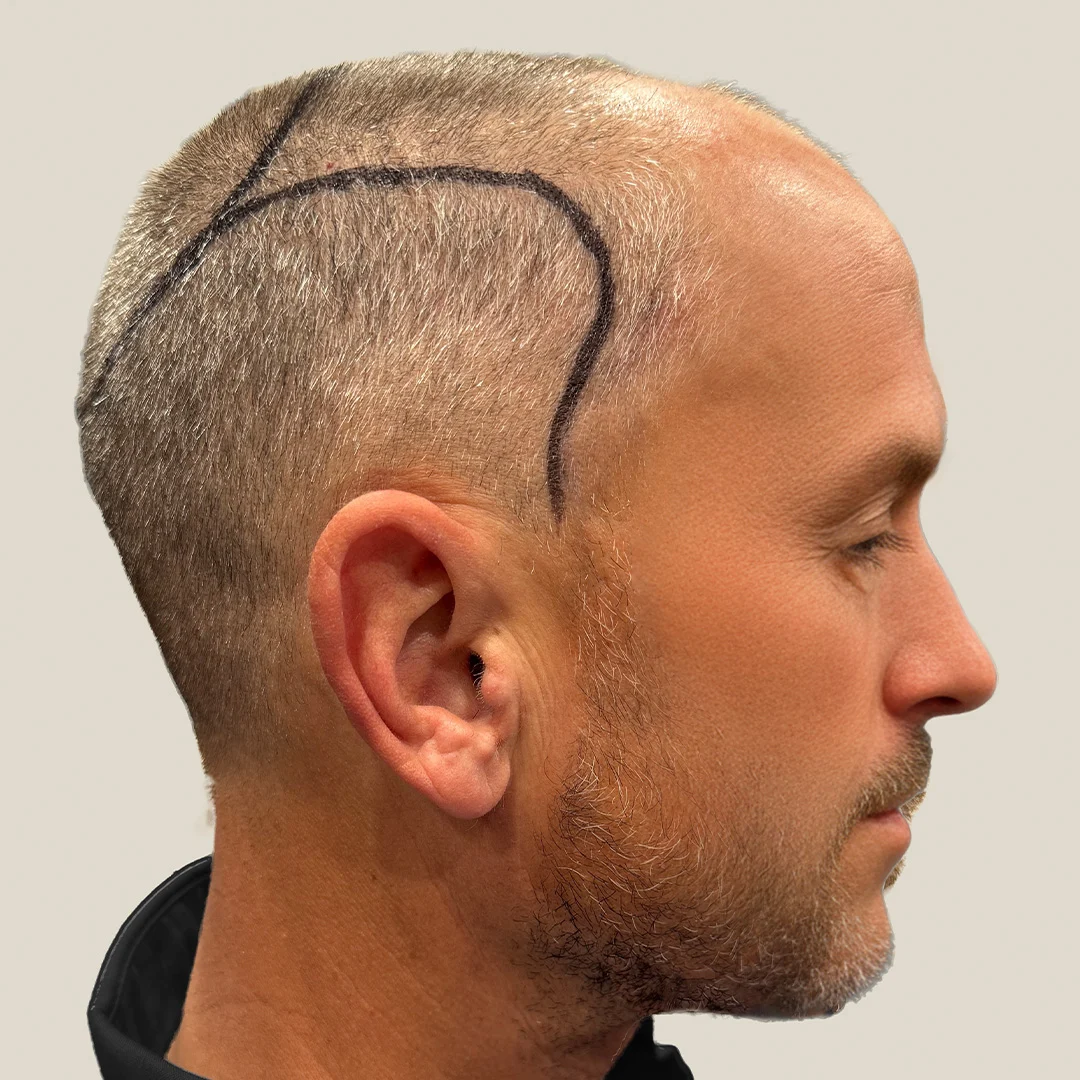
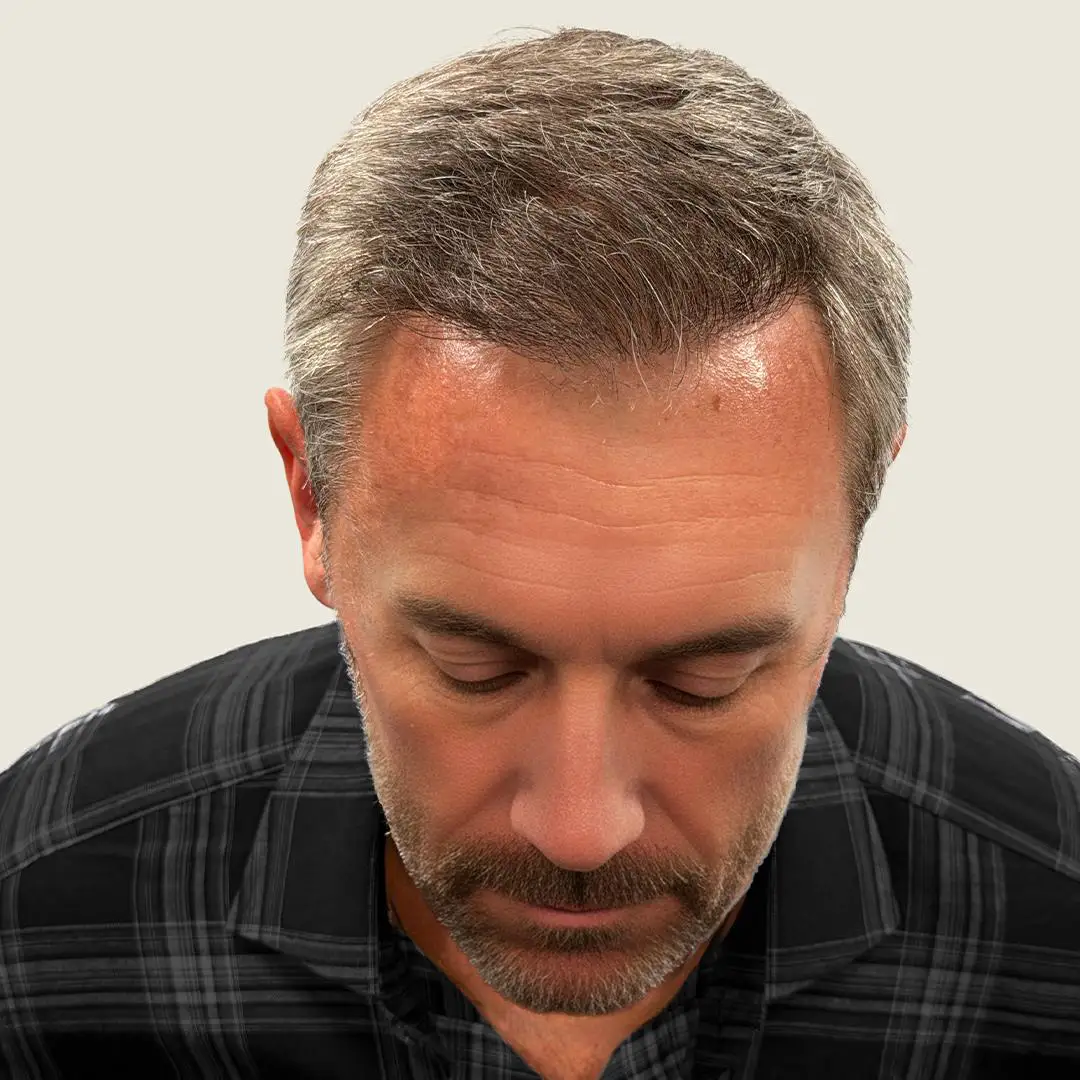
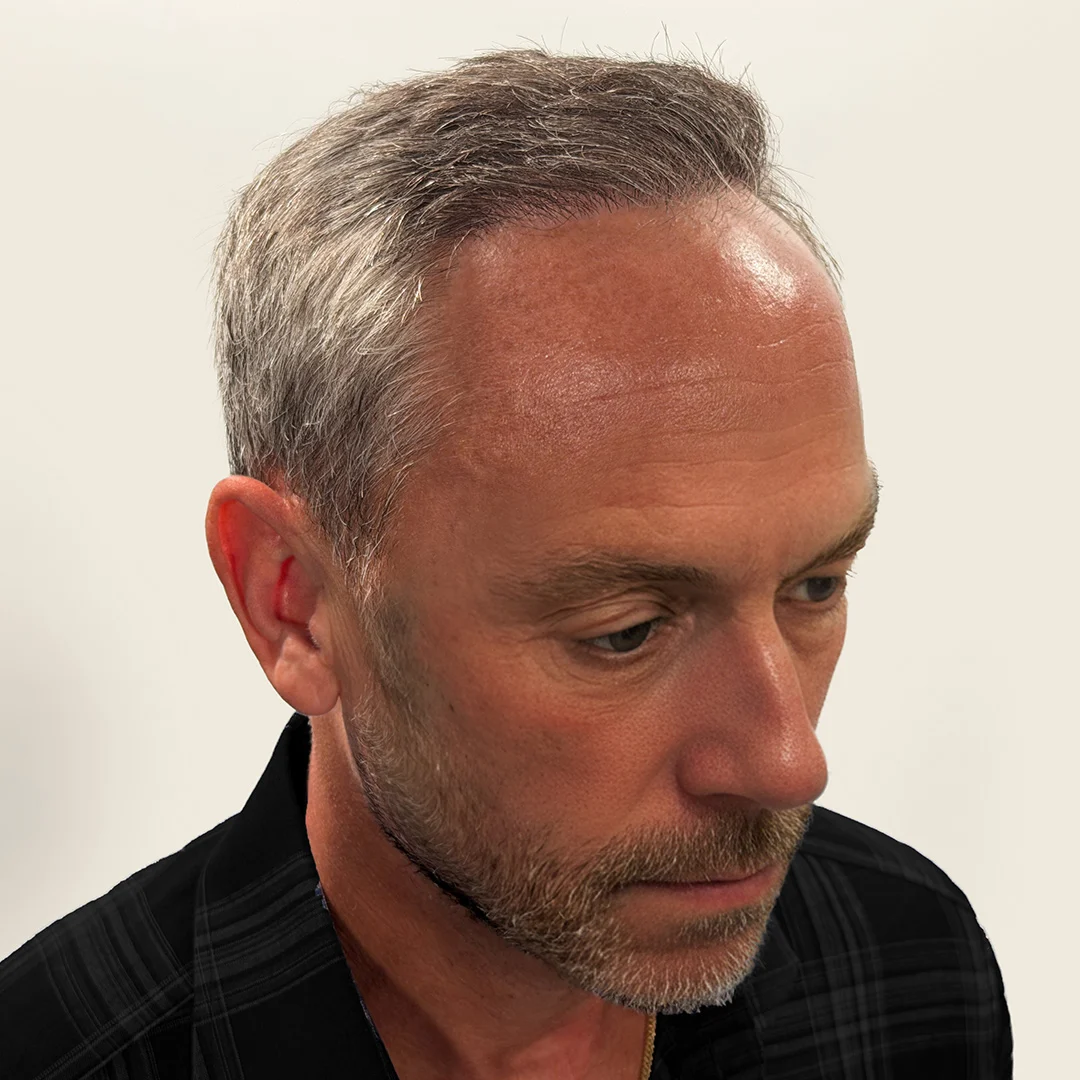
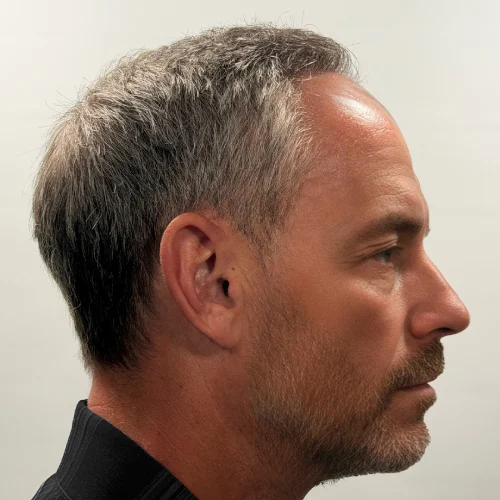
The Timeless Hairline Design technique transformed our results and practice — and we believe it should be part of hair restoration across the world.
As members of an academic community, we share how to perform Timeless Hairline Design — step by step — so any physician can apply it to their own patients. If you have questions beyond what the video covers, please reach out. We welcome physician colleagues to schedule an observational day at our clinic in Chicago.
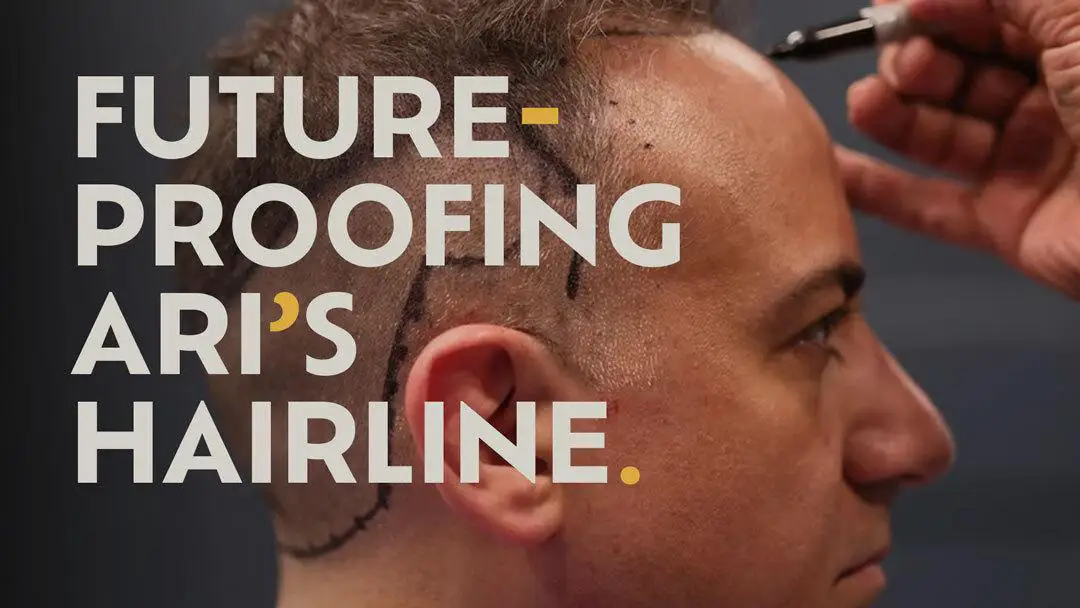
The Timeless Hairline Design is a hairline transplant technique developed at Northwestern Hair over the last four years. It is a way of drawing the hairline so that it looks natural today and evolves naturally along with the patient’s future hair recession. The methodology is a nine-step process that takes one to two hours to complete, performed the morning of every procedure. Each step is based on anatomical landmarks unique to the patient’s face, which is what allows the Timeless Hairline Design to be applied to any ethnicity. And because the design is anchored to the patient’s final recession point, age is no longer a factor — which is why Northwestern Hair can confidently perform a hairline transplant for young men experiencing early hair loss.
Most clinics use measurements to define a hairline — facial proportions, rulers, finger-widths, or pre-shaped templates — and they draw the hairline for a static point in time, which is the patient’s current age. Northwestern Hair takes a different approach. We know the hairline needs to continue evolving with the patient and with the natural recession of the remaining hair. The Timeless Hairline Design starts by drawing the recession line — the final endpoint of the patient’s hair loss. The hairline is then drawn upon that foundation, so that it will evolve naturally over time. The hairline crosses the current temporal hairline in an age-appropriate position, then evolves millimeter by millimeter into a more mature hairline that terminates in the final recession line. The recession line is the basis of the procedure, not a guess.
A hairline transplant will only look natural if it is designed using natural principles. Hairlines drawn with proportion rulers, finger measurements, or templates will look defined by those tools — because they were. The Timeless Hairline Design is based on true anatomical landmarks instead: the final recession line, and the line that connects the patient’s current temporal hairline with that future recession point. A hairline drawn against those anatomical landmarks is not only natural the day it is drawn — it remains natural as it evolves over the rest of the patient’s life. That is what timeless means as a drawn shape.
A nicely feathered hairline transplant with moderate-thickness hair takes approximately 150 grafts per millimeter to establish a natural appearance. Patients with thinner hairs may require closer to 200 grafts per millimeter, while patients with thicker hairs may need only 100. The natural appearance of the hairline is established within the first four to eight millimeters of placement. After that, grafts with thicker or multi-haired follicles can be used to add density behind the leading edge — achieving more visual weight with fewer grafts. A complete hairline transplant at Northwestern Hair typically falls between 2,000 and 8,000 grafts, depending on the patient’s hair characteristics and the area being restored.
A hairline transplant should last a lifetime. The donor hairs used for the transplant come from the bottom of the scalp, along the sides and back, where they are genetically resistant to the testosterone-related hair loss that causes male pattern baldness. These hairs do not recede. They will, however, exhibit normal age-related thinning over time — the same gradual thinning that happens to hairs across the rest of the scalp at the same time. Because the age-related thinning is matched, the hairline transplant continues to look natural at every age the patient lives through. The hair grows; it ages; it stays.
Yes. Northwestern Hair specializes in young men with hair loss, and may be one of the few clinics in the United States willing to perform a hairline transplant for patients under 25 — and as young as 16. This is possible because the Timeless Hairline Design is agnostic to the patient’s current age. We start by drawing the final recession line — the final state of the patient’s hair loss — and design the transplant on top of that endpoint. We also collaborate with hairstylists who can educate the patient about forward-facing hairstyles that make the restoration appear more prominent, which allows the hairline to be positioned more conservatively. The result is a hairline that suits the patient today and remains natural for decades.
Hairline advancement and forehead reduction were originally two terms for the same surgical procedure — advancing the hairline by removing a strip of skin in front of it. That definition still applies to forehead reduction. But the term hairline advancement has since taken on a dual meaning. In addition to the original skin-strip removal, hairline advancement now also refers to advancing the hairline through follicular unit extraction (FUE hairline transplant) or pilosebaceous unit extraction (PUE). At Northwestern Hair, hairline advancement is performed exclusively through transplantation — Micro PUE® and No-Touch FUE — never through forehead reduction surgery.
Yes — the Timeless Hairline Design is ideal for ethnic hairline transplant patients. This is because the landmarks of the methodology are anatomical, including the recession line of the hair along the sides and back of the scalp, the shape of the forehead, and the position of the temporalis muscle. These anatomical landmarks define the position and shape of the hairline automatically. The squared, flat appearance of the African American hairline, for example, is defined by the temporalis muscle and the shorter forehead shape. The flatter hairline of an Asian patient is determined by the taller but flatter forehead common to that ethnic group. The Timeless Hairline Design allows the hairline to take the shape and position that the patient’s ethnicity intended at the anatomical level — preserving heritage automatically.
A hairline transplant is a relatively easy procedure to go through. Pain is minimal, and most patients are off any pain medications by the following day. There is a ten-day protocol for taking care of the scalp and the new grafts during the early healing window, but most patients feel ready to return to normal daily activities by the day after the procedure. The transplanted hairs will shed within the first two to four weeks, then begin growing back at three to four months, with the full result visible at twelve months.
Sequential Extraction is our proprietary graft-sorting technique used in every hairline transplant we perform. A natural hairline transplant is not built from grafts of a single size. The leading edge requires fine single-hair grafts spaced closely together, while the transition zone behind it uses two-hair and three-hair grafts to add density and visual weight. These graft types are physically different sizes, and extracting them with a single punch bit produces one of two failure modes: either the small grafts are extracted well and the larger ones are damaged, or the larger grafts are preserved and the small ones become too bulky to place at hairline density. Sequential Extraction solves this by pre-calculating the exact count needed in each category and extracting each category in sequence with a punch bit sized specifically for that graft type. It is one of the reasons Northwestern Hair’s hairline transplants achieve their natural appearance.
The SP89 sapphire blade creates a linear slit in the scalp rather than a round opening. Two things follow from that. First, slits can be placed closer together than round incisions, because the tissue between them retains more structural integrity — which is essential when the hairline design calls for high graft density along the leading edge. Second, because a slit is linear, it constrains the graft to a single orientation — the graft cannot rotate inside it, which allows each hair to point in exactly the direction the design intended. Round incisions, used across most of the scalp, allow some rotational variation that reads as natural randomness elsewhere but is unacceptable at the hairline. High-density grafting with the SP89 sapphire blade is what allows a hairline transplant to be simultaneously dense, feathered, and angulated with millimeter-level intention.
ACS is used twice during a hairline transplant procedure. Before surgery, ACS is delivered to the hairline area to increase local blood flow — allowing the scalp to safely receive more incision sites per square centimeter than it otherwise could. This is what makes dense, feathered hairlines physiologically possible in patients whose designs demand high graft counts. After surgery, ACS is delivered a second time to solve the vascular catch-22 of hair regrowth: transplanted hairs will only grow back as thick as their new blood supply allows, but the blood supply itself only develops to meet the hairs’ metabolic demand. ACS accelerates both sides of the loop simultaneously by increasing blood flow and delivering growth factors directly to the transplanted grafts. The result is maximum yield — every fine hair at the leading edge returns at its full caliber, which is the difference between a hairline transplant that reads as restored and a hairline that reads as native.