Scalp Micropigmentation vs. Hair Transplant: Which Is Right for You?
Search for hair loss solutions long enough, and you’ll inevitably land on scalp micropigmentation — SMP. The before-and-afters are striking, the price is a fraction of surgery, and the marketing frames it as a modern alternative to a transplant.
Patients bring it up in our Chicago consultations regularly, usually framed as a head-to-head decision: SMP or a transplant? And here’s the honest answer up front: that framing is mostly wrong. These aren’t two competing versions of the same solution. One is an optical illusion — a good one, with legitimate uses. The other is biological restoration. They solve different problems for different people, and treating them as interchangeable is how patients end up disappointed with either. Contact us today for more information.
Here’s the clear-eyed comparison.
What Scalp Micropigmentation Actually Is
SMP is a cosmetic tattooing technique. A technician deposits thousands of tiny pigment dots into the upper dermis of the scalp, mimicking the appearance of hair follicles shaved to stubble. Done well, it creates the illusion of a full head of closely buzzed hair — or, on longer hair, reduces the contrast between scalp and hair so thinning areas look denser.
Note the operative words: appearance and illusion. SMP grows nothing. It changes no follicle, halts no hair loss, and adds no hair. It is, functionally, a highly specialized tattoo — and evaluating it accurately starts from that understanding, not from the “hairline restoration” language some SMP studios borrow.
That’s not a dismissal. Makeup, dentistry veneers, and SMP all belong to the same honorable category: cosmetic camouflage that genuinely improves how people look and feel. The question is whether camouflage is what you need.
What a Hair Transplant Actually Is
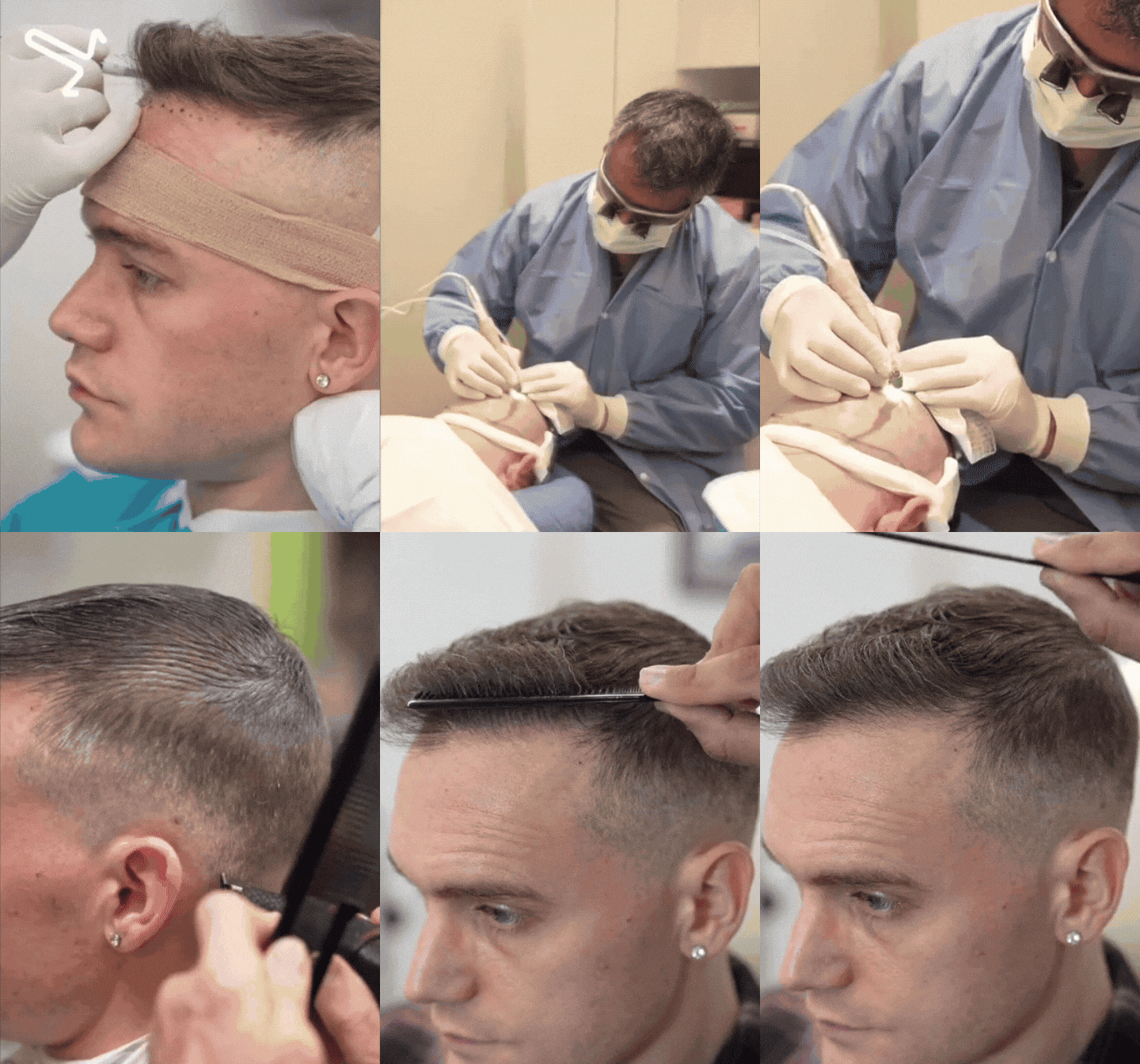
A transplant relocates living, DHT-resistant follicles from your donor area into thinning or bald zones, where they grow real hair permanently — hair you can cut, style, run your hands through, and get rained on without a second thought. We’ve covered the mechanics extensively in our Micro PUE discussions, so here we’ll just note the fundamental distinction: a transplant changes what’s growing on your head. SMP changes what your head looks like from a distance.
The Head-to-Head Comparison
 Result type. SMP: a two-dimensional visual effect — pigment on skin. A transplant: three-dimensional, growing hair with texture, movement, and shadow. This is the difference everything else flows from. SMP is convincing at conversational distance on the right candidate; it cannot be touched, tousled, or grown out. Ever.
The commitment it locks you into. This is the most under-discussed point in the SMP industry. Full-scalp SMP commits you to a shaved or near-shaved head indefinitely — grow your remaining hair out and the illusion collapses, because real stubble grows while tattooed stubble doesn’t. Meanwhile, your actual hair loss continues underneath: as native hair recedes, gaps open between pigment and reality, requiring the shave to continue and the pigment to be extended. A transplant carries the opposite logic — it’s designed to be grown out.
Longevity and maintenance. SMP pigments fade and can shift tone over three to six years, requiring periodic touch-up sessions for life. Sun exposure accelerates fading. Transplanted hair, as we covered in our post on how long a transplant lasts, is genetically resistant donor hair — it’s yours for decades, with the medication conversation applying to native hair, not the grafts.
Cost. Here’s where honesty cuts both ways. Full-scalp SMP typically runs a few thousand dollars — genuinely far less than surgery upfront. But it’s a recurring cost (touch-ups forever), and it’s money spent on camouflage rather than restoration. A transplant costs more upfront — we broke down Chicago pricing in our 2026 cost guide — but it’s a one-time investment in permanent, growing hair. Comparing the two on sticker price alone is comparing rent to a mortgage.
Risk profile. SMP is non-surgical, which is a real advantage — no recovery, no graft survival window, minimal downtime. Its risks are aesthetic: pigment migration (dots blurring into patches), discoloration toward blue or green as pigments break down, unnatural hairline design, and the significant problem of bad SMP being very hard to remove — laser removal is possible but slow, expensive, and imperfect. The SMP industry is essentially unregulated; the skill gap between the best and worst practitioners is enormous, and there’s no medical board overseeing any of it.
Who SMP Is Actually Right For
We’re a surgical practice, but we’ll be straight with you — there are patients for whom SMP is the honest recommendation:
Men who genuinely prefer the shaved look. If you’ve already embraced the buzzed head and simply want the silhouette of a full hairline in stubble form, SMP delivers exactly that. No surgery matches that specific outcome for that specific preference.
Insufficient donor supply. As we discussed in the repair post, donor hair is finite. Men with advanced Norwood 6–7 loss and limited donor reserves sometimes can’t achieve meaningful surgical coverage. SMP — or SMP layered with a smaller strategic transplant — can be the realistic path.
Diffuse thinning camouflage. For patients with longer hair and diffuse density loss, light SMP between existing hair reduces scalp show-through. It’s the same job scalp concealer fibers do, but semi-permanent.
Scar camouflage. SMP into an old strip scar or depleted donor zones can be a useful complement — sometimes alongside the graft-into-scar work we described in the repair discussion.
Medical hair loss without restoration options. Some scarring alopecias and conditions where transplantation isn’t viable leave camouflage as the best available tool.
Who Should Choose a Transplant Instead
The transplant is the right conversation if:
- You want hair, not the image of hair. You want length, styling options, a hairline that moves in the wind. SMP cannot give you any of that at any price.
- You’re early-to-mid pattern loss with good donor supply. This is the classic candidate — restore what’s thinning, protect the rest medically (the finasteride conversation), and never lock yourself into a shaved head.
- You’ve been quoted SMP for a problem surgery solves better. We’ve seen patients in their late 20s with Norwood 3 loss and excellent donor zones who were sold full-scalp SMP — committing a young man with abundant restoration options to a lifetime of shaving and touch-ups. That’s a fit failure, not a bad technology.
- You’re a woman with pattern thinning. Female hair loss is rarely a shaved-head conversation, which removes SMP’s flagship use case entirely. Density restoration — surgical or medical — is the real conversation, as we’ve covered throughout our women’s program content.
Can You Combine Them?
 Yes — and for a subset of patients, the combination beats either alone. The most common pairings we see: a transplant to build a real hairline and frontal density with SMP adding the appearance of fullness deeper in the crown where donor supply ran out; and SMP camouflaging a legacy strip scar while new grafts restore the top. The sequencing matters (surgery first, pigment after healing), and the SMP practitioner and surgeon should each know the other’s plan.
The Questions to Ask Before Choosing Either
- What will I want my hair to look like in ten years? If the answer involves any length at all, SMP-only is the wrong road.
- Is my hair loss stable or progressing? Progressing loss under SMP means chasing the recession with pigment forever. A physician evaluation — not an SMP studio consult — answers this.
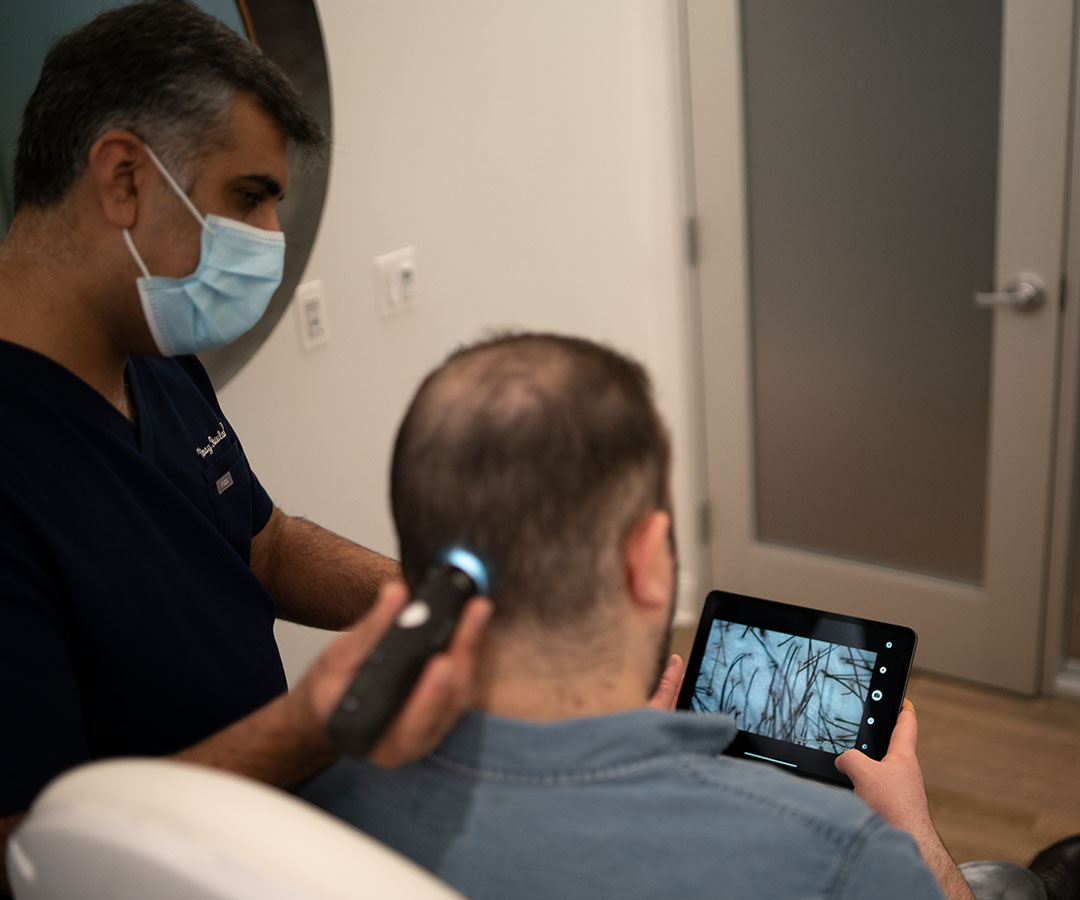
- What’s my donor supply? This determines whether surgery can meet your goals at all, and it’s assessable only under magnification.
- Am I comparing total cost honestly? Lifetime touch-ups vs. one procedure.
- Who is accountable if it goes wrong? A physician-led surgical practice operates under medical licensure and oversight. An SMP studio is accountable to, roughly, its Google reviews.
The Bottom Line
Scalp micropigmentation is a legitimate cosmetic camouflage with real, specific use cases — men committed to the shaved look, scar concealment, diffuse thinning support, and patients without surgical options. A hair transplant is biological restoration — permanent, growing, styleable hair. They are not competitors; they’re different answers to different questions, and the deciding question is simple: do you want to look like you have hair from ten feet away, or do you want to have hair?
Whichever direction you lean, start with an evaluation of what’s actually happening on your scalp — your loss pattern, its trajectory, and your donor reserves — because that’s the information that chooses you. An SMP studio can’t assess any of it. A physician can.
If you’re weighing SMP against a transplant — or wondering whether a combination approach fits your situation — schedule a consultation at Northwestern Hair in Chicago. Dr. Rawlani will give you an honest read on your candidacy, including the cases where we answer that surgery isn’t what you need.