

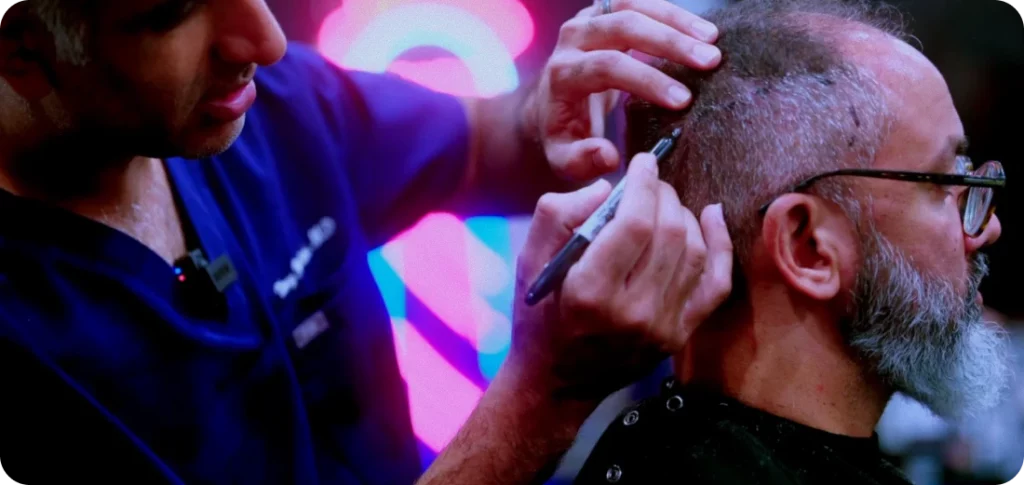
It’s the right question to lead with — and the honest answer is not everyone is.
Hair transplantation is a long-term surgical strategy. It requires the right biological conditions, a realistic understanding of what’s achievable, and a commitment to protecting the result over time. When those things are in place, the outcome can be genuinely life-changing. When they’re not, surgery can create problems that are harder to solve than the original hair loss.
Here’s how we think about candidacy — and what we’re actually evaluating when you come in.
1. Do You Have Strong Donor Hair?
This is the foundational question. Everything else depends on it.
Hair transplantation works by relocating DHT-resistant follicles from the back and sides of the scalp to areas that are thinning or bare. Those donor follicles carry their genetic resistance with them — it’s why transplanted hair is permanent. But the supply is finite. You only have so many follicles available over a lifetime, and how we use them in a first procedure shapes what’s possible in every procedure after it.
During your evaluation, we assess donor density, hair caliber, the surface area available for harvest, and how much of that supply you’re likely to need long-term given where your hair loss is headed. If donor strength is limited, we may recommend a more conservative approach — or suggest that surgery isn’t the right next step at all. A transplant that depletes your donor supply without a plan for future loss doesn’t serve you well. We’d rather be honest about that upfront.
2. Is Your Hair Loss Stable?
Hair loss is progressive. A transplant doesn’t stop future thinning in areas we don’t treat — and if we operate before a patient’s loss pattern is established, we can end up chasing a moving target.
This is why age and progression matter so much in candidacy. Younger patients — particularly those in their early twenties — often don’t yet have a clear picture of how aggressive their hair loss will be. Operating too early risks designing a hairline that looks right today but becomes disconnected from reality in ten years, or depleting donor supply before the full extent of loss is known.
For many patients, the most strategic window for surgery is in their thirties or forties, when patterns are more established and planning is more reliable. That said, significant early hair loss isn’t a disqualifier — it just calls for a more conservative, carefully sequenced approach. We factor in family history, rate of progression, and what the trajectory looks like before making any recommendation.
3. Is Your Scalp Healthy?
 Hair transplantation means moving healthy follicles into healthy tissue. Active scalp conditions — dermatitis, autoimmune disorders, significant scarring, uncontrolled inflammation — can compromise both the procedure and the result. Hair loss driven by nutritional deficiency or medication is a different problem than genetic loss, and surgery isn’t the right answer for it.
When scalp health is a concern, the first step is identifying and treating the underlying condition. We’d rather send a patient away with a proper diagnosis and a path to resolution than operate on a compromised environment and deliver a suboptimal result.
4. Are Your Expectations Realistic?
Modern Micro PUE techniques are genuinely advanced. But there are limits that no technique can overcome, and the best thing we can do for a patient is be direct about them.
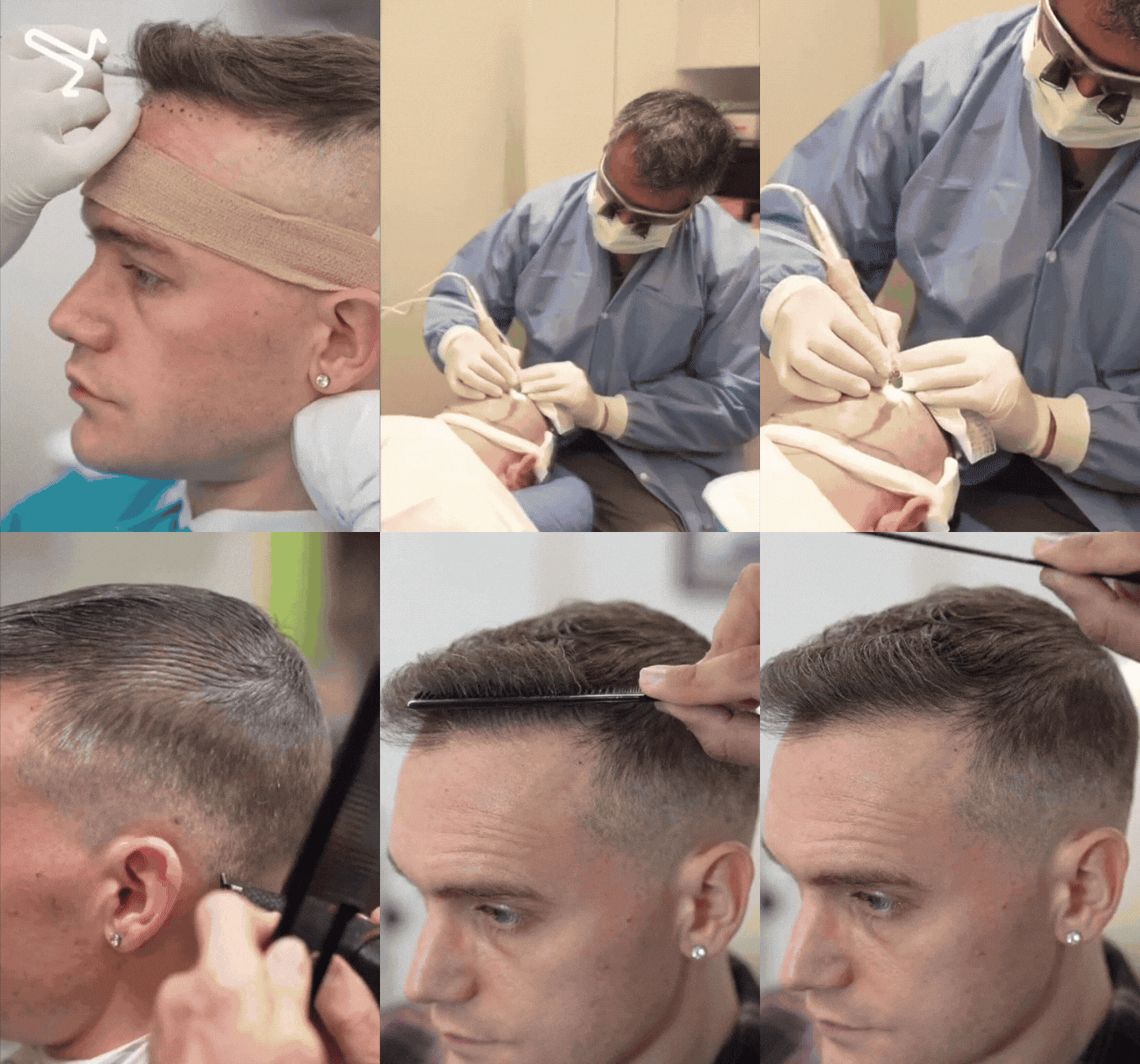
In cases of advanced hair loss, we can’t recreate the density of a twenty-year-old hairline across a large area of coverage. What we can do is focus on the frontal frame, achieve meaningful density where it has the most visual impact, and plan a sequence of conservative sessions that age well over time. The patients who are most satisfied with their results are the ones who understood what they were working toward before they began — not the ones who were told what they wanted to hear.
Improvement, done right, is remarkable. Perfection is the wrong goal.
5. Are You Willing to Commit to Maintenance?
A transplant makes transplanted hair permanent. It doesn’t protect the native hair around it. Without a maintenance strategy, the hair we didn’t treat continues to thin — and over time, that progression can undermine the density the transplant created.
Depending on your hair loss pattern and goals, a maintenance plan might include medication, ACS therapy, laser treatment, scalp optimization, or some combination. We build this into the long-term strategy from the start. Patients who stay engaged with their maintenance plan consistently hold onto fuller, more natural-looking results for decades. It’s not an afterthought — it’s part of what makes the result last.
Who Should Not Get a Hair Transplant?
Candidacy matters in both directions. There are patients for whom surgery, at least right now, isn’t the right answer.
If donor supply is diffuse or unreliable, if an active scalp condition hasn’t been resolved, if hair loss is progressing too rapidly to plan around, or if a patient’s expectations can’t be met by what’s realistically achievable — we say so. Non-surgical treatment, whether medication, ACS, or a combination approach, may be the smarter first move. In some cases it’s the only move. We’d rather have that conversation than perform a procedure that doesn’t serve the patient well.
What Makes a Strong Candidate?
The patients who tend to get the best long-term results share a few things in common: a strong, well-distributed donor supply; a hair loss pattern that’s stable enough to plan around; a healthy scalp; realistic expectations about what surgery can and can’t do; and a willingness to stay engaged with maintenance over time.
When those factors align, the result can be genuinely transformative — and built to last.
The Importance of Long-Term Planning
The best first procedure is one that leaves options open. That means preserving donor supply, anticipating where hair loss is headed, designing a hairline that ages naturally, and building a strategy that holds up not just at one year but at fifteen.
How we approach your first procedure shapes everything that comes after it. That’s not a reason to hesitate — it’s a reason to plan carefully. And careful planning is what the consultation is for.
So… Are You a Candidate?
 The only way to know is through a proper evaluation. Hair loss patterns, donor strength, scalp health, and long-term goals vary too much from patient to patient for any general answer to mean much.
What we can tell you is that we take candidacy seriously — in both directions. If surgery is the right move, we’ll tell you why and build a plan around it. If it isn’t, we’ll tell you that too, and we’ll tell you what is.
Schedule a Consultation at Northwestern Hair Restoration
If you’re wondering whether a hair transplant is right for you, a consultation with Dr. Vinay Rawlani is the place to find out. In-person evaluations are available at our Chicago clinic. Virtual consultations are available for patients anywhere.
The right answer starts with an honest assessment.