





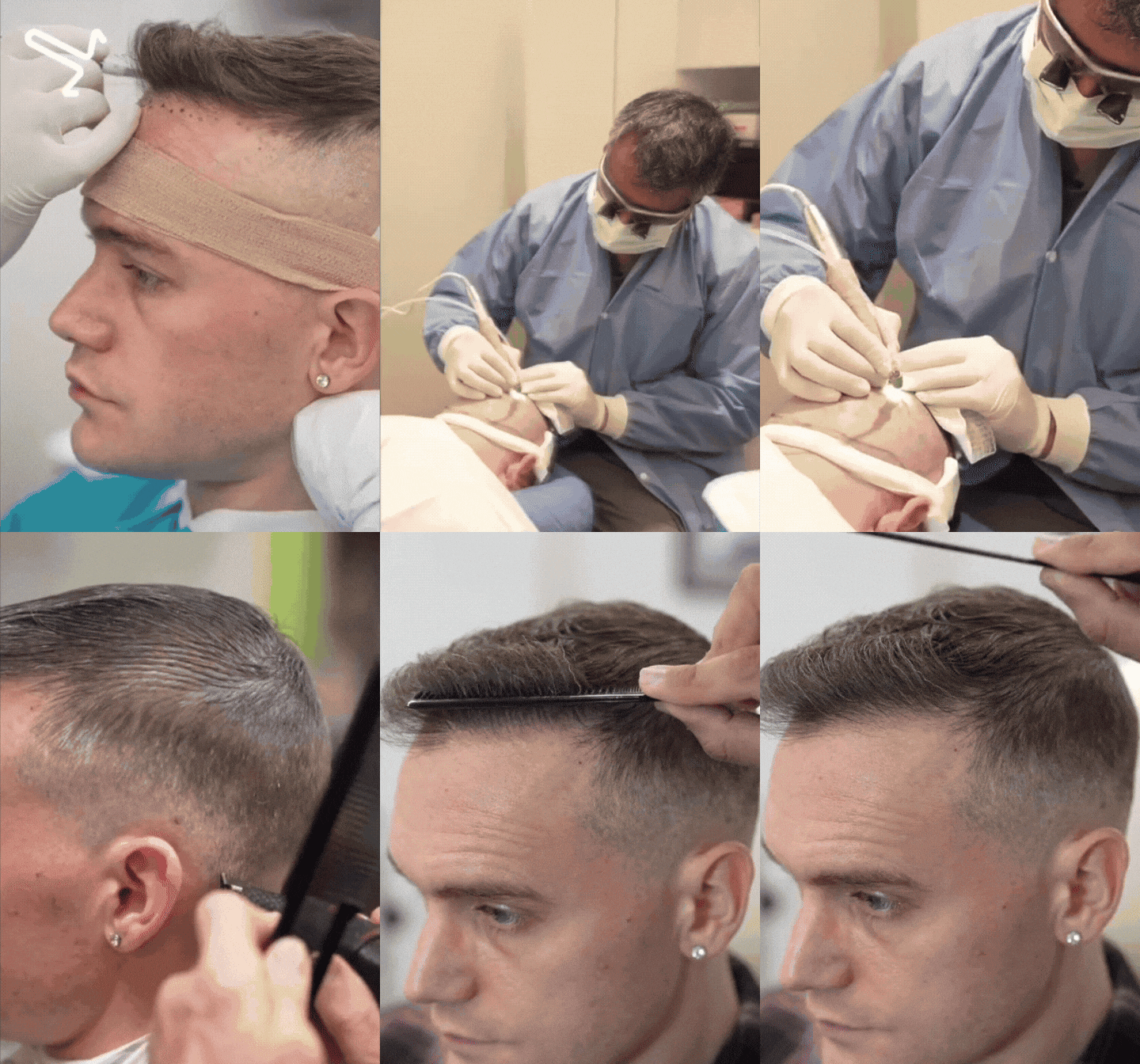
Hair loss rarely begins with sudden baldness. In most men, it starts subtly—often years before obvious thinning or recession becomes noticeable. By the time many men seek treatment, a significant portion of the follicular mass has already been compromised.
At Northwestern Hair, Dr. Vinay Rawlani frequently evaluates men who believed their hair was “fine” until density loss became difficult to hide. Trained in plastic surgery and having personally undergone hair restoration, Dr. Vinay understands that early hair loss is not just easier to treat—it is often far more preventable.
Recognizing the early biological and visual indicators of hair loss allows intervention to begin while follicles are still viable, improving long-term outcomes and reducing the need for extensive surgical restoration.
Why Early Hair Loss Is Commonly Overlooked
 Early hair loss does not usually present as baldness. It presents as a change.
Because these changes are gradual, many men dismiss them as stress, aging, seasonal shedding, or normal grooming differences. However, most male hair loss is progressive. When the first signs are ignored, the underlying biological processes continue uninterrupted.
Early detection allows treatment to focus on follicle preservation and metabolic support, rather than attempting to replace hair that has already been lost.
Subtle Signs Men Commonly Miss
1. Increased daily shedding
 Seeing hair in the shower or on a pillow is not abnormal. What becomes concerning is a sustained increase in daily shedding.
Men often notice:
- More hair in drains or brushes
- Hair collecting on clothing
- Increased scalp visibility after washing
While shedding can reflect stress or temporary cycling changes, persistent increases may signal telogen effluvium, early androgenetic alopecia, or both.
Dr. Vinay evaluates not only the volume of shedding but also the diameter and quality of shed hairs, which can provide insight into follicle miniaturization.
2. Thinner hair texture and reduced volume
One of the earliest indicators of follicular miniaturization is a change in hair quality.
Men may notice:
- Hair feels softer or finer
- Hairstyles no longer hold structure
- Loss of density when hair is dry
- Less resistance when styling
These changes often occur before visible scalp exposure. They reflect shrinking follicles producing weaker hair fibers.
3. A “maturing” hairline that keeps moving
A slight shift in the frontal hairline can be normal. The problem arises when the recession is ongoing.
Early signs include:
- Subtle temple thinning
- Uneven frontal contours
- Loss of density behind the hairline
- Reduced framing of the face
Because these changes develop slowly, many men adapt their hairstyles without recognizing that follicle miniaturization is actively progressing.
Dr. Vinay’s hairline evaluations are not based on snapshots. They are based on trajectory—how a hairline is changing over time and how it is likely to evolve without intervention.
4. Increased scalp visibility under lighting
Another early warning sign is increased scalp reflection under overhead or natural light.
Men often notice:
- The crown shows more easily
- The part line appears wider
- Hair looks thinner when wet
- Styling no longer conceals the scalp
These visual changes indicate reduced hair shaft diameter, reduced density, or both.
5. Slower growth and weaker regrowth
Hair loss is not only about what falls out—it is about what fails to grow back.
Early biological warning signs include:
- Hair is taking longer to grow after haircuts
- Less frequent need for trimming
- Reduced the thickness of regrowing hair
- Uneven density patterns
These changes suggest that follicles are spending less time in the growth phase and producing progressively finer hair.
6. Increased oiliness, itching, or scalp inflammation
Scalp health and follicle health are inseparable.
Men may experience:
- Increased oil production
- Itching or sensitivity
- Redness or flaking
- Scalp tenderness
Inflammatory changes often coexist with early miniaturization and can accelerate follicle compromise if left unaddressed.
Dr. Vinay evaluates the metabolic and inflammatory environment of the scalp, not just hair density.
Why These Signs Matter Biologically
Most male hair loss is driven by androgen sensitivity, inflammatory signaling, vascular factors, and metabolic changes within the scalp.
Early signs indicate that follicles are:
- Shortening their growth cycles
- Shrinking in diameter
- Losing regenerative efficiency
- Becoming less responsive to growth signals
At this stage, follicles are still alive. This is when non-surgical and regenerative strategies are most effective.
Once follicles are lost entirely, surgical restoration becomes the only option.
Dr. Vinay Rawlani’s Preventive Approach to Male Hair Loss
Dr. Vinay approaches early hair loss through a preservation-first philosophy. His evaluations focus on identifying vulnerable follicles before they become non-viable.
Each assessment examines:
- Hair shaft caliber and density patterns
- Follicle miniaturization
- Scalp circulation and metabolic activity
- Inflammatory burden
- Hairline architecture and future trajectory
This allows treatment to begin while there is still a biological opportunity to protect and strengthen existing hair.
What Can Be Done in the Early Stages
1. Stabilizing follicle miniaturization
Early treatment programs are designed to:
- Slow follicle shrinkage
- Support longer growth phases
- Improve hair shaft thickness
- Preserve existing density
This stage is where proactive care delivers the greatest long-term benefit.
2. Improving scalp biology
Hair growth depends on circulation, oxygenation, and cellular signaling.
Northwestern Hair utilizes advanced non-surgical therapies to:
- Enhance microvascular flow
- Reduce inflammatory signaling
- Improve follicle metabolism
- Optimize the scalp growth environment
3. Regenerative stimulation with Autologous Cellular Serum (ACS)
Dr. Vinay integrates regenerative medicine into early-stage programs when follicle support and reactivation are needed.
Autologous Cellular Serum (ACS) leverages the patient’s own biology to support:
- Cellular repair pathways
- Follicle signaling
- Scalp circulation
- Stronger, healthier hair growth
ACS is particularly valuable in early hair loss, when follicles are weakened but still capable of producing terminal hair.
4. Designing for the future
Even in early stages, Dr. Vinay evaluates hairline architecture and long-term progression patterns.
This design-forward philosophy ensures that every preventive or regenerative intervention supports not only present density, but also future aesthetic stability.
The Cost of Waiting
Men often delay care because early hair loss is easy to disguise. Unfortunately, biology does not pause.
Waiting allows:
- Continued follicle miniaturization
- Reduced treatment responsiveness
- Increased surgical dependence
- More extensive restoration requirements
Early evaluation preserves options. Late evaluation limits them.
Northwestern Hair’s Physician-Led Model
Northwestern Hair operates under a physician-led restoration framework. Dr. Vinay Rawlani personally designs and oversees every treatment plan, integrating:
- Diagnostic scalp and follicle analysis
- Non-surgical and regenerative therapies
- Long-term hair preservation strategies
- Surgical restoration when biologically indicated
His methodology—shaped by plastic surgery training, regenerative science, and artistic design—ensures that early intervention supports both follicle biology and future hairline aesthetics.
Final Thoughts
The earliest signs of hair loss are often quiet. They appear as texture changes, subtle shedding, or minor shifts in the hairline. But biologically, these changes reflect active follicle transformation.
Recognizing these indicators allows intervention to begin when follicles are still viable, treatment is most effective, and long-term outcomes are strongest.
Under the direction of Dr. Vinay Rawlani, Northwestern Hair approaches early male hair loss with clinical precision, regenerative support, and intentional design—helping men protect what they still have and plan for what lies ahead.